
The Trump-Intel Meeting and Its Implications for Tech Sector Policy Shifts
 Aime Summary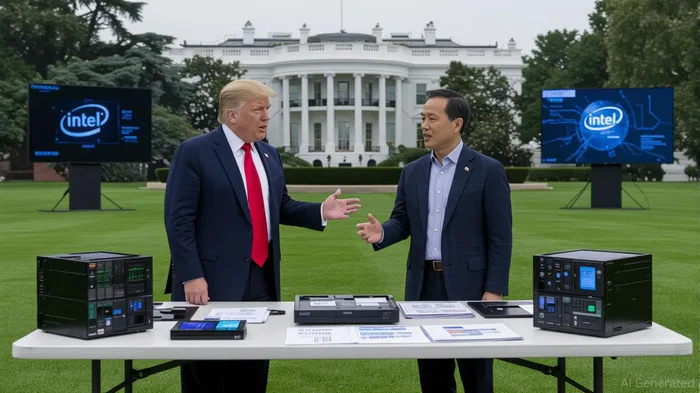
The recent meeting between former President Donald Trump and IntelINTC-- CEO Lip-Bu Tan on August 11, 2025, has sent ripples through the tech sector, signaling a pivotal shift in how political leadership, corporate governance, and geopolitical strategy intersect in the post-election landscape. This event, framed by Trump's abrupt reversal from demanding Tan's resignation to praising his “amazing story,” underscores the volatile interplay between executive leadership and national security priorities. For investors, the episode highlights the growing importance of aligning with government-backed agendas in an era where AI-driven tech stocks are increasingly entangled in global power dynamics.
Geopolitical Signals and Corporate Stock Performance
The Trump-Tan meeting emerged amid escalating U.S.-China competition over semiconductors and AI infrastructure. Intel, as a recipient of $8 billion in CHIPS Act funding, sits at the center of this rivalry. Trump's initial call for Tan's resignation—citing alleged conflicts of interest tied to Chinese investments—sparked a 4% drop in Intel's stock. However, the subsequent meeting, described as “candid and constructive,” reversed this trend, with shares rebounding 3.5% in a single day. This volatility reflects the sector's sensitivity to political narratives, particularly in an election year where corporate leaders are scrutinized for their global ties.
The broader market response reveals a pattern: investors are increasingly factoring in geopolitical alignment when valuing tech stocks. For instance, NVIDIANVDA-- and AMDAMD--, which have seen year-to-date gains of 36% and 47% respectively in 2025, have benefited from their perceived alignment with U.S. national security goals. In contrast, Intel's stock remains undervalued, with a price-to-book ratio of 0.9, suggesting lingering skepticism about its ability to navigate both operational and political challenges.
Policy Shifts and Regulatory Outcomes
The meeting also signals a recalibration of Trump's approach to tech policy. While his earlier rhetoric emphasized punitive measures—such as a proposed 100% tariff on imported chips—the engagement with Tan suggests a pivot toward strategic incentives. This aligns with the administration's broader “America First” agenda, which prioritizes domestic semiconductor manufacturing and AI leadership. The CHIPS Act, with its $52 billion in federal incentives, has become a critical tool for reshaping the industry, and Intel's $100 billion U.S. investment plan positions it as a key beneficiary.
However, regulatory risks persist. The administration's export restrictions on advanced semiconductors to China, while aimed at curbing Beijing's access to critical technologies, have created supply chain bottlenecks. For AI-driven firms, this duality—of being both a strategic asset and a regulatory liability—requires careful navigation. Companies that can demonstrate ESG-aligned practices, such as Intel's commitment to 100% renewable energy in U.S. facilities, may gain a competitive edge in securing government contracts and subsidies.
Sector-Wide Implications for AI-Driven Tech Stocks
The Trump-Tan meeting has broader implications for the AI sector. High-profile political endorsements, such as Trump's praise for Tan, can act as a “halo effect,” boosting investor confidence in aligned companies. For example, the administration's support for NVIDIA's AI infrastructure deals—such as its recent agreement to share 15% of China sales revenue with the U.S. government—has reinforced the stock's premium valuation. Conversely, firms perceived as misaligned with national priorities, such as those with opaque supply chains or ambiguous ESG practices, face heightened scrutiny.
Investors must also consider the long-term risks of political volatility. Trump's unpredictable policy shifts—such as his oscillating stance on tariffs and trade agreements—create a landscape where short-term gains may be offset by sudden regulatory changes. This is evident in the Nasdaq's 2025 correction, driven in part by fears of a Trump-led recession. Diversification across sectors and geographies, coupled with a focus on companies with robust domestic manufacturing capabilities, is increasingly critical.
Investment Advice for a Post-Election Landscape
For investors, the Trump-Intel meeting underscores three key strategies:
1. Prioritize Alignment with National Security Goals: Companies that integrate AI and semiconductor innovation with U.S. strategic interests—such as those leveraging CHIPS Act funding or ESG-aligned manufacturing—are likely to outperform.
2. Monitor Political Volatility: Given the administration's tendency to shift policy abruptly, investors should hedge against regulatory uncertainty by diversifying portfolios and favoring firms with strong cash reserves.
3. Focus on Long-Term Resilience: While short-term stock movements may be driven by political narratives, long-term success in the AI sector depends on R&D investment, supply chain resilience, and adaptability to global competition.
In conclusion, the Trump-Intel meeting is a microcosm of the broader forces reshaping the tech sector. As geopolitical tensions and policy shifts continue to influence corporate stock performance, investors must balance the allure of government-backed opportunities with the risks of political volatility. For AI-driven tech stocks, the path forward lies in strategic alignment with national priorities, operational resilience, and a keen awareness of the ever-evolving geopolitical landscape.

Delivering real-time insights and analysis on emerging financial trends and market movements.
Latest Articles
Stay ahead of the market.
Get curated U.S. market news, insights and key dates delivered to your inbox.




Comments
No comments yet