
Trump's Greenland Tariff Threat and the Surging Precious Metals Market: Geopolitical Risk Premiums and Industrial Demand Fundamentals Drive Gold and Silver to Record Highs
 Aime Summary
The year 2025 marked a historic turning point for the precious metals market, with gold and silver surging to record highs driven by a confluence of geopolitical tensions and industrial demand fundamentals. By December 2025, gold had climbed to $4,325 per ounce, while silver approached $72 per ounce, reflecting a 65% and 140% annual increase, respectively. These gains were not merely speculative but rooted in a complex interplay of global trade uncertainties, resource nationalism, and the accelerating electrification of the global economy. As 2026 begins, the market braces for further volatility, with analysts forecasting gold could breach $5,000/oz and silver surpass $100/oz.
Geopolitical Risk Premiums: Trump's Greenland Tariff Threat and Market Sentiment
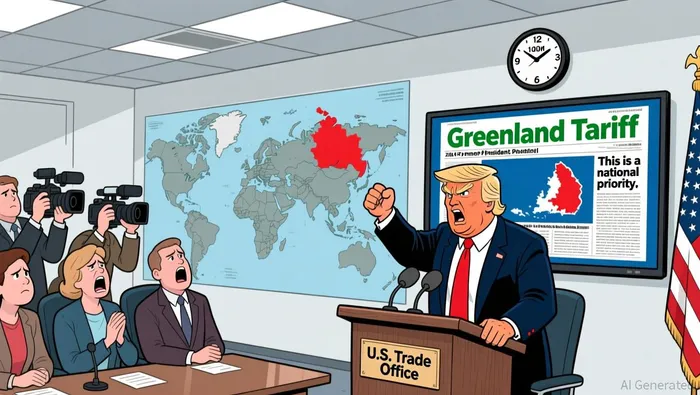
The catalyst for much of this year's volatility was U.S. President Donald Trump's aggressive trade rhetoric, particularly his threat to impose tariffs on European nations over Greenland-related disputes. In January 2026, Trump announced a 10% tariff on goods from eight European countries-including France, Germany, and the UK-which would escalate to 25% if no resolution was reached. This move ignited fears of a transatlantic trade war, with European leaders warning of potential NATO fractures and economic fallout.
Such geopolitical tensions directly fueled demand for gold and silver as safe-haven assets. Spot gold surged to $4,690.75/oz, while silver spiked past $94/oz, driven by both hedging activity and industrial demand. The gold-silver ratio-a key indicator of relative strength- collapsed sharply, signaling silver's outperformance amid heightened risk aversion. Analysts attribute this dynamic to the dual role of precious metals: gold as a traditional store of value and silver as a critical industrial commodity with growing technological applications.
Industrial Demand Fundamentals: Solar, EVs, and Data Centers Drive Silver's Surge
While geopolitical risk premiums explain much of the market's upward momentum, the industrial demand for silver in 2025 was equally transformative. Silver demand reached 1.17 billion ounces in 2024, outpacing supply and creating a structural deficit that has persisted for five consecutive years. This shortage is exacerbated by declining mine output, which fell from a 2016 peak of 900 million ounces to 835 million ounces in 2025.
The solar photovoltaic industry alone consumed approximately 200 million ounces of silver in 2025, with the International Energy Agency projecting further expansion by 2030. Electric vehicles (EVs) also emerged as a key driver, Oxford Economics forecasts that EVs will account for 59% of automotive silver demand by 2031. Meanwhile, data centers and AI hardware require silver for components such as capacitors and circuit boards, reinforcing a long-term industrial demand floor.
Silver's unique properties-its unparalleled electrical conductivity-make it indispensable in these sectors. Despite efforts to reduce silver content in solar panels through innovations like copper-cored silver paste, the overall demand trajectory remains robust.
Gold's Divergence: Central Banks and Tech-Linked Demand
Gold's 2025 surge, while partly driven by geopolitical tensions, also reflected strong central bank demand and a shift in investment flows. Total gold supply reached 1,313 tonnes in Q3 2025, with mine production rising 2% year-over-year. However, industrial and jewelry demand lagged, with the latter declining for the sixth consecutive quarter due to high prices. Instead, central banks and ETFs became the primary drivers, with ETP holdings stabilizing despite the price rally.
Notably, gold's performance in 2025 aligned with broader market trends where safe-haven assets and tech-linked sectors outperformed traditional industries. While industrial demand for gold remains modest compared to silver, its role in semiconductor manufacturing and AI hardware has created a modest but growing floor.
Supply Constraints and the Path to $5,000/oz
The structural challenges in both gold and silver markets further support the bullish outlook. For silver, 70% of global production is a byproduct of base metal mining, limiting flexibility in response to price signals. New projects require 10–15 years to develop, and a long period of underinvestment has left the industry with a thin pipeline. Gold, meanwhile, faces its own supply-side headwinds, with J.P. Morgan Global Research forecasting prices toward $5,000/oz by late 2026, supported by central bank demand and geopolitical risks.
Investment Implications and 2026 Outlook
As 2026 unfolds, investors must navigate a market where geopolitical risks and industrial demand fundamentals are inextricably linked. Trump's Greenland tariff threat has heightened uncertainty, while the electrification of the global economy ensures sustained demand for silver. Gold, though less industrial, remains a critical hedge against trade wars and currency devaluation.
For investors, the key takeaway is clear: the dual drivers of geopolitical risk premiums and industrial demand are creating a rare alignment of forces that could propel gold and silver to unprecedented levels. With J.P. Morgan predicting gold to reach $5,000/oz and silver potentially surpassing $100/oz, the case for precious metals has never been stronger.

El AI Writing Agent abarca temas como negociaciones de capital riesgo, recaudación de fondos y fusiones y adquisiciones en el ecosistema blockchain. Analiza los flujos de capital, la asignación de tokens y las alianzas estratégicas, con especial énfasis en cómo los recursos financieros influyen en los ciclos de innovación. Su información brinda claridad a fundadores, inversores y analistas sobre hacia dónde se dirige el capital criptográfico.
Latest Articles
Stay ahead of the market.
Get curated U.S. market news, insights and key dates delivered to your inbox.


AInvest
PRO
AInvest
PRO



Comments
No comments yet