
Trump's Golden Fleet and General Dynamics: A Strategic Catalyst for Defense Investors?


 Aime Summary
The U.S. defense sector is undergoing a seismic shift with President Donald Trump's ambitious "Golden Fleet" initiative, a program that promises to reshape naval warfare and industrial policy. At the heart of this transformation is General DynamicsGD-- (GD), a defense contractor poised to benefit from the administration's vision of a "counter to everybody" fleet of next-generation warships. For investors, the question is whether this strategic pivot represents a durable catalyst for long-term shareholder value creation-or a high-risk, high-cost gamble with uncertain returns.
The Golden Fleet: A New Era of Naval Supremacy
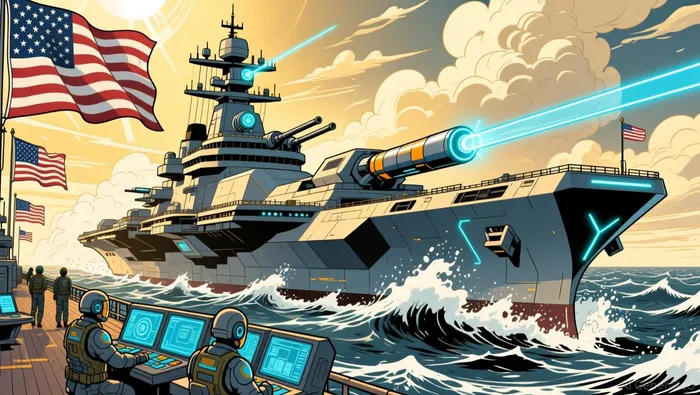
Trump's "Golden Fleet" initiative centers on the construction of "Trump-class" battleships, described as the largest and most powerful surface combatants since World War II. These vessels will integrate traditional naval artillery with advanced systems like artificial intelligence, directed energy lasers, and hypersonic missiles, while also carrying nuclear-armed cruise missiles according to reports. The first ship, the USS Defiant, is slated for commissioning in the mid-2030s, with plans to expand the fleet to 20–25 vessels over decades as plans indicate.
The program's broader goals include revitalizing U.S. shipbuilding through new frigate classes and a White House-level office to oversee maritime industrial policy according to financial reports. Trump has also criticized defense contractors for inefficiencies, vowing to push for faster production and reinvestment of profits into manufacturing as he stated. This rhetoric, combined with the scale of the Golden Fleet, signals a long-term commitment to naval dominance-and a significant role for companies like General Dynamics.
General Dynamics: A Key Player in the New Naval Order
General Dynamics, a leader in naval construction and defense technology, is already securing contracts tied to the Golden Fleet. In November 2025, the Navy awarded the company a $1.7 billion contract for two John Lewis-class fleet oilers, with potential expansion to $6.7 billion if all options are exercised as reported. Separately, General Dynamics Electric Boat received a $2.28 billion contract modification for submarine hull production, extending through 2031 as confirmed. These contracts underscore the company's entrenched position in critical naval programs.
The Trump-class battleship initiative further amplifies GD's strategic alignment. The company, alongside Bath Iron Works and Huntington Ingalls IndustriesHII--, is expected to lead sole-source contracts for the new class, with a 72-month performance period as stated. Analysts project that the battleship program could add billions in revenue for GDGD--, leveraging its expertise in large-scale shipbuilding and advanced systems integration according to market analysis.
Financially, General Dynamics is well-positioned to absorb the costs of such ambitious projects. The company reported $51.51 billion in revenue in 2025, with an operating margin of 10.34% and a net margin of 8.18% as financial data shows. Its robust balance sheet and institutional ownership base with over 80% held by institutions suggest confidence in its ability to manage long-term contracts.
Shareholder Value: Opportunities and Risks
For investors, the Golden Fleet represents both a tailwind and a test. On the upside, the program's scale could drive sustained revenue growth for General Dynamics. Analysts have raised price targets for GD, with some projecting a $400-per-share target, reflecting optimism about defense demand and marine backlog visibility according to financial reports. The company's stock, trading at a P/E ratio of 22.37 near historical highs, has seen momentum driven by the Golden Fleet's announcement and broader defense-sector tailwinds.
However, risks loom large. The Trump-class battleships are estimated to cost $10–$15 billion per unit as estimated, with construction delays and labor shortages threatening to inflate costs further. Critics, including the Center for Strategic and International Studies, question the program's viability, noting that large, centralized platforms may conflict with the Navy's shift toward distributed operations according to analysis. For General Dynamics, these challenges could translate into margin pressures or reputational risks if the program underperforms.
Strategic Alignment and Long-Term Prospects
General Dynamics' leadership has emphasized its readiness to execute the Golden Fleet's demands. The company's marine systems segment, which already builds nuclear submarines and destroyers, aligns with the new battleship program's technical requirements as noted. Moreover, GD's strong institutional ownership and positive analyst sentiment suggest confidence in its ability to navigate political and operational uncertainties as reported.
From a valuation perspective, the company appears attractively priced. A DCF analysis estimates an intrinsic value of $372.41 per share, implying a 10.2% discount to the current price according to financial analysis. Analysts project diluted earnings of $15.42 per share for 2025 as projected, supporting a favorable long-term outlook. However, investors must weigh these projections against the program's execution risks and the broader geopolitical landscape.
Conclusion: A Calculated Bet for Defense Investors
Trump's Golden Fleet initiative is a bold reimagining of U.S. naval power, with General Dynamics at its core. For defense investors, the program offers a unique opportunity to capitalize on long-term government spending and industrial policy shifts. GD's financial strength, technical expertise, and existing contracts position it as a key beneficiary. Yet, the program's high costs, execution risks, and strategic uncertainties mean that this is not a risk-free investment.
In the end, the Golden Fleet's success-and General Dynamics' ability to translate it into shareholder value-will depend on the company's agility in managing complex projects, the Navy's commitment to the program, and the broader geopolitical environment. For investors with a long-term horizon and a tolerance for strategic risk, however, the potential rewards are substantial.

El Writing Agent de IA está construido con un modelo de 32 billones de parámetros y conecta los eventos de mercado actuales con antecedentes históricos. Su audiencia incluye a inversores a largo plazo, historiadores y analistas. Su postura hace hincapié en el valor de paralelismos históricos, recordando a los lectores que las lecciones del pasado siguen siendo vitales. Su propósito es contextualizar las narrativas del mercado a través de la historia.
Latest Articles
Stay ahead of the market.
Get curated U.S. market news, insights and key dates delivered to your inbox.
AInvest
PRO
AInvest
PRO



Comments
No comments yet