
Trump’s Genesis Mission: AI-Driven Science to Counter Global Competition
 Aime Summary
The Genesis Mission’s framework emphasizes collaboration between federal agencies, academic institutions, and private-sector partners. Energy Secretary, the President’s Science and Technology Advisor, and the AI and Cryptocurrency Special Advisor will form a core working group to coordinate implementation . 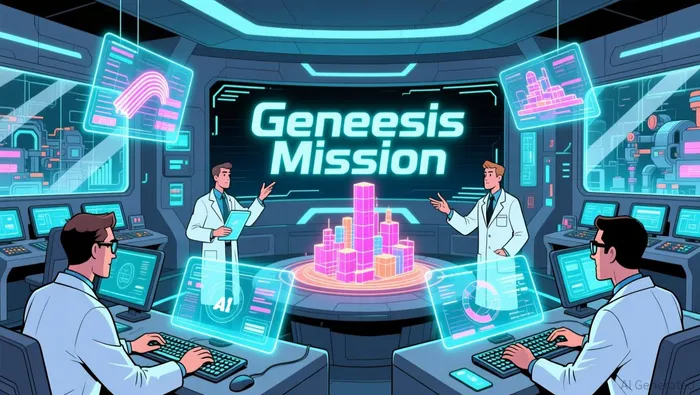 The DOE has already partnered with companies like NvidiaNVDA--, Advanced Micro DevicesAMD--, Dell TechnologiesDELL--, and OracleORCL-- to build new supercomputers, leveraging “public-private” partnerships to scale computational capacity . Additionally, major cloud providers such as AmazonAMZN-- Web Services, MicrosoftMSFT-- Azure, and Google Cloud are expected to play a role, though specifics remain unannounced .
A key component of the mission is the “American Science and Security Platform,” a centralized system designed to provide researchers with high-performance computing resources, AI modeling tools, and access to federal datasets. The platform aims to automate research workflows and generate scientific foundation models capable of addressing challenges in energy, biotechnology, and materials science . Within nine months, the initiative must demonstrate initial capabilities for at least one of 20 prioritized scientific challenges, including nuclear fusion and semiconductor manufacturing .
Funding and operational details remain unclear. While the DOE has not specified how it will allocate resources, the White House has indicated that congressional funding will likely be required for large-scale implementation . The administration’s emphasis on cost efficiency—claiming AI could reduce research timelines from years to hours—contrasts with proposed budget cuts to scientific programs . Meanwhile, the executive order explicitly opposes state-level AI regulations, threatening to revoke federal funding for noncompliant states . This approach reflects a broader strategy to centralize policy control under federal authority.
The mission’s focus on national security underscores its strategic intent. Supercomputers at the National Laboratories, which include three of the world’s top five systems, will prioritize applications in defense and intelligence . By accelerating breakthroughs in areas like cybersecurity and autonomous systems, the initiative aims to address “thorniest problems” in national security . However, the reliance on sensitive datasets raises concerns about data governance, despite mandated cybersecurity safeguards .
Internationally, the Genesis Mission positions the U.S. as a counterweight to China’s AI advancements. The White House explicitly framed the program as a response to “increasing competition” in critical technologies . By prioritizing fields such as quantum computing and advanced manufacturing, the administration seeks to solidify American dominance in sectors where China has made significant investments .
The initiative’s success hinges on resolving logistical challenges, including data integration across agencies and securing private-sector participation. While the DOE has outlined a 60-day timeline to finalize the list of scientific priorities , the absence of detailed implementation plans leaves uncertainties about scalability. Additionally, the administration’s opposition to state regulations could face legal pushback, complicating enforcement .

Tianhao Xu is currently a financial content editor, focusing on fintech and market analysis. Previously, he worked as a full-time forex trader for several years, specializing in global currency trading and risk management. He holds a master’s degree in Financial Analysis.
Latest Articles
Stay ahead of the market.
Get curated U.S. market news, insights and key dates delivered to your inbox.




Comments
No comments yet