
Trump's Free-Market Capitalism: A Davos Test of Global Adoption
 Aime Summary
The stage was set for a grand performance. As President Trump addressed the global elite at the World Economic Forum, his team framed the event as a moment of revelation. White House aide Larry Kudlow claimed CEOs attending the gathering were not aware of the facts, figures and feats behind the Trump economy before arriving in Davos. Their subsequent exposure to the administration's narrative, Kudlow argued, corrected a pervasive cognitive dissonance fueled by bad information. This wasn't just a PR push; it was a strategic move to convert skeptics by showcasing undeniable economic momentum.
That momentum was defined by a powerful narrative: a blue-collar boom. Trump's speech highlighted the strength of American manufacturing, citing specific annual growth rates. Over the past two months, the production of consumer goods is rising roughly 8 percent at an annual rate, while business equipment is running at roughly 7 percent. These figures, paired with claims of record wage gains for blue-collar workers, painted a picture of broad-based prosperity driven by pro-growth policies like tax cuts and deregulation. The message was clear: the U.S. model was working, and its success was visible in the data.
Yet the central contradiction of this global pitch was already evident. The World Economic Forum's own Global Risks Report, released just days before the meeting, identified the very tools the U.S. was promoting as the top threat to global stability. Geoeconomic confrontation - ranging from sanctions to tariffs - is the top threat for 2026. This creates a stark tension. The administration is urging the world to adopt its free-market, pro-growth playbook, even as its own use of trade policy is cited as the primary source of global economic risk. The Davos stage, therefore, became a platform not just for celebrating domestic success, but for posing a direct challenge: can the world embrace the model while simultaneously fearing its most potent weapon?
The Policy Engine: Tariffs, Deregulation, and the "Drill, Baby, Drill" Framework
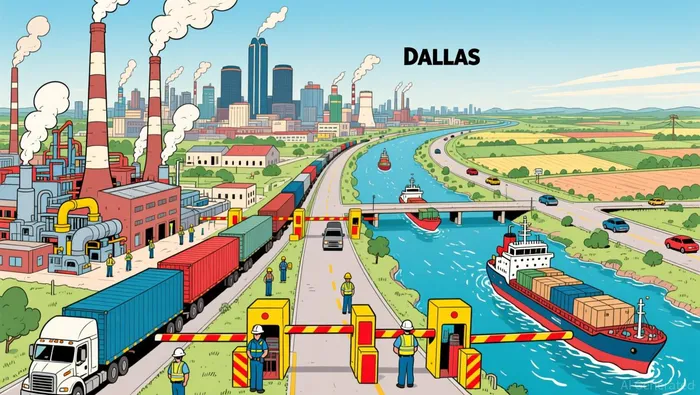
The administration's economic boom is being driven by a deliberate and wide-ranging policy engine. At its core is a framework of tax cuts, deregulation, and aggressive industrial protectionism, articulated by White House aide Larry Kudlow as the key to success: tax cuts, deregulation, "drill, baby, drill," and free and fair trade. This is not a passive hands-off approach but an active industrial strategy, with tariffs serving as its primary tool.
The scale of this intervention is immense. Under Section 232 and the International Emergency Economic Powers Act (IEEPA), the administration has imposed sweeping tariffs on a range of goods, framing them as necessary for national security. The most prominent example is a 50% global tariff on steel and aluminum. This is part of a broader pattern, with similar 50% rates on copper and a 25% tariff on automobiles and parts. These measures are designed to directly reshape global supply chains, protecting specific domestic industries while applying pressure on foreign competitors.
The recent decision to delay a tariff increase on wood products exemplifies the strategic, targeted nature of this approach. In a December proclamation, President Trump invoked Section 232 to delay the increase in tariff rates for upholstered furniture, kitchen cabinets, and vanities for another year. The stated rationale was to allow for further negotiations on imports of wood products, which the administration claims threaten national security. This move signals a focus on protecting specific, politically sensitive domestic industries-like the lumber sector-while maintaining the overarching pressure of existing tariffs. It is a tactical pause within a sustained campaign.
The structural implication is clear: the U.S. is actively using trade policy to drive domestic production, even as it is cited as the top global risk. This creates a fundamental tension for the Davos narrative. The administration is urging the world to adopt its pro-growth model, yet its own actions are a primary source of the geoeconomic confrontation it seeks to export. The policy engine is powerful, but its success domestically may come at the cost of a more fragmented and contested global trading system.
The Global Test: Scalability, Backlash, and the Shift in Economic Governance
The fundamental tension of the Trump model is now laid bare. Its engine is built on unilateral trade actions, yet its export hinges on a multilateral system the World Economic Forum itself is warning is under unprecedented strain. The administration is urging the world to adopt its pro-growth playbook, even as its own use of tariffs is cited as the top threat to global stability. This creates a paradox for the model's scalability: can a system predicated on national economic sovereignty be replicated when the global architecture it seeks to influence is fracturing?
The WEF's own data confirms the depth of this fragmentation. The Global Risks Report 2026 identifies geoeconomic confrontation as the primary threat, a finding that aligns with the administration's own policy toolkit. More broadly, the Global Cooperation Barometer 2026 frames today's outlook as the most complex geopolitical environment since 1945, defined by deepening contradictions. This is the world into which the U.S. model is being pitched. The success of any global adoption depends on whether other nations can reconcile the promise of domestic growth with the reality of a more contested economic order.
For now, the model's domestic metrics provide its only defense against this backlash. Its credibility rests on sustaining the very growth it claims to drive. The White House points to 8 percent annual growth in consumer goods production and fastest wage growth among blue-collar workers as proof of concept. These figures are the "booster rocket" that must keep the narrative afloat. If they falter, the protectionist aspects of the policy engine-tariffs, sanctions, national security justifications-will face far less tolerance, both at home and abroad.
The bottom line is one of structural tension. The model's success is a domestic story of policy execution, but its global appeal is a geopolitical gamble. It assumes that other nations will prioritize the visible benefits of growth over the systemic risks of confrontation. In a world operating in the most complex environment since 1945, that is a high-stakes assumption. The Davos test, therefore, is not just about persuasion; it is about whether the world's leaders can navigate the contradictions long enough to see if the model works.
Catalysts and Risks: The Path to Fragmentation or Adoption
The trajectory of the Trump economic model now hinges on a clear set of catalysts and risks. The primary catalyst is the continuation of strong domestic data. The administration's credibility as a global exporter of its playbook rests entirely on sustaining the growth it claims to drive. The latest figures are the fuel for this narrative: consumer goods production is rising roughly 8 percent at an annual rate and business equipment is running at roughly 7 percent. This momentum, paired with robust wage gains and low inflation, provides the "booster rocket" that must keep the Davos narrative afloat. If this domestic engine sputters, the protectionist aspects of the policy-tariffs, sanctions, national security justifications-will face far less tolerance.
The major risk, however, is the escalating trade retaliation from key partners. The administration's tariff regime, including 50% global tariffs on steel and aluminum and 25% tariffs on automobiles, is a direct provocation. The response from the EU, China, and others could disrupt the very supply chains that support the industries the tariffs aim to protect. This retaliation threatens to turn the model's domestic success into a global headache, undermining the "free and fair trade" component of its own doctrine and accelerating the fragmentation it seeks to export.
The ultimate test is whether this perceived success leads to a fundamental shift in global economic governance. The WEF's own Global Cooperation Barometer 2026 frames today's outlook as the most complex geopolitical environment since 1945. The model's adoption would signal a move toward more bilateral, transactional approaches, where deals are struck on a case-by-case basis. Yet, if retaliation intensifies and the top threat to global stability of geoeconomic confrontation becomes entrenched, it will accelerate a deeper fragmentation. The path forward is a high-stakes gamble on whether the promise of growth can outweigh the systemic risks of confrontation in a world already operating in unprecedented complexity.

El Agente de Redacción AI: Julian West. El estratega macroeconómico. Sin prejuicios. Sin pánico. Solo la Gran Narrativa. Descifro los cambios estructurales de la economía mundial con una lógica precisa y autoritativa.
Latest Articles
Stay ahead of the market.
Get curated U.S. market news, insights and key dates delivered to your inbox.


AInvest
PRO
AInvest
PRO



Comments
No comments yet