
Trump Says He Will Not Use Force to Take Over Greenland in Davos Speech, Prioritizes Nuclear Energy, and More
 Aime Summary
- Trump said he will not use military force to take over Greenland, instead pushing for immediate negotiations while framing the island as critical to U.S. and global security and a net positive for NATO.
- The U.S. will prioritize nuclear energy as a core strategy, citing major advances in safety and cost, while continuing to criticize wind power and Europe's high energy costs.
- Trump portrayed the U.S. as the global economic engine, criticized Europe's green energy and migration policies, urged Europe to take more responsibility on Ukraine, and highlighted U.S. leverage in defense and energy, including Venezuela.
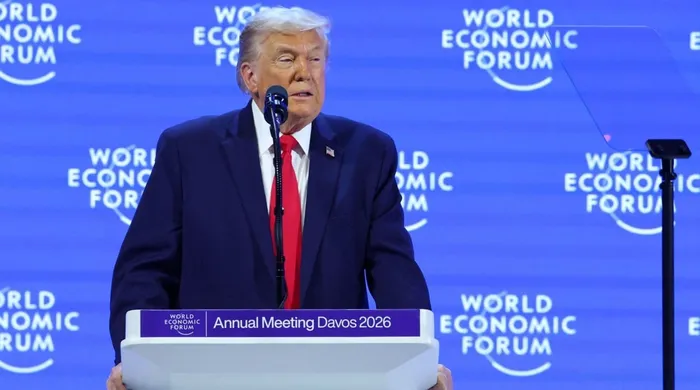
Speaking at the World Economic Forum in Davos, the U.S. President Donald Trump said he would not use force to take control of Greenland, seeking to calm speculation that Washington might pursue a military option while reaffirming his long-standing view that the territory is critical to U.S. and global security.
Trump repeatedly described Greenland, the world's largest island, as "a piece of ice," but stressed that its strategic location makes ownership essential in the event of a future conflict. He argued that leasing or licensing the territory would be meaningless from a defense standpoint, saying it is impossible to protect such a strategically vital area without full ownership. In a hypothetical war scenario, he said, missiles would likely pass directly over Greenland, making it central to any major confrontation.
Addressing concerns that a U.S. acquisition could undermine NATO, Trump dismissed the idea outright. He said the move would strengthen the alliance rather than weaken it, while once again accusing NATO of treating the United States unfairly. According to Trump, the U.S. has long contributed disproportionately to the alliance while receiving little in return.
He acknowledged that the United States could theoretically obtain Greenland through "excessive strength and force," describing such action as unstoppable, but emphasized that he would not pursue that path. Trump said this was the most important clarification of his remarks, noting that many people had assumed military force was on the table. He insisted that he neither needs nor wants to use force and confirmed that Washington is instead seeking immediate negotiations to discuss the acquisition of Greenland.
Trump criticized Denmark, saying it is too weak to protect the island, and asserted that no country other than the United States is capable of securing, developing, and improving Greenland. He framed the territory as part of North America from a strategic perspective, calling it essential to both U.S. national security and broader international security.
After addressing Greenland, Trump turned to energy policy, saying the United States is making a major push into nuclear power. He admitted that he was once skeptical because of safety risks but said advances in nuclear technology have been "unbelievable," with dramatic improvements in safety and cost. According to Trump, nuclear energy is now both affordable and extremely safe, making it a cornerstone of future U.S. energy strategy.
At the same time, he repeated his criticism of wind power and Europe's energy choices. Trump said he wants Europe and the UK to succeed but accused them of sitting on vast energy potential while failing to use it. He also criticized Europe's high energy costs, linking them to policy decisions favoring green energy.
Trump spent part of his speech discussing Venezuela, predicting that the country would perform "fantastically well" under U.S. influence following the removal of former president Nicolás Maduro. He claimed that Venezuela could generate more revenue in the next six months than it had in the past 20 years, saying major U.S. oil companies are moving in, though he did not provide details. He praised the interim administration led by Delcy Rodríguez, saying it has cooperated effectively with U.S. authorities. Complementing these remarks, Trump said the U.S. obtained 50 million barrels of oil from Venezuela last week.
On geopolitics, Trump said he is dealing with Russian President Vladimir Putin and wants to reach an agreement, adding that he planned to meet Ukrainian President Volodymyr Zelensky and believes Zelensky is also interested in a deal. He argued that Europe should take greater responsibility for the Ukraine issue rather than relying on the United States.
Trump also highlighted what he described as the strength of the U.S. economy. He said America remains the economic engine of the world, arguing that when the U.S. economy rises or falls, the rest of the world follows. He cited core inflation at 1.5% and said fourth-quarter economic growth is expected to reach 5.4%, potentially double the pace forecast by the International Monetary Fund. He also claimed gasoline prices could soon fall below $2 per gallon, while U.S. oil production has risen by 730,000 barrels per day and natural gas output is at record highs.
Domestically, Trump said new defense rules will accelerate weapons manufacturing and prohibit defense companies from using profits for stock buybacks. He reiterated plans to fire government employees, cut federal spending, boost exports, and expand domestic steel production.
Turning back to Europe, Trump said parts of the continent are "not recognizable anymore," blaming an overemphasis on green energy and mass migration for what he described as Europe's decline. While saying he wants Europe to do well, he argued that it is not currently heading in the right direction.
Trump opened his speech by joking that it was good to address "so many friends, a few enemies," drawing laughter from the audience, before launching into a wide-ranging address that reinforced his core themes: American economic dominance, energy independence led by nuclear power, skepticism toward Europe's policy choices, and a firm insistence that the United States can pursue strategic goals such as Greenland without resorting to military force.

Crypto market researcher and content strategist with 3 years of experience in digital asset analysis and market commentary. Skilled at transforming complex blockchain data and trading signals into clear, actionable insights for investors. Experienced in covering Bitcoin, Ethereum, and emerging ecosystems including DeFi, Layer2, and AI-related projects. Passionate about bridging professional market research with accessible storytelling to empower readers and investors in the fast-evolving crypto landscape.
Latest Articles
Stay ahead of the market.
Get curated U.S. market news, insights and key dates delivered to your inbox.


AInvest
PRO
AInvest
PRO



Comments
No comments yet