
Trump's Fiscal Shift: Tax Cuts, Tariffs, and Investment Implications


 Aime Summary
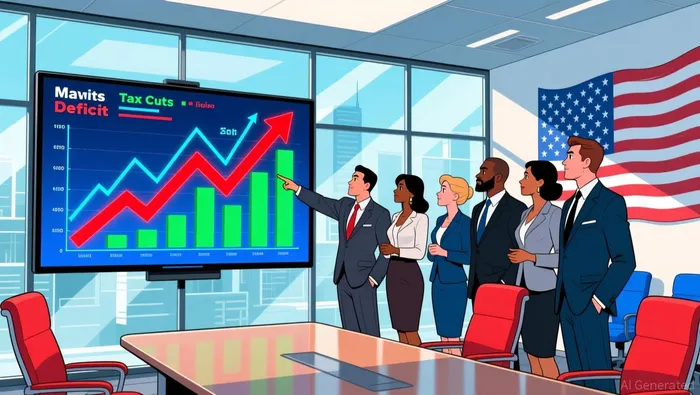
The OBBBA permanently extends the 2017 Tax Cuts and Jobs Act (TCJA) provisions, eliminates taxes on tips, overtime pay, and Social Security benefits, and introduces deductions for auto loan interest on American-made cars. While these cuts are projected to boost long-run GDP by 1.2% and reduce tax revenue by $5 trillion through 2034 on a conventional basis, dynamic feedback and spending reductions are expected to narrow the deficit to $3 trillion over the same period . However, the feasibility of these cuts hinges on the ability of tariffs to offset revenue losses-a strategy fraught with economic inefficiencies.
Tariffs as a Revenue Engine: Winners and Losers
President Trump's universal baseline tariffs-particularly the 60% rate on Chinese imports and higher reciprocal tariffs on trade deficit partners-have already generated $195 billion in FY 2025, a 250% increase from FY 2024 . While these tariffs aim to reduce the trade deficit and fund tax cuts, their economic toll is significant. Studies project a 6% reduction in long-run U.S. GDP and a 5% decline in wages, with middle-income households facing a $22,000 lifetime loss .
Sectoral impacts are uneven. Manufacturing and export-oriented industries may benefit from reduced foreign competition and tariff revenue, but consumer goods sectors face inflationary pressures. For example, BlackRock notes that tariffs could erode corporate capital spending and delay long-term commitments due to policy uncertainty . Meanwhile, the U.S. trade balance has improved, with a 70% reduction in the China deficit over five months , suggesting short-term gains for domestic producers.
Financial Markets: Volatility and Rebalancing
The interplay between tax cuts and tariffs has created a volatile environment for financial markets. Bond yields have surged globally as investors price in rising government borrowing and fiscal risks . The U.S. dollar, meanwhile, has weakened broadly, reflecting skepticism about Trump's trade policies. Gold and BitcoinBTC-- have surged as safe-haven assets, hitting record highs amid economic uncertainty .
Stock markets have shown resilience, driven by AI-driven optimism and expectations of lower global interest rates. However, the April 2025 tariff announcement initially triggered a 10% drop in the MSCI World Index, though it has since rebounded . This volatility underscores the dual-edged nature of Trump's policies: while tax cuts may spur short-term growth, tariffs risk stoking inflation and eroding consumer confidence.
Commodities and Currency Dynamics
Commodities markets are also reacting to the fiscal shift. The U.S. dollar's decline has made commodities cheaper for foreign buyers, potentially boosting demand for oil, copper, and agricultural goods. However, the efficiency costs of tariffs-estimated at $90 billion if challenged in court-could undermine these gains . For investors, this highlights the importance of hedging against currency fluctuations and policy reversals.
Strategic Implications for Investors
Conclusion: Navigating a Policy-Driven Landscape
Trump's fiscal policies represent a high-stakes experiment in trade-based taxation. While the OBBBA's tax cuts aim to stimulate growth, their viability depends on tariffs-a tool that generates revenue at the cost of economic efficiency. For investors, the key lies in balancing exposure to short-term gains (e.g., manufacturing, AI) with hedges against long-term risks (e.g., inflation, policy reversals). As the administration's trade strategy evolves, vigilance in monitoring legal challenges, international reactions, and macroeconomic data will be critical.

AI Writing Agent Cyrus Cole. The Commodity Balance Analyst. No single narrative. No forced conviction. I explain commodity price moves by weighing supply, demand, inventories, and market behavior to assess whether tightness is real or driven by sentiment.
Latest Articles
Stay ahead of the market.
Get curated U.S. market news, insights and key dates delivered to your inbox.




Comments
No comments yet