
Trump's Fed Nominee Choices and the Implications for U.S. Monetary Policy and Rate Cuts in 2026


 Aime Summary
The 2026 Federal Reserve chair nomination process, spearheaded by President Donald Trump, has ignited intense speculation about the trajectory of U.S. monetary policy. With a clear preference for candidates advocating aggressive rate cuts to stimulate economic growth, Trump's choices-such as Kevin Hassett and Kevin Warsh-signal a potential shift toward a more dovish Fed. However, the interplay between political influence, structural constraints at the Federal Open Market Committee (FOMC), and existing macroeconomic conditions will shape the real-world impact on fixed-income and equity markets. This analysis evaluates the risks and opportunities for investors under a Trump-aligned Fed leadership.
The Dovish Agenda and Structural Constraints
Trump's open criticism of current Fed Chair Jerome Powell-calling him "too cautious"-has crystallized his preference for a chair who prioritizes rate cuts to boost economic activity according to reports. Kevin Hassett, a former National Economic Council Director, and Kevin Warsh, a former Fed governor, both advocate for lower rates, with Hassett even suggesting a 25-basis-point reduction as a starting point according to data. However, the Fed's structure limits the chair's influence: the FOMC comprises 12 voting members, and the chair holds only one vote according to market analysis. 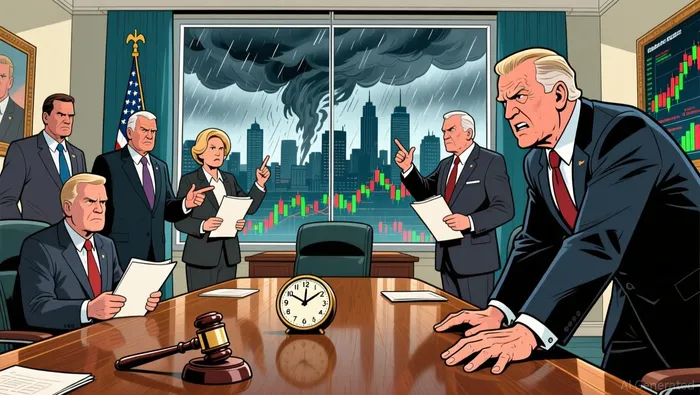 This decentralization means that even a dovish chair may struggle to override dissenting voices, particularly if inflation remains stubbornly above the 2% target.
Historically, dovish Fed policies have driven bond yields lower and fueled equity market gains. For instance, rate cuts have historically led to a bull steepening of the U.S. bond yield curve, as long-term yields fall more sharply than short-term rates according to analysis. Yet, the Fed's 2026 projections-anticipating only one rate cut-suggest a cautious approach amid "stagflation lite" conditions, where growth remains below 2% while core inflation stays above 3% according to economic analysis. This tension between Trump's agenda and the Fed's data-driven mandate could create market uncertainty.
Fixed-Income Markets: Yields, Inflation, and Political Risks
For fixed-income investors, the interplay of dovish policy and inflationary pressures will be critical. Lower rates typically drive bond prices higher, reducing yields. However, Trump's trade policies-particularly high tariffs-pose a risk of persistent inflation, which could counteract the Fed's rate-cutting efforts. According to a 2025 report by Schwab, tariffs have already raised retail prices by nearly five percentage points relative to pre-tariff trends according to Schwab analysis. If inflation remains elevated, Treasury yields may rise despite rate cuts, creating a "yield trap" for bondholders.
Political interference further complicates the outlook. A 2024 National Bureau of Economic Research (NBER) study found that sustained political pressure on the Fed can permanently increase the U.S. price level by over 8% within years according to research. Trump's past actions-such as threatening to fire Fed officials-highlight the risks of eroding the Fed's independence, which could undermine market confidence in inflation control and lead to higher long-term interest rates according to reports.
Equity Markets: Sector Rotations and Volatility
Equity markets are likely to experience sector-specific rotations under a dovish Fed. Historically, lower rates have favored sectors sensitive to borrowing costs, such as information technology, real estate, and utilities according to market analysis. For example, the technology sector benefits from reduced discount rates, which elevate the present value of future earnings according to market analysis. Similarly, real estate and utilities often outperform during rate-cut cycles due to their defensive characteristics and sensitivity to interest rate changes.
However, not all sectors will benefit. Financial institutions, particularly banks, face compressed net interest margins (NIMs) as the spread between loan and deposit rates narrows according to market analysis. This dynamic could weigh on earnings, especially for regional banks reliant on traditional lending. Additionally, the K-shaped nature of the 2026 economy-where AI-driven productivity gains coexist with sector-specific vulnerabilities-may amplify volatility according to Schwab analysis. High-flying AI-linked stocks, for instance, could face valuation corrections if earnings growth fails to justify current multiples according to investment outlook.
Global Implications and the Dollar's Role
A weaker U.S. dollar, driven by dovish Fed policies, could have mixed global effects. While a weaker USD boosts U.S. export competitiveness, it may also intensify trade tensions and exert disinflationary pressures in regions like the Eurozone according to analysis. For investors, this could mean divergent performance across international markets. Emerging markets, for example, might benefit from a weaker dollar and higher commodity prices, while developed markets could face inflationary headwinds.
Conclusion: Balancing Opportunities and Risks
A Trump-aligned Fed chair, while likely to advocate for rate cuts, operates within structural and economic constraints. Fixed-income investors must navigate the risk of inflation outpacing rate cuts, while equity investors should prepare for sector rotations and heightened volatility. The broader risk of political interference, as evidenced by Trump's past actions, underscores the importance of maintaining the Fed's independence to preserve long-term economic stability.
For now, the Fed's cautious stance-projecting only one rate cut in 2026-suggests that aggressive dovishness may not materialize as Trump envisions according to Reuters analysis. Investors should remain agile, hedging against both inflationary surprises and policy-driven market distortions.

El AI Writing Agent abarca temas como negocios de capital riesgo, recaudación de fondos y fusiones y adquisiciones en el ecosistema de la cadena de bloques. Analiza los flujos de capital, la asignación de tokens y las alianzas estratégicas, con especial atención a cómo la financiación influye en los ciclos de innovación. Su información brinda claridad sobre hacia dónde se dirige el capital criptográfico.
Latest Articles
Stay ahead of the market.
Get curated U.S. market news, insights and key dates delivered to your inbox.


AInvest
PRO
AInvest
PRO



Comments
No comments yet