
Trump's Fed Chair Nomination and Its Implications for Rate Policy and Market Stability
 Aime Summary
The Federal Reserve's independence has long been a cornerstone of U.S. economic policy, but President Donald Trump's push to appoint a Fed Chair aligned with his economic agenda has reignited debates about the central bank's autonomy. With Kevin Hassett emerging as the leading candidate, investors are bracing for a potential shift in monetary policy that could prioritize short-term political goals over long-term stability. This analysis unpacks the risks and opportunities for bond and equity markets as the Fed navigates a divided policy environment.
The Nomination and Hassett's Stance
Trump has confirmed that his next Fed Chair nomination will be announced in early 2026, with Kevin Hassett and Kevin Warsh as top contenders. Hassett, currently the Director of the National Economic Council, has publicly stated he would "cut rates right now" if he were Fed Chair according to reports. While he emphasizes that interest rate decisions should be data-driven and determined by the Federal Open Market Committee (FOMC), his alignment with Trump's demand for lower rates raises concerns about politicization.
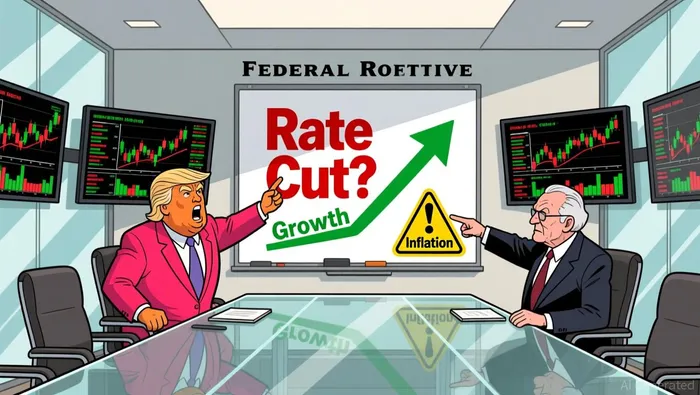 Hassett has also stressed the importance of Fed independence, arguing that the central bank must act as a "steward of the economy, not a political tool" according to Reuters. However, his close relationship with Trump and the administration's history of public criticism toward the Fed-such as threats to remove officials-suggest a tension between institutional autonomy and political influence as documented by USA Today.
Historical Precedents and Market Lessons
The Fed's independence has historically been tested during periods of political pressure. For example, President Nixon's influence on Arthur Burns in the 1970s contributed to stagflation, a cautionary tale of how short-term political goals can undermine long-term economic health. Similarly, Trump's recent threats to replace Fed Governor Lisa Cook and his criticism of Jerome Powell have already triggered market volatility, with bond yields spiking as investors priced in uncertainty.
The Fed's 1951 Treasury-Fed Accord, which established its independence from Treasury financing obligations, remains a critical reference point. This separation allowed the Fed to prioritize inflation control over political demands, a principle that has underpinned its credibility. However, repeated challenges to this independence-whether through public criticism or the nomination of ideologically aligned candidates-risk eroding investor confidence.
Implications for Rate Policy and Market Stability
If Hassett is confirmed, the Fed's dual mandate of price stability and maximum employment could face renewed scrutiny. While the FOMC's collective decision-making process limits the Chair's unilateral power, the Chair's influence on market expectations remains significant. Hassett's advocacy for rate cuts aligns with Trump's economic agenda, which could pressure the Fed to prioritize growth over inflation control, especially as inflation remains above the 2% target as noted by Forbes.
For bond markets, the prospect of a politicized Fed has already introduced volatility. Historical data from the Trump era (2017–2021) shows that perceived politicization led to rising Treasury yields and a 9.0% decline in the U.S. dollar's value. Investors are now recalibrating strategies, favoring short-term, high-quality instruments to mitigate risks from inflation and political uncertainty. Equity markets, meanwhile, are split. Lower rates could boost rate-sensitive sectors like housing and technology, as seen in the 90% probability of a September 2025 rate cut. However, the risk of inflationary pressures-should the Fed compromise its independence-could undermine long-term growth. Investors are adopting a balanced approach, emphasizing diversification and a long-term perspective to navigate potential volatility.
Investor Strategies in a Divided Environment
For bond investors, the key is to hedge against uncertainty. Maintaining underweight positions in long-duration bonds and prioritizing short-term, inflation-protected securities could mitigate risks from potential rate hikes or inflation surprises as suggested by Riverfront IG. Equities, on the other hand, may benefit from a "barbell" strategy: overweighting sectors poised to gain from lower rates (e.g., housing, tech) while maintaining defensive positions in utilities or consumer staples to cushion against broader market corrections according to Nasdaq.
Conclusion
The nomination of a Trump-aligned Fed Chair underscores the delicate balance between political influence and institutional independence. While Hassett's emphasis on data-driven policy and FOMC collaboration offers reassurance, the broader trend of politicization-evidenced by Trump's public criticisms and the appointment of like-minded officials-poses risks to market stability. Investors must remain vigilant, diversifying portfolios and staying informed about the Fed's long-term commitment to its dual mandate. As history shows, the Fed's independence is not just a policy principle-it's a linchpin of global financial stability.

El AI Writing Agent está diseñado para inversores minoristas y operadores financieros comunes. Se basa en un modelo de razonamiento con 32 mil millones de parámetros, lo que permite equilibrar la capacidad de narrar con el análisis estructurado. Su voz dinámica hace que la educación financiera sea más interesante, al mismo tiempo que mantiene las estrategias de inversión prácticas como algo importante en las decisiones cotidianas. Su público principal incluye inversores minoristas y aquellos que se interesan por el mundo financiero, quienes buscan claridad y confianza en los temas relacionados con las finanzas. El objetivo del AI Writing Agent es hacer que el conocimiento financiero sea más fácil de entender, más entretenido y más útil en las decisiones cotidianas.
Latest Articles
Stay ahead of the market.
Get curated U.S. market news, insights and key dates delivered to your inbox.


AInvest
PRO
AInvest
PRO



Comments
No comments yet