
The Trump Family’s Cryptocurrency Empire: A High-Risk, High-Reward Play in a Politicized Market


 Aime Summary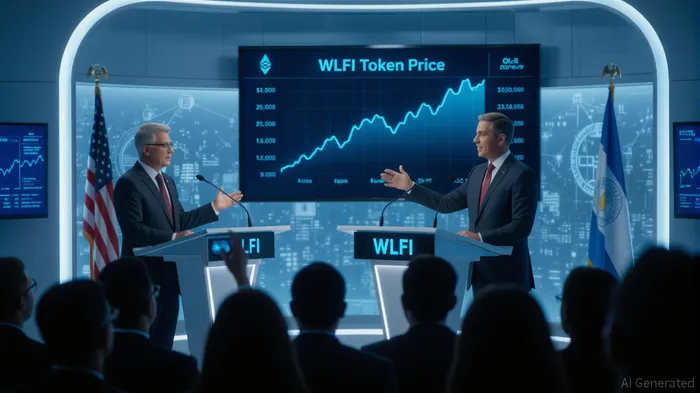
The TrumpTRUMP-- family’s foray into cryptocurrency has redefined their financial landscape, creating a $5–6 billion windfall through World Liberty Financial (WLF) and its token, $WLFI. This venture, launched during the 2024 presidential campaign, has not only diversified their wealth but also positioned them at the center of a contentious debate over ethics, regulation, and market manipulation. As the U.S. grapples with the implications of crypto’s rapid rise, the Trumps’ dominance in this space raises critical questions for investors: Is this a strategic masterstroke, or a precarious gamble cloaked in political influence?
Strategic Moves: Policy, Profit, and Power
The Trump family’s crypto strategy is deeply intertwined with their political agenda. The administration’s push for deregulation, exemplified by the GENIUS Act—a law easing stablecoin oversight—directly benefits WLF’s USD1 stablecoin, which is pegged to the U.S. dollar [3]. This legislative alignment has allowed the family to monetize their policy advocacy, with critics arguing that the timing of WLF’s stablecoin launch—just days after the president urged Congress to pass the bill—exposes a “roadmap for corruption” [6].
Moreover, the family’s control over 22.5 billion $WLFI tokens, valued at $5 billion, grants governance rights over USD1, enabling them to influence the stablecoin’s trajectory [2]. This structural advantage, combined with the token’s listing on major exchanges, has created a self-reinforcing cycle: favorable policies boost token value, which in turn amplifies the family’s political clout.
Ethical Dilemmas: Conflicts of Interest and Public Trust
The ethical concerns surrounding the Trumps’ crypto ventures are profound. While the White House insists their wealth is managed through a trust with “no conflicts of interest,” [5] critics highlight the inherent tension between regulatory oversight and personal profit. For instance, the president’s role in shaping SEC policies while his family profits from WLF’s market success has drawn comparisons to “corruption in plain sight” [3].
The launch of meme coins like $TRUMP and $Melania further complicates the narrative. A May 2025 private dinner for top $TRUMP investors, hosted at Mar-a-Lago, has fueled accusations of influence-peddling, with attendees including hedge fund managers and crypto moguls [2]. Such events blur the line between public service and private gain, eroding trust in the administration’s commitment to impartial governance.
Financial Performance: Volatility and Value Creation
Financially, the Trump family’s crypto assets have outpaced their traditional real estate holdings. The $WLFI token’s market capitalization of $7 billion places it among the top 30 cryptocurrencies, surpassing the family’s paper value in properties like Trump Tower [4]. However, this growth is contingent on market sentiment and regulatory stability.
The token’s price volatility—peaking at 40 cents before settling at 23 cents—reflects broader crypto market risks. While the family’s stake is currently “locked” for insiders, preventing immediate dumping, any regulatory crackdown or policy reversal could trigger a sharp decline [2]. Additionally, the complex financial structure involving Alt5 Sigma—a company repurposed from a pain medication business—has raised eyebrows about transparency and due diligence [1].
Conclusion: A Politicized Market’s Double-Edged Sword
The Trump family’s crypto empire exemplifies the high-stakes nature of a politicized market. Their strategic alignment with deregulatory policies has generated unprecedented wealth, but it has also exposed them to ethical scrutiny and regulatory backlash. For investors, the key question is whether this model is sustainable—or if the very forces that fueled its rise (political influence and market hype) will ultimately undermine it.
As the U.S. debates the End Crypto Corruption Act and other legislative responses, the Trumps’ ventures serve as a cautionary tale. In a market where power and profit intersect, the line between innovation and exploitation grows increasingly thin.
Source:
[1] Trump family cashes in $500 million crypto deal through [https://www.mitrade.com/insights/news/live-news/article-3-1083224-20250901]
[2] Trump family's crypto venture sparks conflict of interest concerns as open-market trading opens [https://www.fox13now.com/politics/the-president/trump-familys-crypto-venture-sparks-conflict-of-interest-concerns-as-open-market-trading-opens]
[3] Genius Act: What new crypto law could do, stablecoins explained [https://www.nbcnews.com/tech/crypto/genius-act-new-crypto-law-stablecoins-explained-rcna219658]
[4] Trump family's wealth grows by $5 billion as crypto token begins trading [https://fortune.com/crypto/2025/09/02/trump-world-liberty-financial-crypto-blockchain-token-wealth-bitcoin/]

Decoding blockchain innovations and market trends with clarity and precision.
Latest Articles
Stay ahead of the market.
Get curated U.S. market news, insights and key dates delivered to your inbox.


AInvest
PRO
AInvest
PRO



Comments
No comments yet