
Trump-EU Trade Deal Imposes 15% Tariffs on EU Goods as EU Commits $750B Energy Purchases and $600B Investment
 Aime Summary
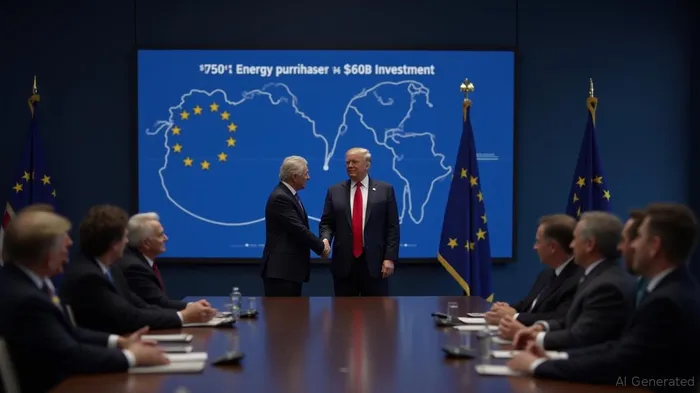
The Trump administration has secured a landmark trade agreement with the European Union, reshaping transatlantic economic dynamics through a deal negotiated by President Donald Trump and European Commission President Ursula von der Leyen. The agreement imposes a 15% tariff on most EU goods exported to the U.S., including automobiles, while eliminating U.S. tariffs for products entering European markets. In exchange, the EU has committed to purchasing $750 billion in U.S. energy and investing an additional $600 billion in the United States. These terms, finalized after months of negotiations, aim to rebalance trade flows but have triggered immediate sector-specific concerns and market volatility [1].
The 15% tariff on EU exports, announced on July 28, 2025, has been hailed by Trump as the “biggest deal ever made,” emphasizing its potential to strengthen U.S. trade balances. However, European businesses and analysts have raised alarms, noting that the tariffs could inflate consumer costs and erode profit margins for companies reliant on cross-border trade. The automotive industry, a cornerstone of EU exports, faces particular scrutiny, with analysts suggesting retaliatory measures or further negotiations may be necessary to mitigate the impact [2].
The energy and investment provisions of the deal have drawn both support and criticism. The EU’s commitment to purchase $750 billion in U.S. energy is projected to boost American fossil fuel exports and domestic energy sectors, aligning with Trump’s economic priorities. Meanwhile, the $600 billion investment pledge is expected to fund U.S. infrastructure and manufacturing projects. European lawmakers, however, have criticized the terms as favoring U.S. interests, arguing they undermine European economic sovereignty [3].
Market reactions to the agreement have been mixed. European and Asian stock markets initially surged, driven by optimism over reduced trade tensions and improved access to the U.S. market. Yet, the pharmaceutical industry has voiced concerns, with analysts estimating the deal could incur $13–$19 billion in additional costs due to shifts in market access and regulatory compliance. These sector-specific adjustments highlight the complex trade-offs inherent in the pact, balancing short-term market gains with long-term structural challenges [4].
The broader implications for global trade remain uncertain. While the agreement addresses immediate transatlantic disputes, critics argue it lacks mechanisms to resolve deeper issues such as intellectual property rights and non-tariff barriers. The Trump administration has positioned the deal as a template for future negotiations, but its success will hinge on the EU’s ability to secure reciprocal benefits and address lingering disputes. The absence of a formal endorsement from the European Commission underscores the deal’s fragility, with both sides now tasked with navigating its implementation [5].
Sources:
[1] [CNN, “Where Trump sees the 'biggest deal ever,' Europe ...”](https://www.cnn.com/2025/07/28/business/eu-us-trade-deal-capitulation-intl)
[2] [Yahoo Finance, “Carney says trade talks in 'intense phase' after Trump ...”](https://ca.finance.yahoo.com/news/carney-says-trade-talks-intense-162546220.html)
[3] [KTVZ, “Trump touts 'biggest deal ever made' as US and EU sketch ...”](https://ktvz.com/money/cnn-business-consumer/2025/07/27/trump-announces-us-and-eu-reached-framework-for-a-trade-deal/)
[4] [Investing.com, “EU-US trade deal could add up to $19 billion in pharma ...”](https://www.investing.com/news/stock-market-news/euus-trade-deal-could-add-up-to-19-billion-in-pharma-industry-costs-analysts-say-4155847)
[5] [Tribune-Democrat, “World shares advance after EU strikes trade deal with Trump”](https://www.tribdem.com/news/world-shares-advance-after-eu-strikes-trade-deal-with-trump/article_94cfbb98-9bb4-5a11-867c-f1c0d8c91ace.html)

Stay ahead of the market.
Get curated U.S. market news, insights and key dates delivered to your inbox.


AInvest
PRO
AInvest
PRO



Comments
No comments yet