
The Trump-EU Trade Deal and Its Implications for Global Equity Markets
 Aime Summary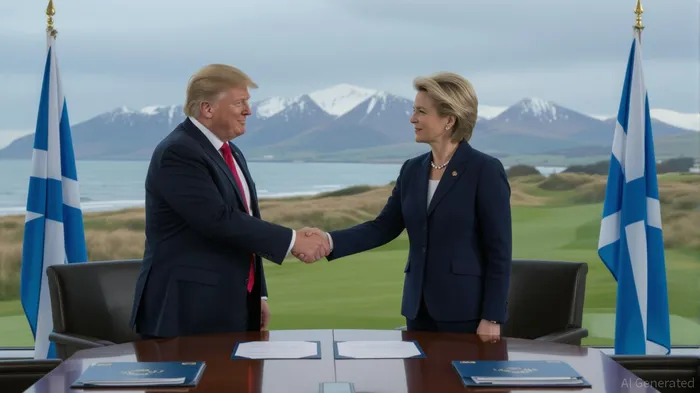
The Trump-EU Trade Deal of July 2025, announced at Turnberry, Scotland, has reshaped the global economic landscape. By imposing a 15% tariff on most EU goods—far below the 30% initially threatened—Washington has averted a catastrophic trade war. However, the deal's implications extend beyond its immediate terms, forcing investors to rethink sector exposure and risk management in a world increasingly defined by geopolitical shocks.
Strategic Sector Rotation: Winners and Losers
The agreement's structure—$600 billion in EU investments in the U.S., $750 billion in energy and military procurement, and a 15% tariff on EU imports—creates clear winners and losers across asset classes.
U.S. Energy and Defense Sectors:
The EU's commitment to purchase $750 billion in U.S. energy over three years is a tailwind for energy stocks. Companies like ExxonMobil (XOM) and ChevronCVX-- (CVX) stand to benefit from increased LNG and oil exports. Similarly, defense contractors such as Lockheed MartinLMT-- (LMT) and Raytheon Technologies (RTX) could see a surge in demand as the EU ramps up military equipment purchases.
European Automotive and Manufacturing:
The 15% tariff on EU cars and parts, while lower than the 27.5% previously in place, still poses a headwind for German automakers like Volkswagen (VOW3.F) and Daimler (DAIGn). These firms may need to shift production closer to the U.S. or pivot to higher-margin EVs to offset margin pressures.Pharmaceuticals and Semiconductors:
The deal excludes tariffs on generic drugs and semiconductor equipment, preserving opportunities for U.S. firms like IntelINTC-- (INTC) and TSMCTSM-- (TSM). However, European pharmaceutical giants such as Roche (ROG) and NovartisNVS-- (NOVN) face uncertain pricing power in the U.S. market.Logistics and Retail:
The layered tariff structure has already caused supply chain disruptions. High-value goods like machinery and aerospace components face delays, with companies like DHL (DHLGn) and C.H. Robinson (CHRN) likely to see increased demand for customs brokerage services.
Risk Management in a Post-Geopolitical Shock World
The deal's success hinges on its implementation. Legal challenges to Trump's tariffs and unresolved issues—such as non-tariff barriers for autos and agricultural products—pose tail risks. Investors must adopt a multi-pronged risk management strategy:
Diversification Across Trade Exposures:
Avoid overconcentration in sectors tied to transatlantic trade. For example, a portfolio heavy in European automotive stocks may need hedging with U.S. energy or defense equities.Monitoring Legal and Regulatory Developments:
The U.S. faces lawsuits over the legality of its tariffs. A favorable court ruling could negate the deal, while a rejection would stabilize it. Investors should track cases like United States v. EU Trade Agreement (expected by Q3 2025).Geographic Rebalancing:
As global supply chains shift, consider emerging markets that benefit from trade diversion. Vietnam and Mexico, for instance, may see increased manufacturing activity as companies seek alternatives to China.Sector-Specific Hedging:
Use derivatives to hedge against volatility in high-exposure sectors. For example, short-term options on European automakers or long-dated puts on energy stocks could mitigate downside risks.
The Long Game: Positioning for Stability
While the deal offers short-term stability, its long-term impact remains uncertain. Investors should prioritize sectors with structural growth drivers, such as renewable energy and AI, which are less sensitive to trade policy shifts. Conversely, sectors like traditional manufacturing and retail face cyclical risks tied to trade tensions.
For those seeking defensive plays, consider:
- Utilities and Consumer Staples: These sectors are less exposed to trade disputes and offer dividend yields to cushion market volatility.
- Technology and Healthcare: These industries benefit from long-term trends like AI adoption and aging populations, which transcend geopolitical noise.
Conclusion: A New Equilibrium
The Trump-EU Trade Deal marks a temporary truce in a world of escalating geopolitical risks. For investors, the priority is to rotate into sectors poised to capitalize on the agreement while hedging against its fragility. Energy, defense, and tech offer growth potential, while a diversified, liquid portfolio provides resilience. As history shows, markets thrive when they adapt to the new normal—this deal is the new normal.

Delivering real-time insights and analysis on emerging financial trends and market movements.
Latest Articles
Stay ahead of the market.
Get curated U.S. market news, insights and key dates delivered to your inbox.
AInvest
PRO
AInvest
PRO



Comments
No comments yet