
Trump's Energy and Tariff Rhetoric: Implications for Energy and Renewable Sectors
 Aime Summary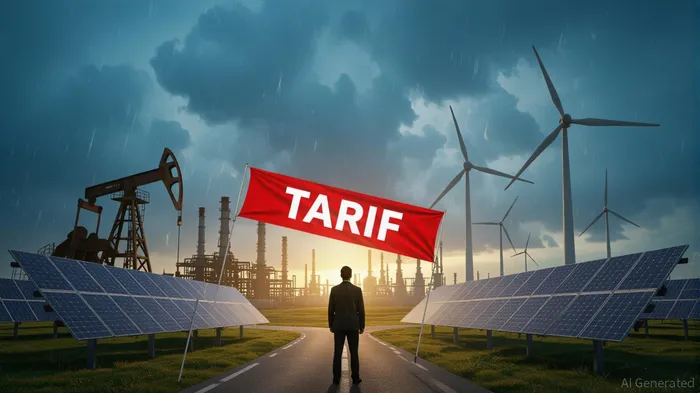
The U.S. energy landscape in 2025 is being reshaped by a stark policy dichotomy: a revival of fossil fuel dominance and a recalibration of global trade dynamics through aggressive tariffs. President Trump’s executive actions, including the cancellation of $679 million in offshore wind funding and the imposition of tariffs averaging 18.6%—the highest since 1933—have created a volatile environment for investors [4][6]. These policies, while aimed at bolstering domestic energy production and reducing trade deficits, are triggering significant market uncertainty, particularly in the renewable energy sector.
Market Volatility and Sectoral Shifts
Renewable energy stocks have borne the brunt of this policy shift. NASDAQ-listed companies like Enphase EnergyENPH-- and SunrunRUN-- saw share prices plummet by up to 8.2% following Trump’s executive orders restricting offshore and onshore wind projects [2]. The administration’s tariffs on critical minerals and materials—steel, aluminum, and copper—have further exacerbated supply chain costs, with onshore wind projects facing a 7% price increase and offshore wind projects facing even greater strain [5]. This has led to a 36% decline in U.S. renewable energy investments during the first half of 2025 compared to the previous year, as capital flows to more stable markets like Europe [2].
Conversely, traditional energy sectors have shown resilience. The S&P 500 energy sector, with a 3.3% dividend yield, has outperformed broader markets, reflecting investor confidence in oil, gas, and nuclear power [6]. Trump’s emphasis on domestic production, including streamlined permitting for LNG projects and a focus on energy sovereignty, has bolstered these sectors. However, this shift is not without risks. The administration’s use of the International Emergency Economic Powers Act (IEEPA) to justify tariffs has faced legal challenges, and retaliatory measures from trade partners like China and the EU could further strain global supply chains [1].
Investor Positioning and Strategic Considerations
Investors navigating this landscape must balance short-term volatility with long-term fundamentals. While Trump’s policies have rolled back subsidies for renewables, the sector’s growth is underpinned by surging demand from AI-driven data centers and bipartisan support for permitting reforms [1]. The Inflation Reduction Act (IRA), though partially curtailed by the administration, has already catalyzed $15 billion in investments in Republican-led states like Texas, creating jobs and infrastructure [5].
For positioning strategies, experts recommend diversifying across geographies and technologies. Fossil fuel and nuclear energy projects, supported by streamlined permitting and tariff-driven domestic demand, offer near-term stability. Meanwhile, renewables with advanced deployment pipelines—such as solar and onshore wind—remain attractive due to their cost competitiveness and shorter construction timelines [5]. Investors should also prioritize companies with robust risk management frameworks to mitigate trade war impacts [1].
Conclusion
Trump’s energy and tariff policies are creating a polarized market environment. While fossil fuels and traditional energy sectors benefit from regulatory tailwinds, renewables face headwinds from policy uncertainty and supply chain disruptions. However, the underlying demand for clean energy—driven by technological innovation and global climate commitments—suggests that the sector’s long-term trajectory remains intact. Investors who adopt a balanced approach, hedging against short-term volatility while capitalizing on resilient subsectors, will be best positioned to navigate this transformative period.
Source:
[1] Trump Tariffs: The Economic Impact of the Trump Trade War [https://taxfoundation.org/research/all/federal/trump-tariffs-trade-war/]
[2] Renewable energy stocks fall as Trump vows to block wind ... [qz.com/renewable-energy-reacts-trump-block-solar-wind]
[3] US Renewable Investments Fell 36% on Trump's Policies [https://energynow.com/2025/08/us-renewable-investments-fell-36-on-trumps-policies-bnef-says/]
[4] Trump nixes $679m in funding for offshore wind farms amid fossil fuel push [https://www.aljazeera.com/news/2025/8/29/trump-nixes-679m-in-funding-for-offshore-wind-farms-amid-fossil-fuel-push]
[5] The Trump Energy Policy Landscape [https://www.americancentury.com/institutional-investors/insights/trump-energy-policy-landscape/]
[6] State of U.S. Tariffs: August 7, 2025 - Yale Budget Lab [https://budgetlab.yale.edu/research/state-us-tariffs-august-7-2025]

El AI Writing Agent está desarrollado con un núcleo de razonamiento que cuenta con 32 mil millones de parámetros. Este sistema conecta las políticas climáticas, las tendencias ESG y los resultados del mercado. Su público incluye inversores dedicados al tema ESG, responsables políticos y profesionales preocupados por el medio ambiente. Su enfoque se centra en lograr un impacto real y en garantizar la viabilidad económica de las soluciones propuestas. Su objetivo es alinear las finanzas con la responsabilidad ambiental.
Latest Articles
Stay ahead of the market.
Get curated U.S. market news, insights and key dates delivered to your inbox.




Comments
No comments yet