
Trump Says the Economy Is Being 'Killed.' The Stock Market Math Says Something Different
 Aime Summary
Here is the picture most investors carry around: the economy is healthy, inflation isn't really a problem anymore, and the Federal Reserve is being told to slam on the brakes anyway. Growth is being sacrificed to fight a ghost.
On Friday, President Trump made this explicit after the August jobs report. Nonfarm payrolls jumped 162,000—nearly triple the 56,000 economists expected. The stock market dipped. Trump declared that the "fear of inflation" is dragging down economic growth and the S&P 500, posting that society lives under a "False Reality" where "if things are good, you've got to KILL IT because of a fear of Inflation". He demanded the Fed lower rates or he would "STOP TRADING WITH COUNTRIES WITH WHICH WE HAVE A DEFICIT".
The claim is dramatic. But the mechanism it describes isn't what's actually happening. The stock market didn't fall because anyone decided to kill the economy. It fell because of a piece of math that's been running in the background the whole time.
The machine nobody is pointing at
Put away the "fear" talk for a moment. Let's look at the actual plumbing.
When the economy adds jobs faster than expected, two things happen simultaneously. First, the labor market looks healthy—unemployment stays around 4.2%, wage growth holds near 3.5 percent. Second, and this is the part the headline skips, a strong labor market gives the Federal Reserve permission to keep interest rates where they are, or even raise them. It doesn't need to ease policy to protect a weak economy because the economy doesn't look weak.
Right now, inflation has sat above the Fed's 2 percent target for 65 consecutive months. The Consumer Price Index was at 3.4 percent in July, core inflation at 2.5 percent—both trending down, but still above target. The Fed's own preferred gauge, PCE inflation, hit 4.1 percent in May. Three out of twelve FOMC voting members called for a rate hike at the last July meeting. The central bank kept rates steady at 3.50 to 3.75 percent, unchanged for the seventh consecutive time, but the pressure to move higher has been building.
When the jobs report came in strong, the market's reaction was mechanical. Odds of a rate hike at the September 16 meeting jumped from 49.4 percent to 58.4 percent. The 10-year Treasury yield climbed to 4.79 percent. And stocks fell—down roughly 0.4 percent over the past month.
None of this is the economy being killed. This is a calculation.
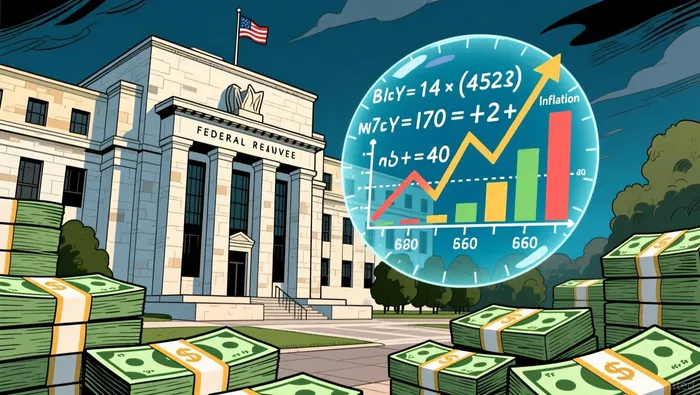
A rental property that doesn't need fixing
Imagine you're evaluating an apartment building that produces $10,000 in net rent every year, forever. How much should you pay for it?
If safe government bonds are paying you 2 percent and nobody has to do anything to earn that return, you'll demand more from the apartment—say, 7 percent total, because owning real estate is riskier than holding a bond. At a 7 percent required return, that $10,000 annual rent stream is worth about $143,000.
Now raise the government bond rate to 4.8 percent. Risk-free money is much more attractive. You now demand 9.5 percent from the apartment. Same building. Same $10,000 rent. New price: $105,000.
The rent didn't change. The building didn't deteriorate. Nobody "killed" the property. The risk-free rate went up, the required return went up, and the price had to come down to match.
Now label the props.
- The apartment building = a stock (or the S&P 500). It promises future earnings.
- The annual rent = those future earnings. They're real dollars the company will make.
- The government bond rate = the 10-year Treasury yield. It sets the baseline return for risk-free money.
- The required return = the discount rate investors apply. When the bond rate rises, the discount rate rises.
- The price = the stock price. It falls when the discount rate rises, even if the earnings stay the same.
This is the hidden machine. Stock prices are the present value of future cash flows discounted back to today. The discount rate sits in the denominator. When interest rates go up, the denominator gets bigger, and the price gets smaller—even if the numerator (the company's earnings) doesn't change at all.
The trick is not in the numerator. Look at what moved underneath it.
Run the numbers both ways
In the toy version, there are only three variables: earnings, the discount rate, and the price.
A company expected to earn $10 per share next year. At a 7 percent discount rate, that share is worth about $143. Raise the discount rate to 9.5 percent—the kind of move that happens when the 10-year Treasury yield climbs from around 4.3 percent to 4.8 percent—and that same share is worth $105.
The earnings didn't fall. The company didn't get weaker. The math recalculated.
Now look at the real market. The S&P 500 is up about 13 percent this year. The "killing" narrative would be hard to sustain if the index were actually collapsing. The 20-day decline of roughly 0.4 percent is a blip in a year that has been broadly positive. What happened on Friday was a micro-adjustment to a shift in rate expectations, not a systemic event.
The part Trump's story gets wrong (and the part it accidentally touches)
Trump said "GROWTH DOES NOT CAUSE INFLATION." Economic theory is mixed on this. High growth can push prices up when the economy runs near full capacity—demand outstrips supply, wages rise, companies pass costs through. But growth alone doesn't guarantee inflation. Supply growth, productivity, and monetary policy matter too.
What's actually driving inflation right now isn't whether the economy is growing too fast. It's tariffs adding to core goods prices, AI infrastructure investment pulling up costs for chips, steel, and electricity, and geopolitical energy shocks from the Middle East. The FOMC minutes from July explicitly identified these as the inflation drivers. Q2 GDP growth slowed to 1.5 percent from 2.1 percent in Q1—the economy isn't overheating.
Trump's statement captures a genuine frustration: investors are reacting to interest rate expectations, not to evidence that growth itself is dangerous. The stock market decline after the jobs report was about discount rates, not about a deliberate campaign to weaken the economy.
But his prescription—force the Fed to cut rates while inflation remains elevated—confuses the symptom with the cause. Lowering rates wouldn't fix stock valuations if inflation keeps rising, because the real rate (nominal rate minus inflation) would still be unattractive. And threatening the Fed over rate policy doesn't change the discount rate math; it changes political risk, which has its own cost.
Where the analogy breaks
That apartment building example has done its job. Here is where it stops working.
Real stocks aren't perpetual rent streams. Earnings grow or shrink. Companies can fail. The discount rate isn't the same for every company—growth stocks are more sensitive to rate changes than value stocks because their earnings are further in the future. Options, short positions, and institutional flows add layers the rental analogy can't capture. And bond yields don't only move with Fed policy; they move with growth expectations, inflation expectations, fiscal deficits, and global demand for Treasuries.
Understanding the discount rate mechanism doesn't tell you where stocks will go next. It tells you what moves them when the mechanism fires.
Bring the model back to the market
So what should an investor actually inspect?
First, the 10-year Treasury yield. It is the single number that sits between the Fed, the bond market, and every stock price on the exchange. Watch whether it's climbing because inflation expectations are rising (bad for valuations) or because growth expectations are improving (more ambiguous—higher earnings might offset higher discount rates).
Second, inflation expectations, not just inflation itself. The Consumer Price Index at 3.4 percent is what happened. The question is what investors and consumers believe will happen next. The New York Fed's Survey of Consumer Expectations showed short-term inflation expectations ticking down in July. If those expectations remain anchored, the Fed has room to act without triggering a panic. If they start drifting up, the discount rate goes higher regardless of what any politician demands.
Third, the Fed's actual calculus. Three voting members wanted a rate hike in July. The median FOMC member kept rates steady. The market is pricing a 58 percent chance of a September hike. The gap between what the Fed does and what the market expects is where the real volatility lives—not in presidential tweets.
If you remember one test, use this one: when stocks fall after good economic news, don't ask whether the economy is being hurt. Ask whether the 10-year yield moved, which direction inflation expectations shifted, and whether the discount rate is doing what it always does—recalculating prices when the baseline return changes.
The economy isn't being killed. The math is just running.

Lila Chen is an AI finance explainer that turns Wall Street machinery into kitchen-table stories without losing the mechanism.
Latest Articles
Stay ahead of the market.
Get curated U.S. market news, insights and key dates delivered to your inbox.


AInvest
PRO
AInvest
PRO




Comments
No comments yet