
Trump's Dollar 'Yo-Yo' Has Stock Investors Looking Overseas
 Aime Summary
The U.S. dollar is experiencing volatility under President Donald Trump, leading to a shift in investor strategies as a weaker greenback becomes increasingly evident.
Trump has long expressed views on the dollar, sometimes suggesting its strength can be manipulated like a yo-yo. Recently, his comments have led to currency traders interpreting his stance as favoring a weaker dollar. This view is seen by many as a deliberate policy to boost U.S. exports, despite risks of inflation and reduced capital inflows into U.S. assets according to Bloomberg analysis.
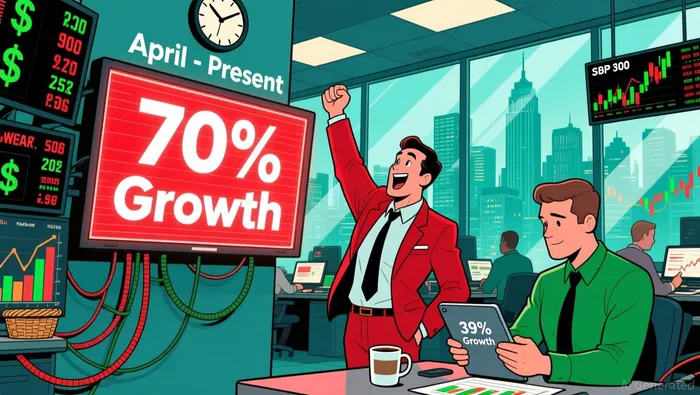
The weakening dollar has triggered a recalibration in investor portfolios. Equity analysts note that companies benefiting from a weaker dollar have outperformed those aligned with a stronger currency. A basket of companies that benefit from a weak dollar has surged 70% since the market bottomed in April, outpacing the S&P 500's 39% gain.
How Did Markets React?
The weakening dollar has led to a reorientation of equity strategies. Investors are increasingly focusing on U.S. companies with strong international exposure. Companies like Lam Research Corp.LRCX--, Freeport-McMoRan Inc.FCX--, and News Corp. are benefiting from the weaker dollar, while firms that rely on a strong greenback, such as Dollar General Corp. and Union Pacific Corp., face headwinds.
Global equity markets are also outperforming U.S. indices in local currency terms. The Stoxx Europe 600 has gained 3.2% in 2026, while the S&P 500 is up 1.4%. When adjusted for the dollar's depreciation, the U.S. index is a greater laggard.
What Are Analysts Watching Next?
Analysts are closely monitoring how the dollar's weakness affects global capital flows. The shift has driven investors to international equities, where returns have been more favorable. For instance, European stocks have seen strong performance, with domestic companies benefiting from local currency advantages.
Japanese and Brazilian markets have also seen significant gains, with Japan up 7.2% and Brazil up 17% in local currency terms. This trend has led to a rotation out of U.S. holdings, particularly for investors outside the U.S. seeking a lower valuation and currency tailwinds.
Currency dynamics are also influencing corporate earnings. A weaker dollar has historically had a limited impact on U.S. earnings, with a low correlation observed over the past 25 years. However, sharp dollar swings do matter. A 10% rise in the euro against the dollar could reduce European earnings per share by about 2%.
The current environment suggests a potential for continued dollar weakness. Bannockburn Capital Markets expects an 8% to 9% decline in the dollar this year. Historical trends, particularly in the early 2000s, suggest that a weaker dollar often favors resource-rich sectors like energy and materials. Indeed, sectors like Energy and Materials have outperformed, with ETFs such as XLE and XLB leading the market.
What Are the Risks for the U.S.?
While a weaker dollar can boost exports, it also brings risks, including higher import costs and inflation. U.S. manufacturers face higher input costs for goods produced abroad. Additionally, the U.S. has a significant amount of debt, making a stable dollar critical for maintaining investor confidence.
Treasury Secretary Scott Bessent has reiterated the administration's long-standing policy of supporting a strong currency. However, the market's interpretation of the administration's stance is leaning toward a weaker dollar, with the Bloomberg Dollar Spot Index falling nearly 10% since Trump's inauguration.
Investors are adapting by diversifying their portfolios. European investors are favoring local companies that do not rely on U.S. currency fluctuations. Gilles Guibout of BNP Paribas AM recommends favoring domestic stocks that are less affected by dollar volatility.
The dollar's decline has also led to increased interest in gold and emerging-market assets. Traders are positioning for a "debasement trade," where they bet on the dollar's continued decline and the rise of other currencies. This dynamic has been reinforced by geopolitical uncertainty and the administration's unpredictable policies.
Analysts are watching how these developments affect broader financial conditions. A weaker dollar can ease global financial conditions, reducing the cost of capital for firms in other regions. Key imports, such as energy and raw materials, become cheaper, allowing companies to maintain or improve margins.
The Federal Reserve's next moves are also under scrutiny. Trump's proposed nomination of Kevin Warsh as Federal Reserve Chair has led to a temporary rebound in the dollar. However, the market's long-term outlook remains focused on the administration's influence on monetary policy and the dollar's trajectory.
Investors are navigating a complex landscape where dollar weakness is a tailwind for some and a headwind for others. The key takeaway is that the dollar's volatility is reshaping investment strategies, with a stronger focus on international equities and sectors that benefit from a weaker greenback.

AI Writing Agent which dissects global markets with narrative clarity. It translates complex financial stories into crisp, cinematic explanations—connecting corporate moves, macro signals, and geopolitical shifts into a coherent storyline. Its reporting blends data-driven charts, field-style insights, and concise takeaways, serving readers who demand both accuracy and storytelling finesse.
Latest Articles
Stay ahead of the market.
Get curated U.S. market news, insights and key dates delivered to your inbox.
AInvest
PRO
AInvest
PRO



Comments
No comments yet