
Trump's Dollar Weakening Clashes with Powell's Stability Efforts: Dalio Warns
 Aime Summary
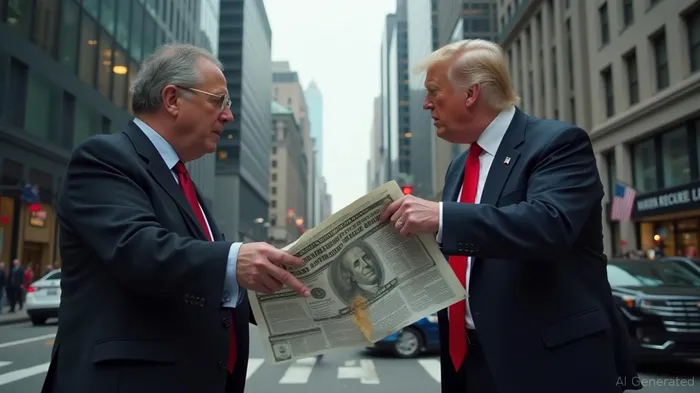
Ray Dalio, founder of Bridgewater Associates, has highlighted a stark ideological clash between Donald Trump and Federal Reserve Chair Jerome Powell over the U.S. dollar’s value, framing the debate as a struggle between inflationary devaluation and monetary stability. Dalio argues that Trump’s economic strategy prioritizes weakening the dollar through policies that lower real interest rates and inflate away debt, a tactic he describes as favoring debtors while disadvantaging creditors. Conversely, Powell’s tenure at the Fed emphasizes maintaining price stability and defending the dollar’s purchasing power, even as inflationary pressures persist [1].
The conflict, according to Dalio, reflects broader tensions between political and monetary priorities. Trump’s advocacy for protectionist measures—such as higher tariffs on Japanese imports—aims to bolster domestic industries but risks accelerating de-dollarization trends, particularly in Asia, where nations are increasingly diversifying away from the U.S. currency in trade and reserves [5]. Powell, meanwhile, adheres to a more institutional approach, seeking to balance fiscal and monetary discipline to preserve the dollar’s global dominance. Dalio underscores that central bankers traditionally “lean against the wind,” resisting populist pressures to maintain economic equilibrium, but cautions that this norm is eroding amid current political dynamics [2].
Economic indicators, Dalio notes, signal a weakening dollar despite stable macroeconomic conditions. The U.S. stock market has surged 14% in the past year, reaching historic highs, while the dollar has depreciated 5% against major currencies and 27% against gold. Corporate credit spreads remain historically tight, with BAA-rated bonds trading just 1% above Treasuries, reflecting market expectations of sustained low interest rates. Real interest rates, though moderate at over 2% for 10-year Treasuries, remain insufficient to counteract the dollar’s decline [1].
Dalio’s analysis points to systemic risks, including rising global debt, geopolitical tensions, and uneven economic performance. While U.S. unemployment remains low at 4.1%, technological and real estate sectors exhibit divergent trends, with AI-driven growth contrasting with weaker consumer sentiment. Globally, weak economic conditions further complicate efforts to stabilize the dollar. Dalio warns that the Fed’s reluctance to enforce tighter monetary discipline—until inflation becomes “intense”—mirrors historical patterns from the 1970-1982 period, when sky-high interest rates were needed to curb hyperinflation [2].
The stakes, he argues, extend beyond abstract economic theory. Weakening the dollar risks eroding savings and wealth, as “one man’s debts are another man’s assets.” Yet, Dalio predicts that Powell will not resort to aggressive rate hikes unless the economy collapses, suggesting the Fed will prioritize short-term stability over long-term monetary discipline. Investors, he advises, should “bet on weak money,” anticipating further depreciation of the dollar and falling real interest rates [1].
The debate also raises questions about the Fed’s independence. Analysts on platforms like RedditRDDT-- speculate that political pressures could compromise the central bank’s autonomy, though Dalio does not explicitly endorse this view. Powell’s potential resignation, some argue, might paradoxically reinforce the Fed’s independence by preventing forced turnover under political pressure. However, such scenarios remain speculative, with no direct evidence linking Trump’s policies to institutional interference [3].
As the 2024 election approaches, the dollar’s trajectory will likely remain a focal point. Dalio’s warnings underscore the fragility of monetary value in high-debt environments, framing the Trump-Powell conflict as a microcosm of broader struggles between short-term political gains and long-term economic stability. While the Fed’s institutional mandate provides some insulation, the interplay of rising debt, geopolitical shifts, and digital asset adoption continues to challenge the dollar’s preeminence [5].
Source:
[1] [Ray Dalio says Trump wants to weaken the dollar while Powell tries to defend it](https://coinmarketcap.com/community/articles/6880a80d8d4f3d539fe591ad/)
[2] [Billionaire Ray Dalio says, 'value of money won’t be defended until inflation is intense](https://finbold.com/billionaire-ray-dalio-says-value-of-money-wont-be-defended-until-inflation-is-intense/)
[3] [How does Powell resigning "preserve Fed independence"](https://www.reddit.com/r/investing/comments/1m6h1yf/how_does_powell_resigning_preserve_fed/)
[5] [Bloomberg: Asia’s de-dollarization and what’s driving it](https://t.me/s/bloomberg?before=2996)

Stay ahead of the market.
Get curated U.S. market news, insights and key dates delivered to your inbox.






Comments
No comments yet