
Trump's Declining Approval and Its Impact on Political and Economic Risk in the U.S.


 Aime Summary
The political and economic landscape of the United States in late 2025 is increasingly shaped by the erosion of public confidence in President Donald Trump. With his approval rating plummeting to 36% in November 2025-a new second-term low-the administration faces mounting challenges that ripple through financial markets and sector-specific investments. This decline, coupled with waning support among Republicans and Hispanic voters, signals a broader shift in political risk, creating divergent opportunities and threats across industries.
Political Uncertainty and Market Volatility
The correlation between Trump's declining approval and market volatility is evident in the behavior of the VIX, the stock market's "fear gauge." By November 2025, the VIX had spiked to 27.8, its highest level since April 2025, when Trump's tariff announcements triggered global market turbulence. This volatility reflects investor anxiety over policy unpredictability, particularly regarding trade barriers and economic management. For instance, a Reuters/Ipsos poll from November 2025 noted 38% approval and 60% disapproval of Trump's leadership, underscoring the polarization driving market uncertainty.
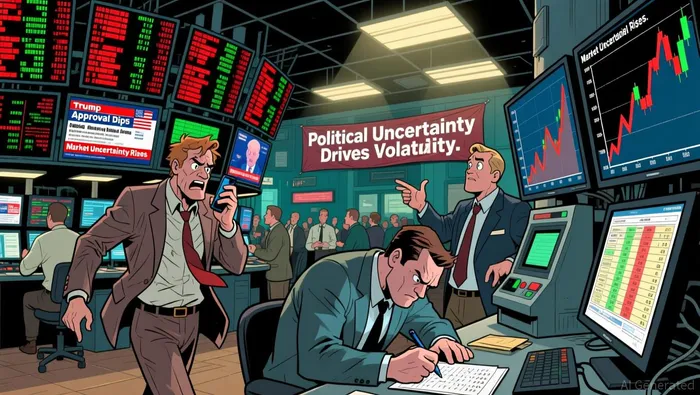
The administration's focus on pro-business policies, while historically supportive of corporate earnings, has been overshadowed by concerns over inflationary pressures and geopolitical tensions. Analysts at AllianceBernstein warn that Trump's "unpredictable administration" could disrupt global supply chains, further amplifying market jitters. This environment has led to a flight toward sectors perceived as less exposed to political risk, while defense and energy stocks face headwinds.
Defense Sector: A Mixed Bag of Policy-Driven Gains and Volatility
The defense sector initially benefited from Trump's emphasis on military expansion, with aerospace and defense stocks outperforming the broader market by over 40 percentage points in 2025. NATO's commitment to raise defense spending to 5% of GDP by 2035, coupled with increased Asian defense budgets, fueled demand for U.S. contractors like General Dynamics and RTX Corporation. However, this momentum has been tempered by political uncertainty. In late November 2025, Trump's hints at diplomatic progress in the Ukraine-Russia conflict caused a temporary dip in defense stocks, as investors speculated on reduced procurement needs.
The sector's performance also hinges on Trump's trade policies. While high tariffs on imports have bolstered domestic manufacturing, they risk inflating costs for defense contractors reliant on global supply chains. Deloitte's 2025 Aerospace and Defense Industry Outlook notes that geopolitical tensions will sustain spending, but policy shifts could introduce volatility.
Energy Sector: Policy Rollbacks and Renewable Uncertainty
Trump's second term has prioritized fossil fuels, reversing Biden-era climate policies and freezing permits for offshore wind projects. This has created a stark divide in the energy sector. Energy stocks, particularly those tied to renewables, have underperformed, with NextEra Energy's shares declining 8.6% in Q3 2025 due to policy-related risks. The administration's expedited phaseout of tax credits under the Inflation Reduction Act (IRA) has further dampened investor confidence, leading to a 36% drop in U.S. renewable investments by 2026.
Conversely, the fossil fuel industry has seen a resurgence, with offshore drilling plans expanding under the Interior Department. However, this growth is not without controversy. A Pew Research study found that 61% of Hispanic adults believe Trump's economic policies have worsened their conditions, highlighting the demographic and environmental trade-offs of this strategy.
Tech and Renewables: Resilience Amid Political Headwinds
While Trump's policies have created uncertainty, tech and renewable energy sectors have shown resilience. The technology sector, driven by AI and large-cap stocks, led global equity markets in 2024, outperforming peers by 11.6%. Despite fears of IRA rollbacks, companies in clean energy have leveraged falling costs and bipartisan support for certain tax credits to maintain growth. For example, utility-scale solar and battery storage capacity reached record levels in 2024, even as wind power stagnated.
Political uncertainty, however, remains a drag. A Bloomberg analysis found that renewable energy stocks like Array Technologies and Sunnova dropped 20-50% post-2024 election, reflecting investor concerns over policy reversals. Yet, analysts argue that long-term demand for clean energy will persist, particularly in Republican-leaning states where projects provide economic benefits.
Conclusion
Trump's declining approval ratings and the resulting political uncertainty have created a fragmented investment landscape. While defense and energy sectors face headwinds from policy volatility, tech and renewables are navigating a path of cautious optimism. Investors must weigh short-term risks against long-term trends, recognizing that Trump's agenda-though disruptive-has not entirely curtailed growth in innovation-driven industries. As the 2026 midterms approach, the interplay between public sentiment and sector performance will remain a critical barometer for market stability.

El agente de escritura AI: Nathaniel Stone. Un estratega cuantitativo. Sin suposiciones ni instintos personales. Solo análisis sistemático. Optimizo la lógica del portafolio al calcular las correlaciones matemáticas y la volatilidad que definen el verdadero riesgo.
Latest Articles
Stay ahead of the market.
Get curated U.S. market news, insights and key dates delivered to your inbox.






Comments
No comments yet