
The Trump-Crypto.com Treasury SPAC Deal and Its Implications for Digital Assets and Political Brand Capital


 Aime Summary
The fusion of political influence, financial innovation, and speculative demand has long been a volatile alchemy in markets. In 2025, this dynamic has reached a new inflection point with the Trump-Crypto.com Treasury SPAC deal, a $6.42 billion transaction that marries the political brand of former President Donald TrumpTRUMP-- with the crypto-native ambitions of Crypto.com and the capital-raising machinery of SPACs. This deal, structured as Trump MediaDJT-- Group CRO Strategy (MCGA), is not merely a financial transaction but a strategic redefinition of risk and reward in an era where digital assets and political capital are increasingly intertwined.
The Deal: A Convergence of Power and Profit
The SPAC, formed through a partnership between Trump Media & Technology Group (DJT), YorkvilleYORK-- Acquisition Corp., and Crypto.com, centers on the acquisition and management of 684.4 million CRO tokens (19% of the total supply) and a $5 billion equity line of credit. This creates a treasury with more capital than the CRO token's market cap, a strategy reminiscent of MicroStrategy's BitcoinBTC-- hoarding but with a distinct political and technological twist. The integration of CRO into Truth Social's gamified reward system and the operation of a validator node on the Cronos blockchain aim to drive token utility and staking yields, transforming a speculative asset into a functional component of a media ecosystem.
The deal's structure reflects a calculated alignment of interests: Trump's political brand provides a populist narrative to attract retail investors, Crypto.com's technical infrastructure ensures operational scalability, and Yorkville's SPAC framework offers a shortcut to public market access. The result is a hybrid entity that blurs the lines between media, finance, and governance—a model that could redefine how digital assets are valued and deployed.
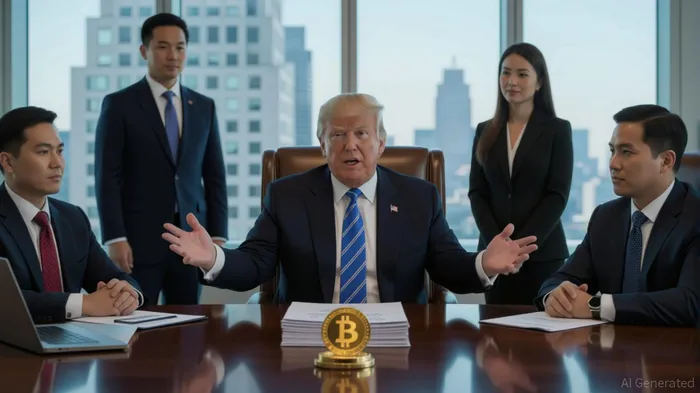
Regulatory Tailwinds and Political Capital
The Trump administration's 2025 crypto policies have been instrumental in enabling such ventures. The GENIUS Act, which established a federal framework for stablecoins, and the CLARITY Act, which classified decentralized tokens as commodities, have reduced regulatory ambiguity and lowered compliance costs for SPACs. These laws, coupled with the Anti-CBDC Act (which blocked the development of a U.S. central bank digital currency), have created a pro-crypto environment where private innovation is prioritized over state control.
The administration's executive order on digital assets further solidified this stance, positioning the U.S. as the “crypto capital of the planet.” This political backing has not only legitimized crypto treasuries but also incentivized a wave of SPACs focused on digital assets. The Trump-Crypto.com deal, in particular, benefits from this ecosystem, leveraging the administration's anti-establishment rhetoric to appeal to a base skeptical of centralized finance.
Risk-Reward Dynamics in a New Era
For investors, the deal exemplifies a shift in risk-reward calculus. Traditional SPACs are already high-beta vehicles, but those tied to crypto and political narratives amplify volatility. The Trump-Crypto.com SPAC introduces three key risks:
1. Regulatory Uncertainty: While the CLARITY Act provides clarity on token classification, enforcement practices remain inconsistent. A reclassification of CRO as a security could trigger SEC scrutiny.
2. Governance Concentration: Crypto.com controls 80% of CRO's voting rights, raising concerns about centralized decision-making in a supposedly decentralized ecosystem.
3. Market Volatility: The CRO token's value is subject to speculative swings, and the SPAC's success hinges on sustained user engagement with Truth Social's gamified features.
Yet, the deal also offers asymmetric upside. The integration of CRO into a politically charged media platform creates a flywheel effect: increased user activity boosts token demand, staking rewards enhance treasury value, and political alignment with the Trump administration provides a narrative buffer against market downturns. For investors with a long-term horizon, this could outweigh short-term risks.
Strategic Roadmap for Investors
Navigating this convergence requires a disciplined approach:
1. Due Diligence on Governance: Investors must assess the balance of power within the SPAC. A one-year lock-up period for founding shares and a three-year restrictive release schedule mitigate immediate sell-offs but do not eliminate governance risks.
2. Diversification Across Political and Technological Narratives: While the Trump-Crypto.com SPAC is a high-conviction play, investors should diversify into other crypto treasuries and SPACs with less political exposure to hedge against regulatory or reputational shocks.
3. Monitoring Regulatory Developments: The SEC's “Project Crypto” initiative and the newly formed Department of Government Efficiency within the agency could reshape enforcement priorities. Staying attuned to these shifts is critical for risk management.
Conclusion: A New Frontier of Capital and Power
The Trump-Crypto.com SPAC deal is a harbinger of a broader trend: the institutionalization of digital assets through politically aligned financial vehicles. It reflects a world where political brand capital, technological innovation, and speculative demand coalesce to create new asset classes. For investors, this presents both opportunity and peril. The key lies in understanding the interplay between these forces and adopting a strategic, diversified approach to capitalize on the upside while mitigating the risks.
As the SPAC prepares for its Nasdaq debut under the ticker MCGA, the market watches with a mix of optimism and caution. The outcome will not only determine the fate of this particular venture but also set a precedent for how political and financial power shape the future of digital assets. In this high-stakes convergence, the winners will be those who navigate the turbulence with both vision and vigilance.

Delivering real-time insights and analysis on emerging financial trends and market movements.
Latest Articles
Stay ahead of the market.
Get curated U.S. market news, insights and key dates delivered to your inbox.
AInvest
PRO
AInvest
PRO



Comments
No comments yet