
Trump's Crypto Earnings Hit $2.4 Billion, 43.5% of Political Wealth Gain
 Aime Summary
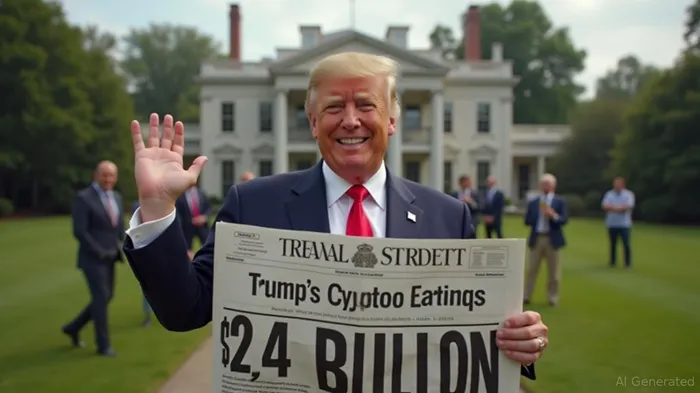
Donald Trump’s involvement in the cryptocurrency sector since 2022 has generated an estimated $2.4 billion in revenue, according to a report by The New Yorker. These figures highlight a significant diversification of the TrumpTRUMP-- family’s personal enrichment strategies, with crypto now accounting for 43.5% of the known wealth gained by the during his political career [1]. The earnings are attributed to various ventures, including token sales, non-fungible token (NFT) collections, and partnerships with international entities such as the United Arab Emirates. For instance, Trump’s World Liberty Financial has reportedly earned $412.5 million through token sales, while his memecoin, Official TrumpTRUMP-- (TRUMP), has contributed $385 million [1].
Trump’s involvement in crypto has expanded beyond personal profit to influence his political responsibilities. As Commander-in-Chief, he oversees the regulation of the cryptocurrency industry in the United States, a role now complicated by his financial stake in the sector. The administration has also seen a shift in regulatory tone, with the Securities and Exchange Commission (SEC) reportedly scaling back enforcement actions against major crypto firms like CoinbaseCOIN-- and UniswapUNI-- [1]. This has led to concerns among lawmakers and the public about potential conflicts of interest and regulatory capture.
The political implications of Trump’s crypto activities have been the subject of scrutiny, particularly by Democratic lawmakers. In May 2025, two Democratic senators raised alarms after Trump hosted a dinner in Washington, D.C., for top holders of his memecoin. They warned that such actions could violate federal ethics laws, including the bribery statute and the emoluments clause of the U.S. Constitution. The senators also expressed concerns that foreign actors might be using the memecoin as a tool to buy influence with the president and his inner circle without public transparency [1].
While the report outlines the financial gains associated with Trump’s crypto ventures, it also notes that direct presidential involvement in these operations may be limited. Many of these initiatives are managed by advisers or family members, which raises questions about oversight and accountability. Nonetheless, the scale and variety of these ventures have sparked debates about the ethical implications of a sitting president’s engagement with a rapidly evolving and often unregulated financial sector.
The report from The New Yorker underscores the broader transformation in Trump’s relationship with the crypto industry. In 2019, he publicly criticized cryptocurrencies for their volatility and potential misuse in illicit activities. Now, with over $2.4 billion in estimated crypto-related earnings, his stance has shifted from skepticism to active participation, highlighting the potential for financial interests to influence policy and regulatory decisions [1].
This development has also raised concerns about insider trading and regulatory conflicts. With Trump’s crypto empire growing, lawmakers and watchdogs are increasingly questioning whether the administration is prioritizing personal financial interests over the public good. These concerns are compounded by the fact that the Trump administration has moved to relax restrictions on crypto firms, including ending the practice of debanking, which had previously limited their access to traditional financial services [1].
The situation presents a complex challenge for the United States in balancing innovation in the financial sector with ethical governance and regulatory oversight. As the crypto industry continues to evolve, the role of political leaders in shaping its trajectory will remain a critical issue for both the public and policymakers [1].
Source:
[1] Trump’s crypto ventures raise conflict of interest, insider trading questions (https://cointelegraph.com/news/trump-crypto-gains-2-4b-since-2022-report)

Stay ahead of the market.
Get curated U.S. market news, insights and key dates delivered to your inbox.
AInvest
PRO
AInvest
PRO



Comments
No comments yet