
Trump's Criticism of the Fed and Its Implications for Global Markets: Assessing the Political-Risk Premium in Fixed Income and Currency Markets Amid Policy Uncertainty


 Aime Summary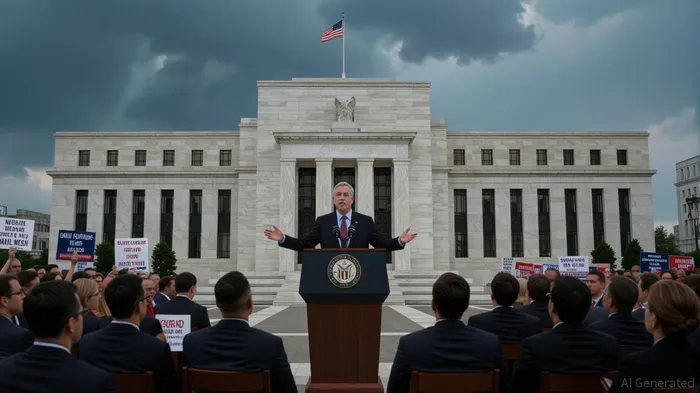
The political landscape in 2025 has been marked by a seismic shift in the relationship between the U.S. executive branch and the Federal Reserve. President Donald Trump's aggressive attempts to remove Federal Reserve Governor Lisa Cook and his broader efforts to reshape the Fed's board have ignited a crisis of confidence in the central bank's independence. This erosion of institutional autonomy has sent ripples through global markets, with fixed income and currency markets pricing in a growing political-risk premium. Investors now face a critical question: How should they navigate the uncertainty of a Fed potentially compromised by political pressure?
The Political-Risk Premium in Fixed Income Markets
The Federal Reserve's independence has long been a cornerstone of U.S. economic stability. However, Trump's public ultimatums to Fed officials—most notably his August 2025 announcement to fire Lisa Cook over alleged mortgage fraud—have cast doubt on the Fed's ability to act as a nonpartisan arbiter of monetary policy. This has directly impacted fixed income markets, where bond spreads and inflation expectations have become key indicators of the political-risk premium.
The 10-year Treasury yield, a benchmark for global interest rates, fell to 4.25% in 2025 as investors priced in the likelihood of politically driven rate cuts. Meanwhile, the yield curve steepened, with shorter-term rates declining sharply. This divergence reflects market skepticism about the Fed's capacity to manage inflation effectively. The five-year breakeven inflation rate—a proxy for inflation expectations—climbed to 2.51%, signaling heightened concerns that political interference could undermine the Fed's inflation-fighting mandate.
Bond spreads have also widened, with BBB-rated corporate bonds trading at moderate premiums and leveraged loan spreads hitting a 13-year high. These widening spreads indicate that investors are demanding higher compensation for credit risk, a clear sign of risk aversion. The Treasury term premium, which measures the extra yield investors demand for holding long-term bonds, remains near its historical median, suggesting that markets are factoring in a moderate but persistent inflation risk over the medium to long term.
Currency Markets and the Erosion of the Dollar's Safe-Haven Status
The U.S. dollar, traditionally a global safe-haven asset, has shown signs of strain under the weight of political uncertainty. The Dollar Index, which measures the greenback's strength against major currencies, fell by 0.2% in the wake of Trump's August 2025 announcement. Safe-haven currencies like the Japanese yen and the euro surged, with the euro reaching $1.17. Gold, another traditional hedge against geopolitical and economic instability, rose 0.5% to a two-week high of $3,382 per ounce.
These movements reflect a shift in investor sentiment. The dollar's weakening is not merely a reaction to economic fundamentals but a response to the perceived erosion of the Fed's credibility. If the Fed becomes a tool of political agendas, its ability to anchor inflation expectations and stabilize markets will diminish, further eroding the dollar's status as a reserve currency.
Investment Implications and Strategic Adjustments
For investors, the implications are clear: the political-risk premium is no longer a peripheral concern but a central factor in asset allocation. Here are three key strategies to consider:
Hedge Against Inflation and Currency Devaluation:
Treasury Inflation-Protected Securities (TIPS) and commodities like gold have gained traction as hedges against inflation and currency uncertainty. Short-term bonds, which are less sensitive to interest rate volatility, also offer a safer alternative to long-duration fixed income.Diversify Into Economies with Strong Central Bank Independence:
Markets in countries like India and Brazil, where central banks maintain robust independence, could provide a counterbalance to U.S. policy risks. These economies offer growth potential while mitigating exposure to a politicized Fed.Monitor Legal and Policy Developments:
The outcome of Lisa Cook's legal challenge and future appointments to the Federal Reserve Board will shape the Fed's trajectory. Investors should closely track these developments, as they could set precedents for the central bank's governance and policy independence.
Conclusion: A Precarious Balance
The political-risk premium in fixed income and currency markets is a direct consequence of Trump's unprecedented interventions in the Federal Reserve. While the immediate market reactions have been muted, the long-term risks—ranging from inflationary pressures to a loss of investor confidence—are profound. Investors must remain vigilant, adapting their portfolios to navigate a landscape where policy uncertainty is no longer an abstract concept but a tangible threat.
As the legal and political battles over the Fed's independence unfold, one thing is certain: the era of the Fed as an apolitical institution is under siege. For investors, the path forward lies in hedging, diversification, and a relentless focus on the evolving interplay between politics and monetary policy.

Stay ahead of the market.
Get curated U.S. market news, insights and key dates delivered to your inbox.


AInvest
PRO
AInvest
PRO



Comments
No comments yet