
Trump's Chip Tariff Carveout and Its Implications for Semiconductor Stocks
 Aime Summary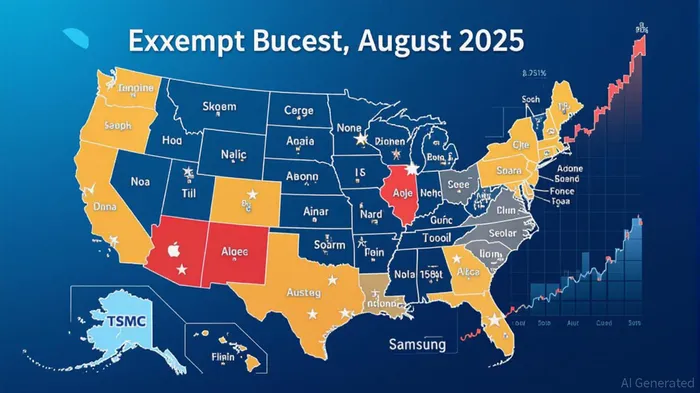
The U.S. semiconductor industry is undergoing a seismic shift as President Donald Trump's 100% tariff on imported chips takes effect on August 6, 2025. While the policy is framed as a national security measure, its strategic implications for global trade dynamics and semiconductor stocks are profound. The carveouts for companies that commit to U.S. manufacturing—such as AppleAAPL--, TSMCTSM--, Samsung, and SK Hynix—have created a bifurcated market, rewarding firms that align with the administration's “America First” agenda while penalizing those reliant on foreign supply chains. For investors, the challenge lies in discerning which companies are positioned to thrive in this new landscape and which may face headwinds.
Strategic Positioning: The Exemption Playbook
The Trump administration's tariff policy hinges on a simple but powerful premise: companies that build in the U.S. are exempt from the 100% tariff. This has incentivized a race to secure exemptions through substantial domestic investments. TSMC, for instance, has pledged $165 billion in U.S. manufacturing, including a $65 billion facility in Phoenix, Arizona. Similarly, Apple's $600 billion U.S. investment plan—encompassing partnerships with CorningGLW-- and Texas Instruments—has secured its exemption. These moves are not merely about tariffs; they reflect a broader strategy to anchor global supply chains to U.S. soil, reducing reliance on China and other offshore hubs.
The stock market has already priced in this shift. TSMC's shares surged nearly 5% in Taiwan following the announcement, while Apple's stock rose 3.3% in premarket trading. and illustrate the immediate investor confidence in these firms' ability to navigate the new rules.
Global Supply Chain Reconfiguration
The tariff carveout is reshaping global trade dynamics in two key ways. First, it is accelerating the onshoring of semiconductor production. TSMC's Arizona facility and Samsung's Texas operations are now critical nodes in the U.S. supply chain, reducing exposure to geopolitical risks in Asia. Second, it is creating friction with traditional manufacturing hubs like India and Vietnam. India, for example, faces a 50% tariff due to its trade imbalances and purchases of Russian oil, while Vietnam's 20% tariff threatens Apple's production of MacBooks and iPads. would highlight the shift toward domestic and allied production.
For investors, this reconfiguration presents both opportunities and risks. Firms with U.S. manufacturing footprints—like GlobalFoundriesGFS--, which saw a 10% premarket surge after announcing a deeper collaboration with Apple—are well-positioned to benefit. Conversely, companies dependent on Southeast Asian or Indian manufacturing may face margin pressures as tariffs bite.
Market Volatility and Long-Term Considerations
While the immediate market reaction has been positive, the long-term implications are less certain. The Trump administration's threat of additional tariffs on electronics and pharmaceuticals—potentially up to 250% on the latter—could further disrupt global trade. Moreover, the criteria for exemptions remain opaque. For example, QualcommQCOM--, which designs chips in the U.S. but relies on TSMC for manufacturing, may still face tariffs if the exemption is strictly tied to production location. This ambiguity could lead to volatility in semiconductor stocks, particularly for firms with hybrid supply chains.
Investors should also monitor the Section 232 investigation into semiconductor imports, which could result in further tariffs or quotas by December 2025. would provide context for how the industry's reliance on foreign imports has evolved.
Investment Advice: Focus on Resilience and Diversification
Given the current climate, investors should prioritize companies with:
1. Substantial U.S. manufacturing commitments (e.g., TSMC, Samsung, Apple).
2. Diversified supply chains to mitigate risks from country-specific tariffs.
3. Strong R&D pipelines in AI and advanced manufacturing, which align with U.S. strategic priorities.
Conversely, firms with heavy exposure to India, Vietnam, or China—such as Foxconn or smaller Southeast Asian foundries—may require closer scrutiny. The key is to balance short-term gains from tariff exemptions with long-term resilience against regulatory shifts.
In conclusion, Trump's chip tariff carveout is more than a policy move; it is a catalyst for a new era of strategic trade dynamics. For semiconductor stocks, the winners are those that have embraced the U.S. manufacturing imperative. Investors who align their portfolios with this shift may find themselves well-positioned for the next phase of the global semiconductor race.

Delivering real-time insights and analysis on emerging financial trends and market movements.
Latest Articles
Stay ahead of the market.
Get curated U.S. market news, insights and key dates delivered to your inbox.




Comments
No comments yet