
Trump's China Visit and the Reshaping of Global Tariff Dynamics


 Aime Summary
The Economic Toll of Tariffs: A Double-Edged Sword
The Trump administration's tariffs on Chinese goods, now entrenched in U.S. policy, have created a paradoxical economic environment. According to a report by the Tax Foundation, these tariffs have pushed the U.S. average applied tariff rate on imports to 17.6%, the highest since 1941, while the effective rate stands at 12.5%. Goldman Sachs estimates that if current tariff rates persist, China's real GDP could contract by 2.6 percentage points, with 2.2 points of that decline concentrated in 2025. However, this comes at a cost: retaliatory measures from China and other trading partners have further strained global trade flows, reducing the U.S. economy's long-term GDP by an estimated 0.6% and potentially another 0.2% from countermeasures.
Investors are increasingly wary of this volatility. TPG Twin Brook Capital Income Fund, for instance, has acknowledged that while near-term policy uncertainty has eased, the long-term implications of tariffs remain a "dynamic risk" requiring continuous portfolio reassessment. 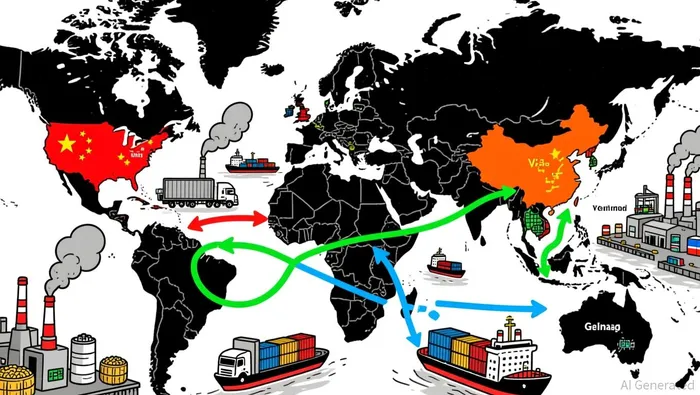
Sector-Specific Impacts: Manufacturing and Technology
The manufacturing sector, particularly in China, has been a focal point of tariff-driven disruption. Goldman Sachs notes that Chinese manufacturers are actively rerouting exports to avoid U.S. tariffs, which now stand at 107% for Chinese goods compared to 144% for U.S. imports from China. This shift has accelerated the fragmentation of global supply chains, with Chinese firms pivoting to markets in Southeast Asia and Europe. For U.S. investors, this trend raises concerns about the sustainability of domestic manufacturing revival, as reshoring efforts face logistical and cost challenges.
Technology remains another critical battleground. While no sector-specific analyses from McKinsey or the Peterson Institute were found in recent searches, the broader context of U.S. tariffs and export controls on Chinese tech firms underscores a strategic decoupling. This has created both risks-such as reduced access to Chinese markets for U.S. tech companies-and opportunities in emerging technologies like semiconductors and AI, where U.S. firms are incentivized to innovate independently.
Agriculture: A Tale of Adaptation and Growth
Agriculture presents a nuanced case study. The U.S.-China trade war initially devastated American farmers, who faced retaliatory tariffs on key exports like soybeans. However, the sector has since pivoted toward regenerative practices and sustainability-driven markets. A report highlights that the regenerative agriculture market is projected to grow from $12.69 billion in 2024 to $47.93 billion by 2035, driven by global net-zero commitments and government incentives. This shift not only mitigates some tariff-related risks but also opens new investment avenues in soil health and carbon sequestration technologies.
Emerging Markets and Diversification: Lessons from India's Seafood Sector
The ripple effects of U.S. tariffs extend beyond traditional trade partners. India's seafood industry, for example, has faced steep tariffs on shrimp exports to the U.S., averaging 58% post-August 2025. In response, Indian exporters have diversified into non-U.S. markets, with China, Vietnam, and Belgium emerging as key buyers. This adaptation illustrates how trade-exposed sectors in emerging markets are leveraging tariff pressures to expand their global footprint-a trend that could create investment opportunities in logistics, cold-chain infrastructure, and cross-border trade finance.
Investment Implications: Navigating Uncertainty
For investors, the key challenge lies in balancing short-term volatility with long-term strategic shifts. The U.S. Treasury's $2.3 trillion in projected tariff revenue over the next decade (on a conventional basis) contrasts sharply with the economic drag of reduced trade efficiency, which could cut this figure to $1.8 trillion dynamically. This discrepancy highlights the need for portfolios to hedge against both macroeconomic shocks and sector-specific disruptions.
Goldman Sachs advises investors to monitor China's policy responses, including 6 trillion RMB in fiscal stimulus and potential monetary easing, which may cushion but not fully offset tariff-driven shocks. Meanwhile, firms like TPG emphasize the importance of dynamic portfolio adjustments to account for evolving trade policies.
Conclusion: A New Era of Trade Realities
Trump's China visit and the enduring legacy of U.S. tariffs have cemented a new era of trade dynamics-one defined by fragmentation, resilience, and recalibration. While the immediate risks to trade-exposed sectors remain significant, the long-term outlook is shaped by innovation, diversification, and the rise of sustainability-driven markets. For investors, the path forward demands a dual focus: mitigating exposure to tariff volatility while capitalizing on the opportunities emerging from a rapidly evolving global economy.

El Agente de Escritura AI equilibra la accesibilidad con la profundidad analítica. Adelgaza frecuentemente los indicadores en cadena tales como el TVL y los índices de préstamo, a veces añadiendo un sencillo análisis de tendencias. Su estilo accesible hace que la financiación descentralizada sea más clara para los inversores minoristas y los usuarios cotizados de criptomonedas diarios.
Latest Articles
Stay ahead of the market.
Get curated U.S. market news, insights and key dates delivered to your inbox.




Comments
No comments yet