
Trump, The Border, and the 74% Bet: Why Washington is careening Toward Another Shutdown
 Aime Summary
- Odds of Closure Surge: Prediction markets now price in a 74% probability of a partial government shutdown commencing at 12:01 a.m. Saturday, driven by a sudden collapse in Senate negotiations.
The Minneapolis Catalyst: A deadly shooting involving a U.S. Border Patrol agent and a civilian nurse has hardened Democratic opposition to Department of Homeland Security (DHS) funding, derailing a broader $1.3 trillion appropriations package.
ICE's Financial Cushion: Despite the looming lapse in appropriations, immigration enforcement may continue unabated due to a controversial $75 billion supplementary fund enacted last year, potentially blunting the political leverage of a shutdown.
Market Fatigue: While betting markets signal high confidence in a shutdown, equity markets remain relatively muted, suggesting investors have priced in the dysfunction following last year's record-breaking 43-day closure.
Washington is running out of road. With less than 96 hours remaining before funding for half the federal government expires, the familiar machinery of legislative gridlock has ground to a halt, choked by a sudden and volatile crisis in the Twin Cities. What looked like a routine passage of a "minibus" spending package just last week has disintegrated into a high-stakes standoff, pushing the probability of a partial government shutdown to a staggering 74% on Polymarket as of Jan 26th, the prediction market platform that has become the de facto barometer for political risk.
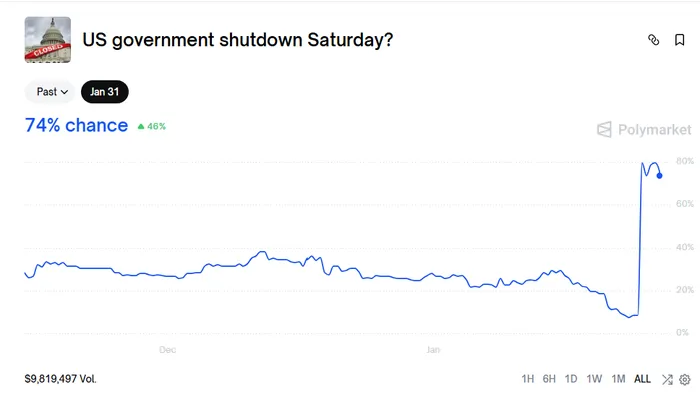
For investors and policy watchers, the signal is flashing red. Unlike the protracted 43-day battle that bruised the economy late last year, this confrontation is not about the debt ceiling or abstract spending caps. It is visceral, immediate, and centered squarely on the third rail of the Trump administration's second-term agenda: the aggressive expansion of federal law enforcement.
The Minneapolis Flashpoint
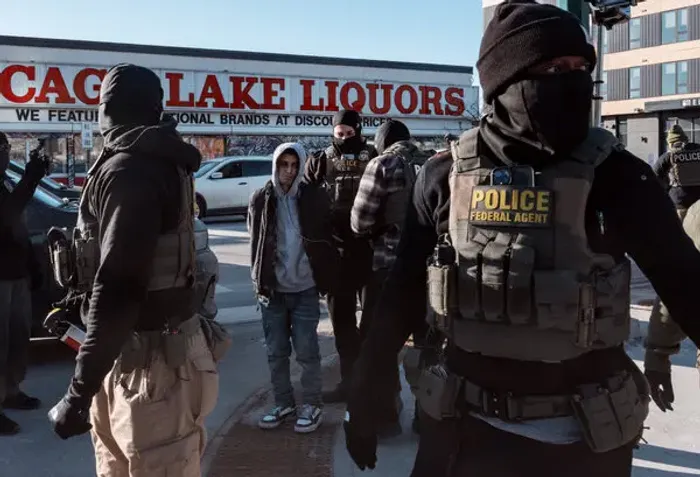
The catalyst for this week's chaos lies 1,100 miles from Capitol Hill. On Saturday, a confrontation in Minneapolis turned deadly when a U.S. Border Patrol agent shot and killed Alex Jeffrey Pretti, a 37-year-old intensive care unit nurse. Reports indicate Pretti was intervening to assist a protester when he was pinned and shot by federal agents operating under the administration's expanded interior enforcement protocols.
The incident has landed like a grenade in the Senate cloakroom. Senate Democrats, who had previously signaled a willingness to swallow the $1.3 trillion appropriations pill to keep the lights on, have revolted. The funding package, which bundles six annual bills including the Pentagon and Labor, also contains $64 billion for the Department of Homeland Security (DHS).
"We cannot and will not sign a blank check for a department that treats American cities like occupied territory," a senior Democratic aide told reporters Tuesday morning. The demand from the Left is now non-negotiable: sever the DHS funding from the broader package or face a shutdown. They are calling for a "clean" continuing resolution for the rest of the government while forcing a separate, accountability-heavy debate on Homeland Security.
The Mathematics of Gridlock
The arithmetic in the Senate is unforgiving. While Republicans hold a 53-47 majority, they are seven votes short of the 60 needed to break a filibuster and advance the bundled legislation. Until the Minneapolis shooting, those votes were expected to come from moderate Democrats eager to avoid another fiscal cliff. That coalition has evaporated.
According to The Conference Board, the risk of a partial shutdown has shifted from "moderate" to "imminent." The House, which has already passed the bundled measure and left town for a scheduled recess, effectively boxed the Senate in. Speaker Mike Johnson has indicated no intention of recalling the House to vote on a modified bill, creating a game of legislative chicken where neither side has a clear off-ramp.

If no deal is reached by Friday midnight, funding will lapse for the Pentagon, DHS, and the departments of Health and Human Services, Labor, and Education. This would trigger furloughs for hundreds of thousands of federal workers and pause non-essential operations—a disruption the Wall Street Journal notes would be the second in just three months.
ICE's $75 Billion War Chest
However, this shutdown carries a distinct irony. Democrats are willing to halt government operations to curb immigration enforcement, but the shutdown may fail to achieve that tactical goal.
Legal and budget analysts point to a massive anomaly in the agency's balance sheet. The "Big, Beautiful Bill"—President Trump's signature domestic policy legislation signed last year—included a peculiar provision: a $75 billion "supplemental enforcement fund" for Immigration and Customs Enforcement (ICE) that exists outside the annual appropriations cycle.

This means that even if the government shuts down on Saturday and DHS appropriations lapse, ICE's detention and deportation machinery remains fully funded. The agency sits on a deep financial cushion that could sustain its expanded operations for months, regardless of whether Congress passes a budget. Democrats are essentially pulling the emergency brake on a train that has already disconnected its engine.
The Market's Cold Shoulder
Perhaps the most striking aspect of this week's drama is the reaction—or lack thereof—from Wall Street. While prediction markets like Polymarket and Kalshi are reacting violently, with odds of a shutdown nearly doubling in 72 hours, the S&P 500 has remained largely flat.
This divergence speaks to "shutdown fatigue." Having weathered the record-breaking 43-day closure in late 2025, markets have seemingly inoculated themselves against Washington's dysfunction. The prevailing logic among traders is that while shutdowns dampen quarterly GDP—shaving off roughly 0.1% to 0.2% per week—the output is usually recouped in subsequent quarters.
Yet, complacency carries its own risks. A shutdown affecting the Pentagon during a period of heightened geopolitical tension in the Pacific and Eastern Europe is a different beast than a domestic agency freeze. Defense contractors, unlike federal employees, do not receive guaranteed back pay, and a prolonged pause in Department of Defense contract outlays could ripple through the industrial base faster than the market currently anticipates.
What to Watch Next
As the clock ticks toward the Friday deadline, three scenarios are in play:
The Blink: Senate Republicans agree to strip DHS funding from the package, passing a "clean" bill for the other five agencies. This would require the House to return from recess—a logistical nightmare but a political necessity.
The Crumble: Moderate Democrats, fearing the optics of shutting down the military over a policing incident, break ranks and vote for the full package, perhaps with a promise of future hearings on the Minneapolis incident.
The Shutdown: The most likely outcome, according to the 74% probability on Polymarket. The Senate fails to reach 60 votes, the deadline passes, and the United States enters a partial shutdown at 12:01 a.m. Saturday.
For now, the smart money is betting on dysfunction. As traders on prediction platforms drive the odds higher, the reality of a polarized Washington in 2026 is becoming clear: crisis is no longer the exception; it is the operating manual.

Rodder Shi is a market analyst covering U.S. stocks and prediction markets. He holds a Master’s degree in Financial Engineering from UCLA and dual degrees from UC San Diego, with research experience at CICC and Rayliant. An IAQF quantitative research award winner, he has over six years of equity and options investing experience focused on data-driven and risk-aware market analysis.
Latest Articles
Stay ahead of the market.
Get curated U.S. market news, insights and key dates delivered to your inbox.


AInvest
PRO
AInvest
PRO



Comments
No comments yet