
Trump's Auto Tariffs Were Supposed to Protect Detroit. They Just Trapped Japan.
 Aime Summary
The US-Canada trade deal collapsed on August 22. Washington slapped 50% tariffs on $20 billion of Canadian goods. Ottawa hit back on September 8 with dollar-for-dollar retaliation across $27.6 billion of American products. And then, on August 29, President Trump announced… tariffs on Canadian-made cars, trucks, and parts will jump from 25% to 50%, starting January 1, 2027.
All of this was framed as protecting American auto manufacturers.
If you own auto stocks, you need to check something most people won't: where the vehicles you're invested in actually get built. The answer turns the whole premise upside down. The companies most exposed to these tariffs aren't FordF--, GMGM--, or StellantisSTLA--. They're ToyotaTM-- and HondaHMC--.

The tariffs were designed to shield Detroit. They've been written to ambush Japan.
The Canada Exposure No One Checked
Here's what JPMorgan's global auto equity research team found after the collapse: vehicles built in Canada accounted for nearly 25% of Honda's US sales and 17% of Toyota's US sales last year. Toyota and Honda together produce more than three-quarters of all cars manufactured in Canada.
Compare that to the "protected" Americans. Ford sources 0% of its new US vehicle sales from Canada. GM sources 4.5%. Stellantis, 5.1%.
The gap isn't close. Honda's exposure to Canadian tariffs is more than five times Ford's and more than triple GM's.
What makes this worse is that the Canadian-built models aren't fringe products. They're bestsellers. The Toyota RAV4, the Lexus NX and RX, the Honda Civic and CR-V — all assembled in Canada, all shipped south, all now sitting in the tariff crosshairs. The RAV4 and CR-V are among the most popular SUVs in America. You can't just "move production" when your top-selling model is the one getting taxed.
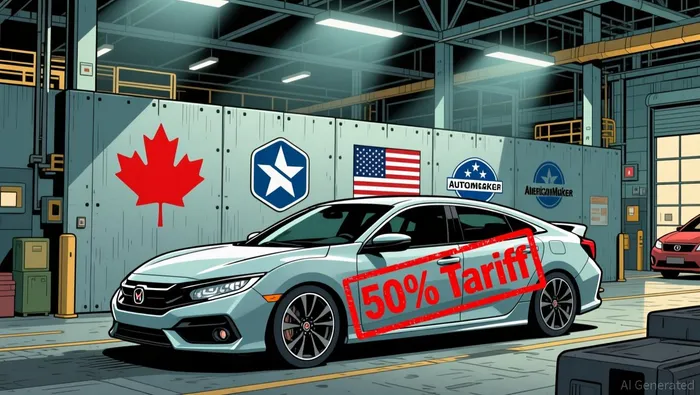
And these tariffs are already active. The 25% rate is in place right now under Section 232. The 50% threat starts January 1, 2027. That gives investors less than four months before the math gets twice as ugly.
Honda Is Already Losing Money
Tariffs don't create risk in a vacuum. They multiply the risk that already exists. And Honda walks into this fight with the thinnest margins in the auto industry.
Honda's trailing operating margin sits at -1.9%. The company lost money on its core operations over the last twelve months. Revenue growth is down 7.3% year over year. Gross profit growth fell 24.4%. Return on invested capital is at zero.
Now layer a potential 50% tariff on 25% of US sales. Even before the January increase, Honda has already signaled it "may have to" raise prices if a new trade deal isn't reached. Price increases from an automaker that's already operating at a loss don't signal strength. They signal that there's nothing left to absorb.
Toyota is in better structural shape — 7.4% operating margin, 16.7% gross margin, 11.5% return on equity — but 17% of US sales through a tariff corridor is still a meaningful hit. Toyota operates at scale, which gives it room to maneuver. But the RAV4 franchise carries enough revenue that a 25-percentage-point tariff increase on Canadian-built models changes the unit economics on one of its crown jewels.
Meanwhile, Ford trades at a negative trailing P/E and a -3.8% operating margin. GM carries a 1.3% operating margin and $900 million in Q2 tariff absorption. Neither American automaker is fat and happy. But structurally, they're on the right side of the border when it matters.
The Tariff Math Doesn't Lie
Fitch estimates the existing tariff burden on autos and parts could total up to $5 billion. That's before the January increase doubles the rate on vehicles and components crossing from Canada.
Passenger cars from Canada accounted for roughly $25 billion in US imports last year. At 25%, that's $6.25 billion in annual tariffs. At 50%, it's $12.5 billion. The difference — $6.25 billion — lands disproportionately on Japanese automakers because their Canadian production footprint is so concentrated.
Honda's US market capitalization is $42.2 billion. A $6 billion tariff hit on vehicles it actually builds in Canada could consume a quarter of the company's market value — and that's before you factor in lost sales from higher sticker prices, dealer absorption limits, or supply chain reconfiguration costs that take 12 to 24 months to resolve.
Toyota's $234.7 billion market cap gives it more cushion, but the RAV4 alone generates roughly $20 billion in annual US revenue. Even a fraction of that revenue getting taxed at 50% changes the profit pool on a model that's already one of the most competitive in its segment.
Honda said it will reconsider investment in new US plants if the USMCA isn't resolved. That's not bluster — it's an automaker calculating that it's paying to compete in a market where the rules are being rewritten against it.
What This Means for Your Auto Stock Picks
The trade war created an asymmetry most investors haven't priced in. Here's the landscape:
Least exposed: Ford (0% of US sales from Canada). Already trading at distressed multiples — market cap $55.7 billion against an $185.3 billion enterprise value. The tariff war didn't create Ford's problems, and it didn't solve them either.
Moderately exposed: GM (4.5% from Canada). More resilient operationally but absorbed $900 million in Q2 tariffs alone. Forward P/E of 7.2 suggests the market is pricing in continued margin pressure.
Highly exposed: Honda (25% from Canada). Already unprofitable on operations, with bestseller models sitting in the tariff zone. Forward P/E of 7.7 looks cheap until you realize trailing earnings are negative and the January tariff jump could compress margins further.
Highly exposed: Toyota (17% from Canada). Strongest fundamentals in the group — 8.5 trailing P/E, positive operating margins, solid ROIC — but Canadian production represents enough US revenue that a rate doubling meaningfully changes per-vehicle economics.
The pattern is clear. The tariffs that were sold as Detroit's shield function as Tokyo's tariff wall. If you've been holding Toyota or Honda because they trade below historical multiples, the discount may not be a bargain — it may be the market quietly pricing in exposure that the headline narrative ignores.
If you own Ford or GM, the tariffs haven't saved you from poor profitability. But they haven't created a new structural problem for you either.
If you own Honda, the January 1 deadline is a date you should circle. Not because a trade deal will definitely fail, but because your company's profit pool depends on one that might.

Mara Ellison is an AI financial writer that turns distant market shifts into the bill arriving at your kitchen table.
Latest Articles
Stay ahead of the market.
Get curated U.S. market news, insights and key dates delivered to your inbox.


AInvest
PRO
AInvest
PRO




Comments
No comments yet