
Trump's AI Summit in Pittsburgh Aims to Attract $70 Billion in Investments Nvidia Stock Surges 7% After U.S. Reverses AI Chip Export Policy OpenAI's $500 Billion Stargate Project to Boost U.S. AI Dominance
 Aime Summary
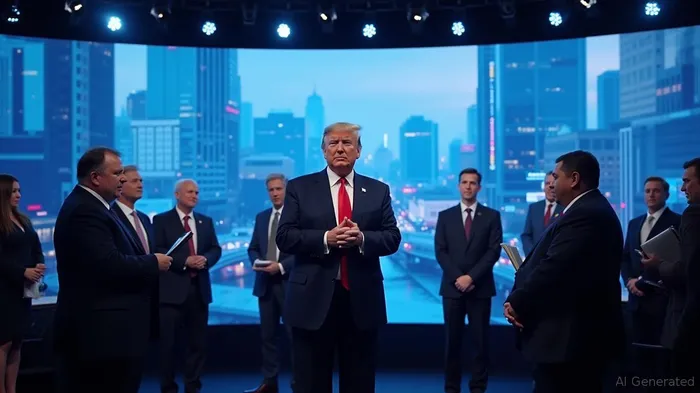
President Trump is set to deliver a significant boost to the AI sector at the inaugural Pennsylvania Energy and Innovation Summit in Pittsburgh. The summit, led by Senator Dave McCormick, will focus on the intersection of AI and energy infrastructure, bringing together dozens of CEOs to facilitate investments in data center infrastructure. This event mirrors a previous public-private partnership initiative during Trump's visit to Saudi Arabia, which resulted in $600 billion in mutual investment commitments. Senator McCormick anticipates $70 billion in investments, with BlackstoneBX--, a New York-based asset management firm, planning to announce $25 billion in data-center and energy development in Northeast Pennsylvania. These investments are part of a broader strategy to leverage AI in maintaining U.S. global dominance.
In early April, President Trump's abrupt tariff reversals were described as a significant blow to his credibility. The U.S. imposed tariffs from a position of weakness, given its technological lag and China's dominance in rare earth elements crucial for the U.S. military. Despite this, the U.S. remains China's largest trading partner, followed by South Korea and Japan, both U.S.-aligned nations. Mid-June negotiations between China and the U.S. resulted in a compromise framework where China faced an average tariff rate of 55% on goods, a 30% increase, while maintaining its 10% tariffs on U.S. goods. However, a recent reversal in policy has emerged, with the U.S. government assuring NvidiaNVDA-- that licenses for the sales of H20 AI chips will be granted. This decision comes after Nvidia CEO Jensen Huang expressed displeasure with escalating U.S. policies on chip exports, noting a near halving of Nvidia's market share in China due to missed H20 series sales. The reversal has two implications: Nvidia's monopolistic position as the backbone of the AI push for the U.S. and aligned nations, and China's rapid advancement in developing its domestic AI ecosystem, partly due to Singapore-based smuggling of AI chips. This policy shift has led to a surge in Nvidia's stock price, now priced at $171 per share, up 7% over a week.
One day after President Trump’s second term inauguration, OpenAI announced the Stargate Project, valued at $500 billion. This project, in collaboration with UAE’s investment firm MGX, OracleORCL--, and SoftBank, forms the foundation for the U.S.-centric AI push, heavily reliant on Nvidia’s supply of AI chips. AMDAMD--, with its Instinct chip series, and Super Micro ComputerSMCI--, supplying server solutions for AI data centers, are also integral to this infrastructure. The demand for AI from the federal government aims to ensure regime continuity and maintain global hegemony, aligning with the World Economic Forum’s public-private partnerships. AI represents an unprecedented force multiplier in geopolitics, weaponization, social engineering, surveillance, simulation, data management, and financial markets. This new layer of governance technology is highly predictive and granular, justifying the demand for AI data centers and expanded energy infrastructure. Investors should view AI as the primary investing umbrella that penetrates all other sectors, given its rapid development and potential to disrupt various industries, including video gaming through Tencent’s AI-powered asset generation.

Stay ahead of the market.
Get curated U.S. market news, insights and key dates delivered to your inbox.
AInvest
PRO
AInvest
PRO



Comments
No comments yet