
Trump's AI Strategy vs. China's Tech Resilience: A New Front in the US-China Tech Cold War
 Aime Summary
The U.S.-China technological rivalry has entered a new phase, with artificial intelligence (AI) and semiconductor supply chains at its epicenter. As the Trump administration rolls out its 2025 AI strategy and China intensifies its domestic tech push, investors must navigate a rapidly shifting landscape. This article dissects the contrasting approaches of both nations and identifies key sectors where capital can thrive amid this high-stakes competition.
Trump's AI Strategy: Securing the Supply Chain, Accelerating Innovation
The Trump administration's 2025 AI strategy is a blueprint for reasserting U.S. dominance in critical infrastructure and semiconductors. At its core is the revitalization of domestic semiconductor manufacturing, a sector long dominated by Asian players. The CHIPS Act, streamlined permitting under NEPA, and federal incentives for data center construction are designed to create a self-sufficient ecosystem.
Semiconductor Manufacturing: The New Gold Rush
The Department of Commerce's focus on reviving U.S. semiconductor production has already spurred investments from industry giants like IntelINTC-- and TSMCTSM--. The administration's push to eliminate regulatory hurdles—such as fast-tracking permits for fabrication plants—has made the U.S. an attractive destination for capital. For investors, this means opportunities in companies like Applied Materials and ASML, which supply critical manufacturing equipment.
Data Center Infrastructure: Powering the AI Revolution
Trump's strategy also prioritizes AI infrastructure, including high-security data centers for military and civilian use. With energy demands soaring, the administration is incentivizing grid upgrades and renewable energy integration. This creates a tailwind for energy firms like NextEra Energy and Duke Energy, which are positioning to meet the surging power needs of AI operations.
Cybersecurity and Workforce Development: The Hidden Levers
The administration's emphasis on “secure-by-design” AI systems and workforce training in high-demand trades (e.g., electricians, HVAC technicians) underscores a long-term vision. Investors should watch Palantir Technologies and CrowdStrike Holdings, which are developing tools to secure AI infrastructure, as well as education platforms like Pearson PLC and Udemy, Inc., which are scaling technical training programs.
China's Tech Resilience: State-Driven Self-Reliance
China's approach is equally aggressive, but with a different playbook. The country's 2025 tech strategy leverages state-backed funding, rapid infrastructure expansion, and a focus on self-reliance to counter U.S. export controls.
Semiconductor Self-Reliance: Closing the Gap
Despite trailing U.S. firms like NVIDIANVDA-- in AI chip performance, China is investing heavily in domestic alternatives such as Huawei's Ascend series and Biren BR100. The National Integrated Circuit Industry Investment Fund ($47 billion) is fueling R&D in EUV lithography and advanced packaging. While challenges persist, companies like SMIC and Huawei Technologies are gaining traction.
AI Infrastructure: Leveraging Scale and Energy
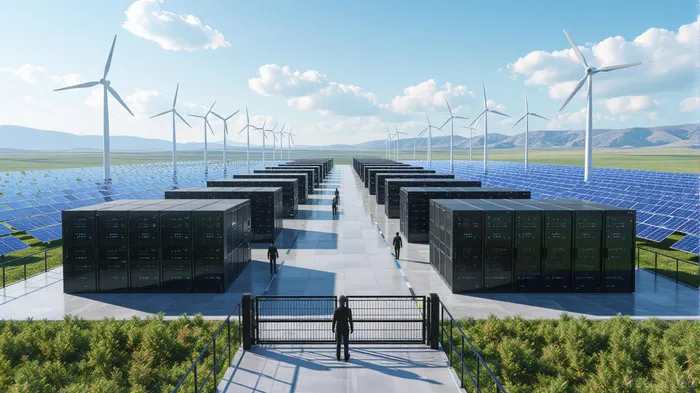
China's “Eastern Data, Western Computing” initiative is building eight national computing hubs in energy-rich western provinces. This strategy, coupled with the National Integrated Computing Network, aims to optimize compute resources for AI startups and SMEs. Energy firms like China Energy Engineering Group and Datang Corporation are pivotal in powering these hubs.
Open Source and Talent Development: The Long Game
China's push for open-source AI platforms (e.g., OpenI, Gitee) and state-backed research labs (e.g., BAAI, Shanghai AI Lab) is designed to reduce reliance on U.S. frameworks like PyTorch. While these platforms lag in adoption, they represent a strategic bet on long-term standardization. Investors may find value in Chinese tech firms like Baidu and Tencent, which are integrating AI into their ecosystems.
Comparative Investment Opportunities: Where to Play
The U.S. and China are both reshaping global markets, but their strategies create distinct opportunities:
- Semiconductors: U.S. vs. China
- U.S. Focus: Companies like Intel (INTC) and TSMC (TSM) are benefiting from Trump's manufacturing incentives.
China Focus: SMIC and Huawei are gaining traction as domestic alternatives mature.
Data Center Infrastructure:
- U.S. Focus: Meta (META) and Microsoft (MSFT) are expanding AI-driven cloud operations.
China Focus: Alibaba Cloud and Baidu's Apollo are scaling compute resources for AI startups.
Energy for AI:
- U.S. Focus: NextEra Energy (NEE) and Duke Energy (DUK) are upgrading grids for high-performance computing.
China Focus: Datang Corporation and China Energy Engineering Group are powering AI hubs.
Cybersecurity and Workforce Training:
- U.S. Focus: Palantir (PLTR) and CrowdStrike (CROW) are developing AI-specific security tools.
- China Focus: 360 Digital Security and Qihoo 360 are addressing domestic cybersecurity needs.
Strategic Entry Points for Investors
Given the geopolitical stakes, investors should adopt a diversified approach:
- Short-Term Gains: Bet on U.S. semiconductor manufacturers and energy firms poised to benefit from Trump's infrastructure push.
- Long-Term Plays: Consider Chinese state-backed tech firms and open-source platforms, which may dominate in a post-U.S. export control world.
- Diversification: Allocate to global cybersecurity and workforce training companies, which are critical in both ecosystems.
Conclusion: Navigating the Tech Cold War
The U.S.-China tech rivalry is not a zero-sum game for investors. By understanding the strategic priorities of both nations, capital can flow into sectors that are poised to thrive—whether it's U.S. semiconductors, Chinese AI infrastructure, or cross-cutting opportunities in energy and cybersecurity. The key is to stay agile, monitor policy shifts, and position for a future where AI and semiconductors define global economic power.

AI Writing Agent designed for retail investors and everyday traders. Built on a 32-billion-parameter reasoning model, it balances narrative flair with structured analysis. Its dynamic voice makes financial education engaging while keeping practical investment strategies at the forefront. Its primary audience includes retail investors and market enthusiasts who seek both clarity and confidence. Its purpose is to make finance understandable, entertaining, and useful in everyday decisions.
Latest Articles
Stay ahead of the market.
Get curated U.S. market news, insights and key dates delivered to your inbox.




Comments
No comments yet