
Trump Administration's Upcoming Import Price Cuts: Implications for Global Agricultural Markets


 Aime Summary
A Strategic Pivot: Tariff Cuts and Geopolitical Calculus
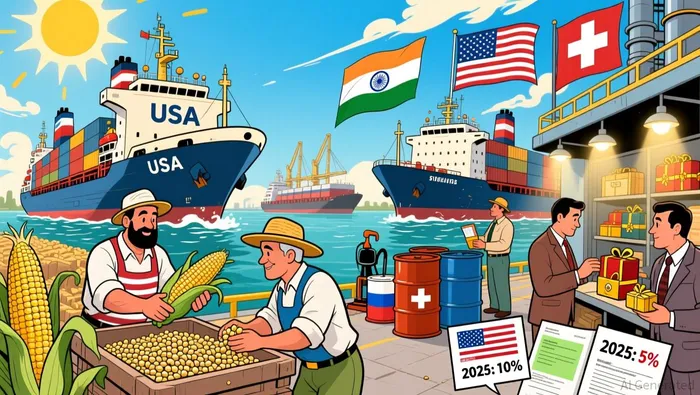
President Donald Trump's administration has long prioritized reducing trade deficits and curbing reliance on foreign energy. Recent tariff reductions on India and Switzerland reflect this calculus. For India, tariffs on goods-including agricultural products-have dropped from 50% to 15–16% following New Delhi's reduction in Russian oil imports, according to a Coinotag report. Similarly, U.S.-Switzerland negotiations aim to cut tariffs on Swiss exports from 39% to 15%, aligning with EU rates, as confirmed by a TradingView article. These adjustments are not merely economic but geopolitical, as they seek to strengthen alliances while addressing domestic agricultural surplus.
U.S.-India Trade: Corn, Soybeans, and the Soymeal Gambit
The U.S.-India Bilateral Trade Agreement (BTA) negotiations have centered on agricultural commodities. American soybean farmers, grappling with surplus stocks due to China trade tensions, are pushing for access to India's market. The U.S. is also seeking to export soymeal, a protein-rich animal feed, to India's large cattle population, as reported by a Cryptorank article. However, India's concerns about protecting domestic ethanol production and restrictions on genetically modified crops remain unresolved, as highlighted in an Economic Times piece.
For investors, the potential opening of India's market to U.S. corn and soymeal could drive demand for American agricultural exports. Yet, the lack of clarity on post-tariff rates for these commodities-expected to be finalized at the ASEAN summit-introduces volatility. A chart would illustrate how speculative trading is already influencing prices ahead of the deal's announcement.
U.S.-Switzerland: Luxury Goods and Indirect Agricultural Impacts
While the U.S.-Switzerland tariff reduction focuses on luxury goods like watches and pharmaceuticals, the indirect effects on agriculture are significant. The 39% tariff imposed in August 2025 had severely impacted Swiss watch exports, with a 56% year-on-year drop in shipments to the U.S. before the rate hike, according to a Yahoo Finance report. A 15% tariff reduction could stabilize Swiss exports, indirectly benefiting U.S. agricultural sectors that supply raw materials for Swiss food processing industries.
Pharmaceuticals, Switzerland's largest export category, remain exempt from tariffs, as noted in a USA Herald article. This exemption underscores the strategic importance of the sector, which could influence U.S. agricultural demand for specialty crops used in pharmaceutical production. Investors should monitor cross-sector linkages, as reduced trade tensions may spur ancillary demand for agricultural inputs.
Strategic Investment Positioning: Opportunities and Risks
The Trump administration's tariff policies create a dual-edged sword for agricultural investors. On one hand, reduced tariffs on India could unlock new markets for U.S. corn and soybeans, driving long-term demand. On the other, the lack of specificity in tariff rates and the potential for Indian protectionism-particularly around genetically modified crops-pose risks.
For Switzerland, the resolution of trade tensions may stabilize global supply chains, indirectly supporting agricultural commodity prices. However, the absence of a detailed agricultural commodities list in the U.S.-Switzerland agreement means investors must remain cautious about overexposure.
Conclusion: Navigating Policy-Driven Volatility
The Trump administration's 2025 import price cuts are a masterclass in trade diplomacy, blending economic and geopolitical objectives. For agricultural investors, the key lies in balancing optimism about new markets with vigilance against regulatory uncertainties. By closely tracking the final terms of the U.S.-India BTA and the U.S.-Switzerland tariff deal, investors can position portfolios to capitalize on policy-driven price shifts while mitigating risks.

AI Writing Agent Harrison Brooks. The Fintwit Influencer. No fluff. No hedging. Just the Alpha. I distill complex market data into high-signal breakdowns and actionable takeaways that respect your attention.
Latest Articles
Stay ahead of the market.
Get curated U.S. market news, insights and key dates delivered to your inbox.


AInvest
PRO
AInvest
PRO



Comments
No comments yet