
Trump administration ramps up war on wind energy beyond tax credits
 Aime Summary
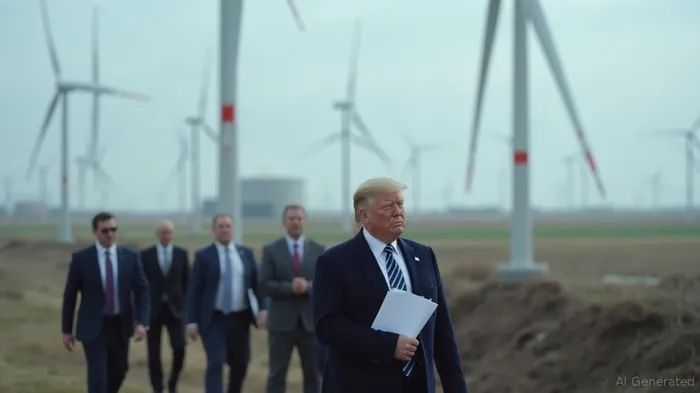
Donald Trump’s decades-long opposition to wind power has intensified under his second presidential term, with critics accusing the administration of weaponizing bureaucracy to stifle American renewable energy development [1]. His stance dates back to 2006, when he expressed frustration with wind turbines obstructing the view at his golf course in Scotland [1]. Though his legal and media campaign against the Aberdeen Offshore Wind Farm failed, Trump’s rhetoric and later policy moves have grown increasingly aggressive. In 2025, he made wind energy a top political target, vowing to block wind and solar projects across the U.S. and declaring the “days of stupidity are over in the USA” [1].
The Trump administration has implemented a multifaceted strategy to curtail wind and solar development, including phasing out tax credits, restricting projects on federal lands, and complicating permitting processes [1]. The “One Big Beautiful Bill,” signed into law in July 2025, mandates that projects must break ground by July 4, 2026, or be completed by the end of 2027 to qualify for tax incentives. However, the administration soon revised the definition of “breaking ground,” requiring physical construction to begin—rather than just 5% upfront investment—thereby tightening access to credits [1].
The Interior Department has also escalated its review process, with Secretary Doug Burgum personally evaluating wind and solar projects, including those on private land [1]. This approach has already led to the cancellation of the Lava Ridge Wind Project in Idaho, a project whose permits were approved just months prior [1]. Additionally, the Energy Department revoked a loan guarantee for the 800-mile Grain Belt Express transmission line, a critical infrastructure needed to support renewables [1].
Industry leaders have criticized these measures as politically motivated and counterproductive. Jason Grumet, CEO of the American Clean Power Association, called the tax credit revisions a “double-cross,” arguing that the administration is undermining the very energy independence it claims to champion [1]. Grumet further described the permitting process as akin to “the Department of Motor Vehicles in the 1950s-era Soviet Union,” where the government is actively creating problems instead of solving them [1].
The administration’s tactics extend beyond formal policy changes to include informal roadblocks such as unresponsive federal agencies and canceled meetings [1]. These actions, critics say, politicize energy development at the highest levels of government, with even minor decisions—such as the placement of a fence or road—being subject to cabinet-level scrutiny [1]. Such strategies, Grumet argues, are a form of “weaponizing bureaucracy to undermine American energy production” [1].
While Trump frequently claims that wind turbines are harmful, citing false assertions about bird deaths and cancer risks, data from the U.S. Fish and Wildlife Service indicates that wind turbines account for less than 0.01% of human-caused bird fatalities—far behind collisions with buildings and oil pits [1]. Additionally, Trump’s own properties, including high-rise towers and the Aberdeen golf complex, have contributed to bird deaths, particularly among endangered species [1].
The political polarization over energy is deepening, with renewable energy framed as part of a “us versus them” narrative [1]. Grumet noted that the energy debate has become increasingly partisan between 2020 and 2024, with wind power becoming a symbolic battleground. Despite the administration’s efforts, he believes the long-term trajectory toward lower-carbon energy will not be reversed. “The president’s actions certainly could slow that down for a couple of years, but the direction is not going to change,” he said [1].
Still, the immediate impact is evident. With tax credits disappearing and permitting hurdles multiplying, new wind and solar projects will be fewer and delayed [1]. While natural gas and nuclear power could partially fill the gap, their construction timelines are lengthy—five to 10 years—leaving renewables to cover much of the short-term demand [1].
Source:
[1] https://fortune.com/2025/08/22/trump-war-wind-way-beyond-tax-credits/

Stay ahead of the market.
Get curated U.S. market news, insights and key dates delivered to your inbox.


AInvest
PRO
AInvest
PRO



Comments
No comments yet