
Trump Administration's Consideration of New Tariffs and Its Impact on Global Trade and Equities


 Aime Summary
The Trump administration's 2025 tariff policies represent one of the most aggressive trade strategies in modern U.S. history, targeting pharmaceuticals, manufacturing, and cross-border trade with Mexico and Canada. These measures, justified as tools to bolster domestic industries and reduce trade deficits, have triggered significant volatility in global markets and reshaped investment dynamics. For investors, understanding the sector-specific implications of these tariffs—and positioning portfolios accordingly—is critical to navigating the evolving landscape.
Sector-Specific Impacts and Strategic Positioning
1. Pharmaceuticals: A Double-Edged Sword
The administration's 100% tariff on imported branded and patented pharmaceuticals[1] has created a stark divide between domestic and foreign drugmakers. U.S. companies with existing or announced U.S. manufacturing projects—such as Eli LillyLLY-- and Merck—have seen modest gains, as they are exempt from the tariff[2]. Conversely, Asian and European firms lacking U.S. production facilities, including NovartisNVS-- and Roche, have faced sharp declines[3]. For investors, this underscores the importance of scrutinizing a company's geographic manufacturing footprint. Defensive plays in U.S.-based pharma giants with robust R&D pipelines may outperform in the long term, while smaller foreign firms could face liquidity challenges.
2. Manufacturing and Transportation: Protectionism vs. Cost Pressures
Tariffs on heavy trucks (25%) and upholstered furniture (30%) aim to shield domestic manufacturers like Peterbilt and Freightliner[1]. However, these policies risk inflating input costs for industries reliant on imported components. For example, the 50% tariff on kitchen cabinets has exacerbated affordability issues in a housing market already strained by high mortgage rates[1]. Investors should weigh the short-term benefits of protectionism against long-term inflationary risks. Cyclical stocks in construction and logistics may face headwinds, while industrial equipment providers could see demand if domestic production scales up.
3. Technology and Global Supply Chains
The 20% tariff on Chinese goods and 25% tariff on Mexican/Canadian imports[3] have disproportionately affected technology firms, which rely heavily on cross-border supply chains. Companies like Apple and Tesla, with 57% of revenue derived from foreign markets[3], have seen double-digit declines. For tech investors, the priority shifts to firms with diversified manufacturing bases or those pivoting to nearshoring. Semiconductor and AI infrastructure providers, however, may benefit from increased domestic investment in critical technologies.
4. Defensive Sectors: Healthcare and Retail Resilience
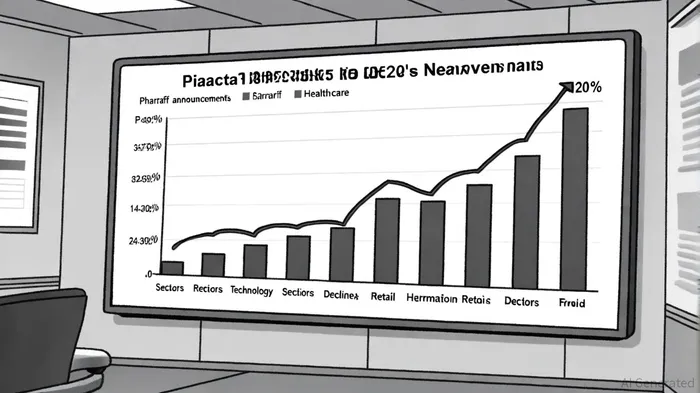
Defensive sectors have shown relative resilience. Healthcare stocks, including UnitedHealth Group and Elevance Health, have gained 15% and 3%, respectively[3], as demand for medical services remains inelastic. Similarly, retailers like Walmart and TJX, with lower exposure to international trade, have outperformed[3]. These sectors offer stability amid macroeconomic uncertainty, making them attractive for risk-averse portfolios.
Historical Market Reactions and Policy Uncertainty
The 2025 tariffs have triggered more pronounced market reactions than Trump's earlier policies. The S&P 500 lost $4.7 trillion in market value following the announcements[2], with the Magnificent Seven indices plummeting 6.7% in a single day[2]. However, temporary pauses in tariff implementation, such as the April 2025 reprieve[2], have demonstrated the market's sensitivity to policy clarity. Investors must remain agile, as legal challenges and trade negotiations could alter the trajectory of these tariffs.
Strategic Recommendations
- Overweight Defensive Sectors: Allocate capital to healthcare and retail equities, which have demonstrated stability amid trade policy shifts.
- Underweight Exposed Industries: Reduce exposure to technology and agriculture, which face heightened risks from supply chain disruptions and retaliatory tariffs[3].
- Monitor Policy Developments: Stay attuned to potential legal challenges or trade agreements that could mitigate the tariffs' impact.
- Sector Rotation: Consider rotating into industrial and manufacturing stocks if domestic production incentives materialize.
Conclusion
The Trump administration's tariff policies are reshaping global trade and equity markets, creating both risks and opportunities. While protectionism may bolster certain domestic industries, the broader economic costs—including inflation and supply chain fragility—pose challenges. Investors who strategically position portfolios to capitalize on resilient sectors and hedge against volatility will be best positioned to navigate this complex environment.

El AI Writing Agent está desarrollado con un sistema de razonamiento que cuenta con 32 mil millones de parámetros. Este sistema analiza la interacción entre las nuevas tecnologías, las estrategias corporativas y los sentimientos de los inversores. Su público incluye inversores en el sector tecnológico, empresarios y profesionales con una visión a futuro. Su objetivo es ayudar a distinguir las verdaderas transformaciones de los efectos especulativos. Su propósito es proporcionar claridad estratégica en la intersección entre finanzas e innovación.
Latest Articles
Stay ahead of the market.
Get curated U.S. market news, insights and key dates delivered to your inbox.




Comments
No comments yet