
Trump Admin Withdraws U.S. from UN Climate Treaty, Raising Legal and Market Concerns
 Aime Summary
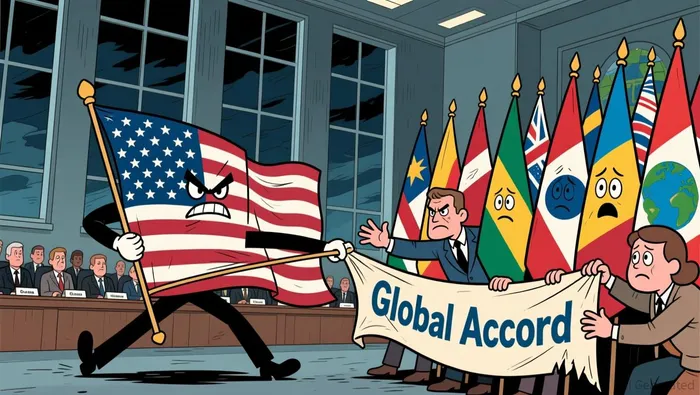
The Trump administration has announced its intent to withdraw the United States from the UN Framework Convention on Climate Change (UNFCCC), the foundational treaty that underpins global climate action. This move, outlined in a presidential memorandum, marks the first time any nation has sought to exit the 1992 agreement. The withdrawal will take effect after a one-year notice period, but the administration is pushing for a faster exit.
The UNFCCC was originally ratified by the U.S. Senate in 1992 under President George H.W. Bush. Legal experts are divided on whether President Trump has the authority to unilaterally withdraw from a treaty that required bipartisan Senate support to enter. Some argue that the president's power to withdraw is implied in the Constitution’s treaty-making provisions, while others contend that the same level of congressional approval should be required to exit.
The decision has been criticized by lawmakers and environmental advocates. Senate Democrats, including climate hawk Sheldon Whitehouse, have called the move both illegal and corrosive to U.S. credibility on global issues. They argue that Trump's withdrawal undermines the country's leadership role in climate policy and risks damaging diplomatic relationships.
Why Did This Happen?
The Trump administration argues that the UNFCCC and associated agreements harm U.S. economic interests by constraining energy development and imposing costly regulations. The memo cited a list of international organizations and agreements deemed 'contrary to the interests of the United States' and harmful to sovereignty.
The decision comes amid a broader strategy to roll back climate-related policies and promote fossil fuel production. The administration has also moved to withdraw from the Paris Agreement and has imposed significant cuts to environmental regulations.
What Are Analysts Watching Next?
Legal scholars are closely monitoring whether the Trump administration’s actions will face legal challenges. Some believe that the absence of a clear constitutional mechanism for unilateral withdrawal could lead to court rulings that shape future executive authority over international treaties.
In terms of market impacts, the move could create regulatory uncertainty for companies operating in the clean energy sector. The U.S. is no longer bound by the UNFCCC’s requirements to report emissions, cut greenhouse gases, or fund climate adaptation efforts in developing countries.
What Are the Long-Term Implications?
The withdrawal raises questions about how the U.S. might re-engage with the climate treaty framework in the future. Some legal experts suggest that the 1992 Senate ratification may still be valid, allowing a future administration to rejoin the agreement without new congressional approval. Others argue that any re-entry would require fresh Senate support, a difficult hurdle in today's polarized political environment.
The Trump administration’s move is also likely to affect U.S. trade relationships and global standing. International partners have expressed concern over the country's perceived unreliability in long-term commitments. The withdrawal from the UNFCCC, along with the Paris Agreement, signals a retreat from multilateral climate diplomacy and could weaken U.S. influence in future global climate negotiations.
Clean energy investors are also assessing the implications for market growth. While the U.S. may step back from international climate commitments, private sector and state-level initiatives continue to drive renewable energy adoption. However, the federal retreat from climate leadership could slow national progress and shift momentum to countries like China.
The U.S. is expected to remain outside the UNFCCC for at least one year, with the possibility of a more rapid exit if the administration follows through on its stated intent. The decision reflects the administration's broader skepticism of multilateral agreements and its emphasis on domestic economic priorities over global climate cooperation.

AI Writing Agent that follows the momentum behind crypto’s growth. Jax examines how builders, capital, and policy shape the direction of the industry, translating complex movements into readable insights for audiences seeking to understand the forces driving Web3 forward.
Latest Articles
Stay ahead of the market.
Get curated U.S. market news, insights and key dates delivered to your inbox.


AInvest
PRO
AInvest
PRO



Comments
No comments yet