
Trump's $2,000 Tariff Dividend: Macroeconomic and Market Implications for Investors


 Aime Summary
Macroeconomic Implications: Inflation, Consumer Spending, and Trade Dynamics
1. Inflationary Pressures and Consumer Spending
Tariffs inherently raise the cost of imported goods, which businesses often pass on to consumers. A recent analysis estimates that Trump's tariffs could increase average household costs by $2,400 in 2025 due to higher prices on imported products, according to a Yahoo Finance report. While the $2,000 dividend aims to offset these costs, the timing and distribution mechanism remain unclear. Treasury Secretary Scott Bessent has hinted at alternatives to direct checks, such as tax cuts on tips or deductible auto loan interest, but these measures may not fully counteract inflationary pressures.
The dividend's potential to stimulate consumer spending hinges on its reach. By excluding high-income earners, the plan targets households with higher marginal propensities to consume. However, the $195 billion in tariff revenue generated in the first three quarters of 2025 falls short of the $300 billion needed to fund the dividend, according to a CBS News report. This shortfall raises questions about whether the administration will adjust the plan or scale back its ambitions.
2. Trade Dynamics and Global Reactions
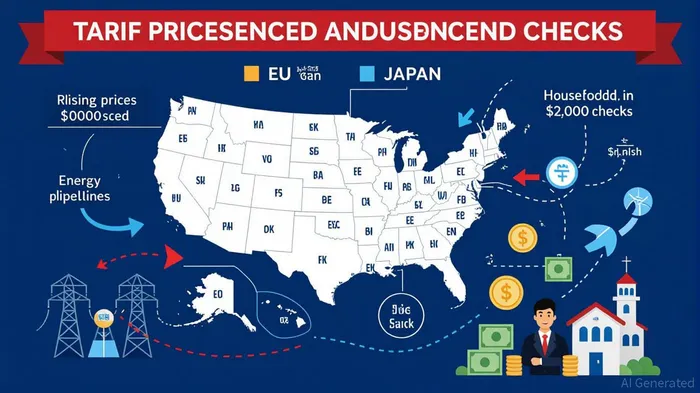
Trump's tariffs have already triggered a wave of trade negotiations, with countries like South Korea, the European Union, and Japan agreeing to lower U.S. tariff rates in exchange for market access and investments, as detailed in a National Law Review article. For instance, Japan pledged $550 billion in U.S. semiconductor and mineral investments, while the EU committed $750 billion in energy purchases, as reported in the same article. These deals suggest that tariffs are being leveraged as a tool to secure strategic industrial investments rather than purely as revenue generators.
However, the Supreme Court's pending review of the tariffs' legality under the 1977 International Emergency Economic Powers Act (IEEPA) introduces uncertainty, as noted in the CBS News report. A ruling against the administration could disrupt these negotiations and force a recalibration of trade policies. Investors should monitor this legal risk, as it could ripple through global supply chains and commodity markets.
Sector-Specific Market Implications
1. Manufacturing and Energy Sectors
The proposed dividend aligns with Trump's broader push to revitalize U.S. manufacturing. By using tariff revenue to fund the dividend, the administration aims to reduce reliance on foreign imports and incentivize domestic production. This could benefit sectors like semiconductors, automotive, and energy, which have already secured investment commitments from trading partners, as noted in the National Law Review article. For example, Japan's $550 billion pledge includes strategic investments in U.S. semiconductor manufacturing, as reported in the same article, a sector critical to long-term economic competitiveness.
Energy companies may also benefit from increased demand for U.S. exports. The EU's $750 billion energy purchase commitment, as reported in the National Law Review article, could drive growth in oil, gas, and renewable energy infrastructure. However, investors should weigh these opportunities against the risk of retaliatory tariffs from trading partners, which could dampen demand for U.S. goods.
2. Retail and Consumer Goods
Retailers and consumer goods companies face a dual challenge: higher import costs from tariffs and potential shifts in consumer behavior. While the dividend could boost disposable income for middle-class shoppers, the inflationary effects of tariffs may erode purchasing power. For instance, a 15% tariff on electronics or apparel could reduce demand for these products, forcing retailers to adjust pricing strategies or source locally, according to the Yahoo Finance report.
Investment Considerations and Risks
The $2,000 tariff dividend presents both opportunities and risks for investors. On the upside, the focus on domestic manufacturing and energy could drive long-term growth in sectors like semiconductors and renewables. However, short-term volatility is likely due to inflationary pressures, legal uncertainties, and global trade tensions.
Investors should also consider the political and legislative hurdles. No formal legislation has been introduced, and approval from Congress remains uncertain. Additionally, the Treasury's emphasis on addressing the government shutdown before implementing the dividend, as noted in the Yahoo Finance report, underscores the fragility of the timeline.
Conclusion
Trump's $2,000 tariff dividend represents a bold but untested approach to economic policy. While it aims to address affordability challenges and stimulate domestic industries, its success depends on resolving funding shortfalls, legal challenges, and global trade negotiations. For investors, the key lies in balancing the potential benefits of a manufacturing renaissance with the risks of inflation, market volatility, and geopolitical tensions.

Delivering real-time insights and analysis on emerging financial trends and market movements.
Latest Articles
Stay ahead of the market.
Get curated U.S. market news, insights and key dates delivered to your inbox.


AInvest
PRO
AInvest
PRO



Comments
No comments yet