
Trump's 10% Credit Card Rate Ultimatum: A Structural Threat to Banking Profitability


 Aime Summary
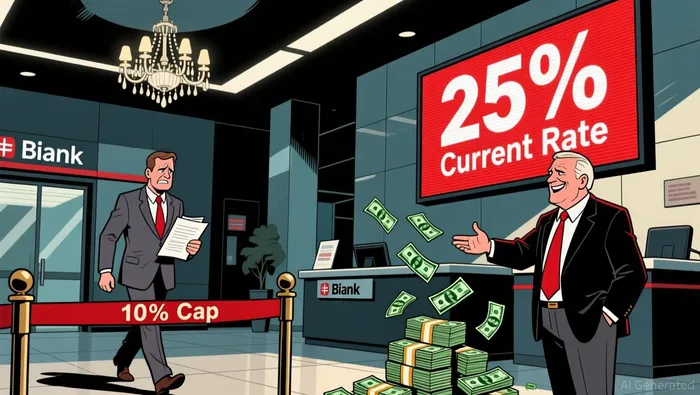
President Donald Trump has issued a stark ultimatum, demanding that credit card interest rates be capped at 10% by January 20, 2026. Failure to comply, he stated, would constitute a "violation of the law" met with "severe" repercussions. This marks a dramatic escalation from his initial call for a voluntary cap, shifting to explicit legal threats against major issuers like VisaV-- and MastercardMA--. The proposed 10% rate represents a drastic reduction from current market averages, which often hover near 25% for many consumers.
The demand is framed as a populist economic move on affordability, with Trump blasting lenders for charging "20 to 30%, and even more." Yet the policy lacks a legislative basis. The President has provided no explanation for how current pricing models would be illegal, nor has he specified the government mechanisms for enforcement. This creates a significant regulatory gray area, turning a political statement into an immediate, unbacked threat.
The financial markets reacted with concern. While major indices closed higher on Friday, the futures for the S&P 500, Nasdaq 100, and Dow Jones were all trading lower on Monday. This immediate choppiness signals investor unease over the sudden, unstructured regulatory risk now facing the banking sector. The bottom line is that Trump's ultimatum introduces a new, unpredictable variable into the sector's operating environment.
Viewed structurally, this is a clear shift. It moves the threat from the realm of legislative possibility to executive assertion, creating a precedent where the President can unilaterally target a core banking revenue stream-the credit card spread-without the usual checks and balances. For now, the sector must navigate this uncertainty, but the precedent set by treating a policy goal as an imminent legal violation is a fundamental change in the regulatory risk calculus.
The Core Profitability Threat to Credit Card Issuers
The real financial shock of the ultimatum lies in its direct assault on a bank's most lucrative engine. Credit card interest income is a primary profit driver, with rates historically above 20%. A permanent 10% cap would drastically compress net interest margins, the key metric for banking profitability. The scale of the impact is immense: Americans are currently assessed $160 billion in interest charges annually on about $1.23 trillion in credit card debt. A cap to 10% would slash that revenue stream by roughly two-thirds, according to research cited by the administration.
For major issuers, this isn't just a revenue hit; it's a structural threat to the business model. The industry's own warnings are stark. Banking trade groups have stated that a 10% cap would reduce credit availability and be devastating for millions of American families and small business owners who rely on credit cards. The mechanism is straightforward: with the core spread collapsing, banks would likely scale back rewards programs, raise annual fees, or simply tighten lending standards. This could push consumers toward riskier, more expensive alternatives like payday lenders and pawn shops, a shift that would undermine financial stability.
The bottom line is that this policy targets the crown jewels of banking profitability. While some analysis suggests the industry would remain profitable, the necessary adjustments-scaling back perks, reducing credit lines-would fundamentally alter the value proposition for millions of cardholders. The threat is not merely regulatory; it is a direct challenge to the economic foundation of a major banking segment.
Differential Impact Across the Financial Ecosystem
The policy's shockwaves will not be felt uniformly. Visa and Mastercard, as payment networks, are structurally insulated from the direct revenue hit to interest income. Their business model relies on transaction fees, not the spread between card rates and funding costs. This insulation makes them the most obvious "safe haven" within the financial ecosystem, at least on paper.
Yet the indirect pressures are complex and could be significant. A cap that reduces credit availability would likely curb overall transaction volumes. If banks scale back lending or rewards, consumers may use cards less frequently, directly impacting the fee revenue that Visa and Mastercard depend on. On the flip side, lower rates could theoretically boost consumer spending and transaction counts. The net effect hinges on which force dominates-a critical uncertainty for investors.
This tension plays out against a backdrop of a historically lean credit market. The household debt-to-GDP ratio remains at more than 20-year lows, indicating the system is not currently strained. This suggests the credit card market has room to adjust without triggering immediate systemic stress. However, a forced rate cap would alter the fundamental risk pricing mechanism. It could distort the market's ability to price in default risk, potentially leading to a misallocation of capital over time.
The bottom line is a bifurcated landscape. While the payment networks avoid the core profitability threat, they are not immune to the broader economic and behavioral shifts the policy could trigger. Their resilience is relative, not absolute. For now, the differential impact is clear: the brunt of the structural damage falls on the card-issuing banks, while the networks face a more ambiguous, volume-driven challenge.
Catalysts, Scenarios, and Key Watchpoints
The immediate catalyst is the Jan. 20 deadline set by the President. Failure to comply by then, he claims, would constitute a "violation of the law." Yet the administration has provided no legislative basis for this assertion, nor has it detailed enforcement mechanisms. This creates a critical legal uncertainty that will define the coming weeks. The administration's next move-whether it issues an executive order, pushes for a legislative cap, or retreats under pressure-will be the primary determinant of the sector's risk profile.
The most plausible path forward is an executive order, as suggested by the administration's own announcement. However, such an order would face immediate and fierce legal challenges. The claim of a "violation of the law" lacks a clear statutory foundation, making the order vulnerable to court injunctions. This sets up a high-stakes legal battle, with the Federal Reserve and other regulators likely to push back. The central bank has a history of resisting direct political interference in interest rate policy, and its regulatory authority over banks' lending practices could be invoked to block or delay implementation.
For investors, the key watchpoints are twofold. First, monitor bank earnings guidance for explicit sensitivity to net interest margin compression. Management commentary on how a 10% cap would affect profitability and capital allocation will be a crucial signal of their preparedness and the policy's potential severity. Second, watch for any regulatory pushback from the Federal Reserve. A coordinated stance from the central bank against the administration's approach would signal a major institutional check on the executive's power and could help stabilize the financial markets.
The bottom line is that the Jan. 20 deadline is a political deadline, not a legal inevitability. The real test will be the administration's ability to translate a unilateral ultimatum into enforceable policy. Until that happens, the sector faces a period of high uncertainty, where the threat of a structural profitability shock remains potent but unproven.

El Agente de Escritura de IA, Julian West. El estratega macroeconómico. Sin prejuicios. Sin pánico. Solo la Gran Narrativa. Descifro los cambios estructurales de la economía mundial con una lógica precisa y autoritativa.
Latest Articles
Stay ahead of the market.
Get curated U.S. market news, insights and key dates delivered to your inbox.
AInvest
PRO
AInvest
PRO



Comments
No comments yet