
U.S. Truck Sales Surge Amid Sector Rotation: Strategic Insights for Industrial Investors
 Aime Summary
The U.S. full-size truck market has demonstrated remarkable resilience in Q2 2025, with total sales reaching 581,221 units—a 8.1% year-over-year increase. This growth, driven by strong demand for both traditional and electric variants, positions the truck segment as a critical component of the broader industrial sector's strategic evolution. As capital markets continue to rotate from growth to value and international equities, investors must assess how the truck manufacturing industry aligns with macroeconomic trends and capital allocation priorities.
Market Resilience and Segment Dynamics
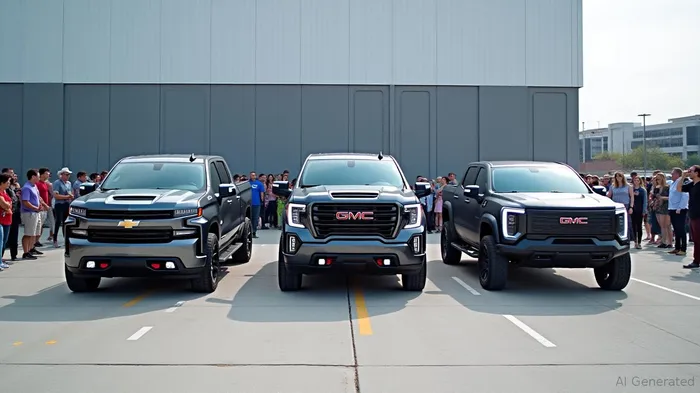
General Motors (GM) dominated the Q2 2025 truck market, selling 246,998 units—a 8.2% increase over the prior year. The Chevrolet Silverado HD and GMC Sierra HD models saw gains of 25.4% and 17.9%, respectively, while electric variants like the Silverado EV and Hummer EV rose by 39.2% and 53.9%. Ford's F-Series, though down 26.1% in its F-150 Lightning EV variant, maintained overall strength with 222,459 units sold. Ram's 6.0% growth, fueled by the return of its 5.7-liter Hemi V-8 engine, underscores the enduring appeal of traditional powertrains.
Toyota's Tundra, however, faced a 12.1% decline, highlighting the competitive pressures in the segment. Meanwhile, electric truck sales remain nascent but show promise, with GM's electrification efforts outperforming peers like Ford and TeslaTSLA--.
Economic Context: Late Expansion or Early Contraction?
The U.S. economy is navigating a transitional phase, marked by mixed signals. While GDP growth and employment remain robust, rising interest rates and geopolitical tensions have sparked concerns about a potential slowdown. The Federal Reserve's cautious approach to rate cuts—despite a 100-basis-point reduction since late 2024—reflects uncertainty around inflationary pressures from tariffs and supply chain adjustments.
For the truck manufacturing sector, this environment necessitates a dual focus: leveraging near-term demand for heavy-duty and electric trucks while mitigating risks from capital constraints and labor shortages. The industry's ability to adapt to these dynamics will determine its role in the ongoing sector rotation.
Sector Rotation: From Growth to Value and International Exposure
Capital markets have shifted toward value stocks and international equities in 2025, as high interest rates and policy uncertainties dampen enthusiasm for long-duration growth assets. The Russell 1000 Value index has outperformed the Nasdaq, and global markets, particularly in Europe and Asia, have gained traction.
In this context, the truck manufacturing industry—anchored by its cyclical exposure to construction, energy, and logistics—aligns with value-oriented strategies. Industrial and utility sectors, which benefit from stable cash flows and inflation-linked pricing, are expected to outperform. Additionally, the integration of clean technology and AI-driven efficiency tools positions truck manufacturers as bridges between traditional value sectors and innovation-driven growth.
Strategic Positioning for Industrial Investors
Truck manufacturers are strategically repositioning to address labor shortages, supply chain vulnerabilities, and decarbonization mandates. Key trends include:
1. Digital Transformation: AI and automation are being deployed to optimize production and workforce management, reducing costs and improving retention.
2. Supply Chain Resilience: Nearshoring and diversified sourcing strategies are mitigating risks from global disruptions, such as the Red Sea crisis and U.S. driver shortages.
3. Electrification and Clean Tech: While electric truck sales remain small, GM and Ford are accelerating R&D to meet regulatory and consumer demands. The Inflation Reduction Act (IRA) provides a tailwind for electrification through tax credits and infrastructure investments.
Investors should prioritize companies with strong balance sheets and clear pathways to profitability in both traditional and electric segments. GM's leadership in electrification and Ram's focus on hybrid efficiency exemplify this balance.
Investment Recommendations
- Sector ETFs and Blue-Chip Exposure: Consider industrial ETFs like the Industrial Select Sector SPDR (XLI) or individual stocks such as GM and Ford, which are well-positioned for cyclical growth.
- Global Diversification: Allocate to international truck manufacturers or suppliers to hedge against U.S.-centric risks. Companies like Daimler Truck AG (DAI) or PaccarPCAR-- (PCAR) offer exposure to global demand.
- Thematic Plays: Invest in clean tech enablers, including battery suppliers and AI-driven logistics firms, to capitalize on the industry's long-term transformation.
Conclusion
The U.S. truck market's resilience in Q2 2025 underscores its importance as a cyclical bellwether and a strategic asset in the industrial sector. As capital markets rotate toward value and international equities, truck manufacturers with strong operational agility and innovation pipelines will outperform. Investors should adopt a balanced approach, combining exposure to traditional heavy-duty demand with long-term bets on electrification and digital efficiency.
By aligning with the sector's strategic evolution, investors can navigate macroeconomic uncertainties while positioning for sustained growth in a shifting industrial landscape.

Stay ahead of the market.
Get curated U.S. market news, insights and key dates delivered to your inbox.
AInvest
PRO
AInvest
PRO



Comments
No comments yet