
TRON Strengthens Market Position Through Profitability and AI Collaboration
 Aime Summary
TRON generated $624 million in revenue in 2025, outperforming EthereumETH-- and SolanaSOL-- in profitability due to its deflationary token model according to analysis.
- The network hosts over $85 billion in USDT, making it the second-largest stablecoin platform by market cap and a preferred option for low-cost transactions in emerging markets as reported.
- TRONTRX-- has joined the Agentic AI Foundation to shape AI payment standards, using its high transaction volume and infrastructure to target AI-driven commerce according to industry sources.
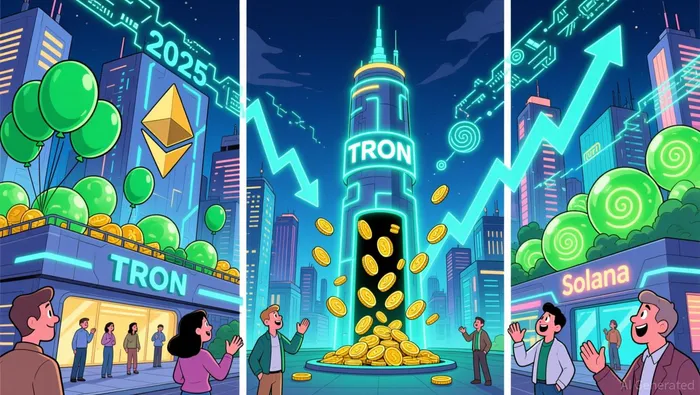
TRON's economic model stands out in the blockchain industry due to its deflationary dynamics. Unlike Ethereum and Solana, which face inflationary pressures that erode token value, TRON destroyed more tokens than it issued in 2025. This strategy, combined with stablecoin transaction fees, resulted in $624 million in revenue. Analysts highlight that this creates a stable income stream not reliant on speculative demand.
The network's focus on stablecoins has positioned it as a key player in global finance. With $85 billion in USDT hosted on TRON, the blockchain is heavily used for peer-to-peer transfers in regions prioritizing low-cost, high-speed transactions. This utility has driven TRON's stablecoin market cap growth, even as it remains underrepresented in Western crypto narratives.
TRON is also positioning itself for the future of AI-driven commerce. By joining the Agentic AI Foundation, it aims to influence how AI agents will process high-volume, low-value transactions. The foundation includes major tech companies like Anthropic and Block, and TRON's role as a governing board member gives it a strategic voice in shaping AI infrastructure.
How Does TRON's Economic Model Compare to Ethereum and Solana?
TRON's profitability is largely attributed to its deflationary token model. In 2025, it burned more tokens than it issued, reducing supply and increasing value for existing token holders. This contrasts with Ethereum and Solana, where token issuance outpaces revenue, leading to a net loss in value for holders according to analysis.
Analysts at Kaiko have noted that while both Ethereum and Solana earned significant revenue—$260 million and $170 million respectively—the inflationary costs associated with token issuance made them unprofitable. TRON's model, however, has shown resilience, generating consistent revenue from stablecoin transactions.
What Role Is TRON Playing in the Future of AI Payments?
TRON is seeking to influence AI infrastructure through its collaboration with the Agentic AI Foundation. The foundation is focused on developing open AI standards, and TRON's involvement as a Gold Member and Governing Board member gives it a seat at the table.
With its existing transaction volume and stablecoin infrastructure, TRON is well-positioned to support high-frequency, low-value AI commerce payments. The network currently processes over 994 million transactions per quarter, making it a strong candidate for handling the large volumes expected in AI-driven economies.
The integration of AI into blockchain payments could redefine how transactions are processed. By aligning with the Agentic AI Foundation, TRON aims to ensure that it is at the forefront of these developments, setting standards that align with its existing infrastructure and user base.
What Are the Risks and Limitations of TRON's Strategy?
While TRON's economic model and AI collaborations offer strong potential, there are limitations to consider. The network's profitability is closely tied to stablecoin transactions, which are subject to regulatory scrutiny and market volatility. Any changes in stablecoin regulations could impact TRON's ability to maintain its current revenue streams.
Additionally, TRON's position as a leading stablecoin platform does not guarantee long-term dominance. Solana, for example, is gaining traction in volume-based metrics and may challenge TRON's position if it can address its inflationary challenges.
TRON's involvement in AI payment standards also carries uncertainty. While the Agentic AI Foundation includes major industry players, the long-term impact of its efforts on TRON's relevance remains to be seen. The success of these collaborations will depend on the adoption of AI-driven commerce and the alignment of infrastructure with TRON's capabilities.
Overall, TRON's focus on profitability, stablecoin utility, and AI integration positions it as a key player in the evolving blockchain and AI landscapes. However, the long-term success of these strategies will depend on market dynamics and regulatory developments in the years ahead.

Blending traditional trading wisdom with cutting-edge cryptocurrency insights.
Latest Articles
Stay ahead of the market.
Get curated U.S. market news, insights and key dates delivered to your inbox.


AInvest
PRO
AInvest
PRO



Comments
No comments yet