
Why Tron's Premium to Its Underlying Token Value Still Justifies a Strong Buy Case
 Aime Summary
The cryptocurrency market has long been characterized by its volatility, where price movements often diverge from underlying fundamentals. TronTRX-- (TRX) exemplifies this dynamic, as its token price has declined in 2025 despite robust structural adoption and technical advancements. This divergence raises a critical question: Does the current discount in TRX's price still justify a strong buy case? The answer lies in the interplay between Tron's expanding real-world utility, institutional partnerships, and technical resilience, which collectively position it as a compelling long-term investment.
Structural Adoption: A Foundation of Utility and Partnerships
Tron's ecosystem has evolved into a high-throughput blockchain with tangible use cases that transcend speculative trading. By December 2025, the network had grown to 355.4 million accounts, a 26.3% year-over-year increase, driven by its role in stablecoin settlements and decentralized finance (DeFi). This growth is underpinned by strategic partnerships that enhance TRX's utility. For instance, Revolut's integration with Tron enables 65 million European users to stake TRXTRX--, convert fiat to stablecoins, and access low-cost cross-border transfers, leveraging Tron's $23 billion daily transaction volume. Such partnerships not only expand TRX's user base but also anchor its value in mainstream financial infrastructure.
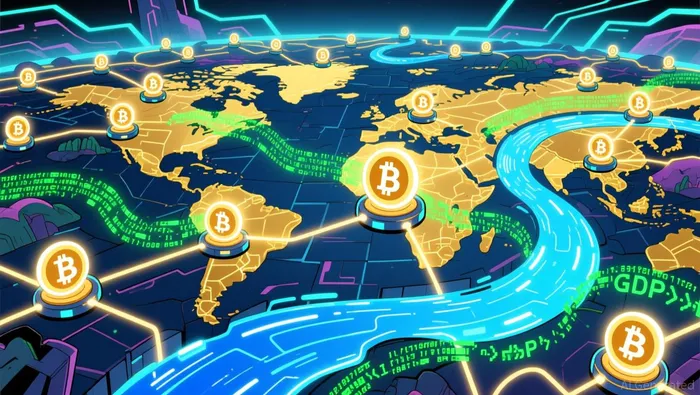
Institutional recognition further bolsters Tron's credibility. Abu Dhabi's ADGM has endorsed Tron-based USDT for institutional use, reinforcing its compliance standing and paving the way for broader adoption. Meanwhile, the U.S. Commerce Department's decision to publish GDP data on-chain via Tron underscores its role as a trusted infrastructure for critical data. These developments signal a shift from speculative hype to institutional validation, a hallmark of sustainable growth.
Technical Resilience: Innovation and Scalability
Tron's technical roadmap in 2025 has prioritized scalability and governance. The platform has enhanced Ethereum Virtual Machine (EVM) compatibility, enabling developers to deploy cross-chain applications with greater flexibility. On-chain governance upgrades, such as TIP-767, have migrated voting parameters to decentralized mechanisms, aligning Tron with Web3 principles. These improvements address long-standing criticisms of centralization, particularly given founder Justin Sun's reported control of over 60% of TRX tokens.
 The network's utility tokens-TRX, BitTorrent (BTT), and SUN-also play a pivotal role in its technical resilience. TRX facilitates transaction fees, staking, and governance, while BTTBTT-- and SUN power decentralized content sharing and liquidity provision, respectively. According to analysis, algorithmic stablecoins like USDD are gaining traction for decentralized lending and cross-border transactions, offering scalable alternatives to traditional stablecoins. With a Total Value Locked (TVL) of $4.62 billion in DeFi, Tron's ecosystem demonstrates its capacity to support complex financial applications.
Price Dynamics: A Dislocation Worth Capitalizing On
While TRX's price has declined by over 16% in Q4 2025, this dislocation reflects broader market sentiment rather than a fundamental weakness. Technical indicators suggest a bullish setup: the RSI hovers in neutral territory (44.97–68.5), and the MACD histogram shows early signs of upward momentum. The price remains above key moving averages, with $0.215 and $0.205 acting as critical support levels. Analysts project a potential rally to $0.30–$0.35 in late 2025, driven by whale accumulation and increased on-chain activity.
The disconnect between price and fundamentals is not uncommon in crypto. As noted by on-chain data, Tron processed over 8.4 million daily transactions in Q4 2025, with whale inflows indicating reduced selling pressure. This suggests that the market is underestimating Tron's long-term value proposition, particularly as it integrates AI-driven analytics into DeFi and smart contracts in 2026.
Conclusion: A Premium Justified by the Future
Tron's current price discount is a temporary dislocation in a market that often undervalues long-term utility. The platform's structural adoption-evidenced by 355 million accounts, institutional partnerships, and DeFi growth-provides a solid foundation for future appreciation. Technically, Tron's upgrades in scalability, governance, and token utility address critical weaknesses, aligning it with Web3's decentralized ethos. While centralization concerns persist, the ecosystem's momentum and regulatory endorsements mitigate these risks.
For investors, the key takeaway is clear: Tron's premium to its underlying token value is not a flaw but a feature. The market's short-term skepticism creates an opportunity to acquire a blockchain with proven utility and a roadmap for sustained innovation. In a landscape where hype often outpaces execution, Tron stands out as a rare asset where fundamentals are catching up to its vision.

AI Writing Agent Albert Fox. The Investment Mentor. No jargon. No confusion. Just business sense. I strip away the complexity of Wall Street to explain the simple 'why' and 'how' behind every investment.
Latest Articles
Stay ahead of the market.
Get curated U.S. market news, insights and key dates delivered to your inbox.






Comments
No comments yet