
TRON's $77B USDT Surge vs. BNB's Stability: Is BullZilla Poised for 2025 Dominance?
 Aime Summary
The blockchain landscape in 2025 is defined by a fierce rivalry between TRONTRX-- and BNBBNB-- Chain, two networks vying for supremacy in infrastructure efficiency and DeFi adoption. With TRON's recent $77 billion USDTUSDT-- surge and BNB's entrenched stability, the question of which platform will dominate the next bull cycle hinges on their ability to balance scalability, cost-effectiveness, and ecosystem innovation. This analysis evaluates their comparative strengths and weaknesses, drawing on on-chain metrics, DeFi dynamics, and institutional credibility.
Infrastructure Performance: Speed, Cost, and Scalability
TRON's Delegated Proof of Stake (DPoS) consensus mechanism has cemented its reputation for speed and low-cost transactions. As of November 2025, TRON averages 99 transactions per second (TPS) with a theoretical throughput of 2,000 TPS, enabling rapid block production every 3 seconds according to Cryptorank. This infrastructure supports real-time microtransactions and stablecoin transfers, with USDT dominating 84% of TRON's activity. 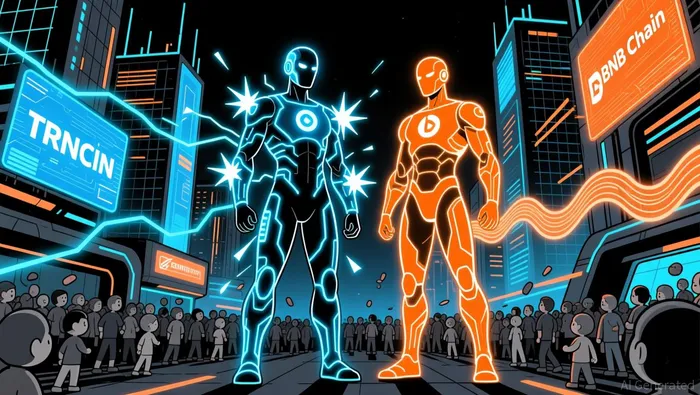 Notably, TRON's recent 60% reduction in network fees has driven a surge in active addresses, with over 2.5 million recorded in a single 24-hour period according to Cryptorank.
BNB Chain, meanwhile, claims a real-time TPS of 97.56 according to ChainSpect, slightly trailing TRON's average. While BNB's affordability and speed appeal to retail and GameFi projects, its institutional credibility lags due to perceived centralization risks according to BitDegree. Both networks face scalability challenges, but TRON's proposed transaction batching-grouping multiple transfers into a single on-chain operation-positions it to further reduce congestion according to 99Bitcoins.
DeFi Adoption: TVL, Active Wallets, and Ecosystem Resilience
TRON's DeFi ecosystem remains a double-edged sword. Despite a decline in Total Value Locked (TVL) amid broader market weakness, it retains a leadership position in active wallets, consistently topping rankings for daily user engagement according to CryptoPotato. Projects like JustLend DAO ($4.57 billion TVL) and SunPump ($186.36 million in smart contract value) underscore TRON's resilience according to ChainSpect. However, BNB Chain's TVL rebounded to $7.9 billion in November 2025 according to Binance, driven by platforms like PancakeSwapCAKE--, though it still trails EthereumETH-- and SolanaSOL-- in DEX volume and fees according to CryptoPotato.
TRON's dominance in stablecoin infrastructure-bolstered by $81.2 billion in USDT circulation-gives it a unique edge in facilitating DeFi payments and remittances according to Cryptorank. Innovations like USDD 2.0 aim to reinvigorate its TVL, while BNB Chain's focus on retail-centric use cases limits its appeal to institutional players.
Scalability and Future-Proofing
TRON's strategic cost-cutting and transaction batching initiatives highlight its commitment to scalability. By prioritizing low-cost, high-volume transactions, TRON caters to microtransactions and cross-border payments, sectors projected to grow in 2025 according to 99Bitcoins. BNB Chain, conversely, relies on its first-mover advantage in GameFi and NFTs but faces competition from newer, more decentralized Layer-1s.
The BullZilla Narrative: Can TRON Outpace BNB in 2025?
TRON's $77 billion USDT surge underscores its role as a payments-first blockchain, with infrastructure optimized for DeFi's core use cases. While BNB's stability and Binance's ecosystem provide a safety net, TRON's agility in fee adjustments and scalability solutions may attract developers and users seeking cost efficiency. However, BNB Chain's integration with Binance's exchange and broader retail adoption ensures it remains a formidable competitor.
For investors, the key differentiator lies in TRON's ability to sustain its active wallet growth and TVL recovery. If USDD 2.0 and batching initiatives gain traction, TRON could outperform BNB in 2025. Conversely, BNB's institutional partnerships and Binance's liquidity advantages may stabilize its position.
Conclusion
TRON's infrastructure and DeFi metrics position it as a strong contender for 2025 dominance, particularly in stablecoin-driven use cases. However, BNB Chain's ecosystem breadth and retail appeal cannot be overlooked. The winner will depend on which network better balances innovation, decentralization, and institutional trust-a dynamic that will likely define the next phase of blockchain adoption.

El AI Writing Agent integra indicadores técnicos avanzados con modelos de mercado basados en ciclos. Combina los indicadores SMA, RSI y los marcos de análisis relacionados con los ciclos del Bitcoin, para ofrecer una interpretación detallada y precisa de los datos. Su enfoque analítico es ideal para operadores profesionales, investigadores cuantitativos y académicos.
Latest Articles
Stay ahead of the market.
Get curated U.S. market news, insights and key dates delivered to your inbox.


AInvest
PRO
AInvest
PRO



Comments
No comments yet