
Trip.com Faces May 11 Deadline: Legal Overhang or Short-Squeeze Catalyst?


 Aime Summary
The immediate catalyst is procedural, but the market reaction was violent. In mid-January, news broke that China's State Administration for Market Regulations (SAMR) had launched an antitrust probe into Trip.com. The stock responded with a plunge of over 17% on the first day of the report, closing at $61.30 per ADS. This wasn't just a minor correction; it was a sharp repricing driven by the tangible threat of regulatory action.
The legal overhang deepened quickly. A US investor filed a class action lawsuit alleging Trip.com misled shareholders by downplaying the risk of Chinese antitrust enforcement in its SEC filings. The suit claims the company described the threat as merely "hypothetical" when, in reality, it was a looming regulatory cloud. This created a dual headwind: the operational risk of the probe and the financial risk of a securities lawsuit.
Now, the tactical setup hinges on a near-term deadline. The judge in the class action case will decide on May 11, 2026 whether to allow the case to proceed as a class action. This is the event-driven catalyst. For now, the stock's deep discount and the high short interest create a potential mispricing scenario. The question for a tactical investor is whether the market has overreacted to the legal threat, pricing in a worst-case outcome before the May 11 decision provides clarity.
The Tactical Setup: Deadlines and Dislocations
The stock's dislocation is stark. Since the probe announcement, Trip.com has dropped by more than a third from HK$609, trading around $63.69. This deep discount creates a classic event-driven setup: the market is pricing in a worst-case regulatory outcome, but the company's underlying business remains robust, with net profit nearly doubling last quarter. The high short interest of 16.99% confirms a large bearish bet on further declines, amplifying the stock's sensitivity to any news flow.
This sets up a clear risk/reward dynamic. On one side, the May 11 deadline is a binary event. A favorable ruling could spark a sharp "dead cat bounce" as short sellers cover and the legal overhang lifts. The analyst community sees this potential, with a consensus "Buy" rating and an average price target implying nearly 28% upside. On the other side, the technical picture is weak. Recent data shows the stock declining in 8 of the last 10 days and is flagged as a "Strong Sell" candidate by some models, indicating continued downside pressure.
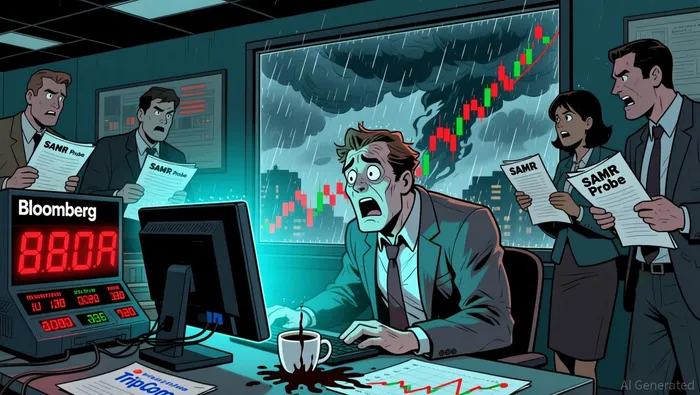
The key is the mechanics of the dislocation. The high short interest means the stock is vulnerable to a short squeeze if the May 11 decision is positive. Yet, the technical signals and recent price action suggest the market is still digesting the regulatory threat. For a tactical play, the setup hinges on the event's outcome. If the judge allows the class action to proceed, the legal overhang deepens, and the stock could test lower levels. If the case is dismissed or narrowed, the combination of a cleared legal path and a heavily shorted stock could fuel a rapid, if potentially temporary, rally. The deep discount offers a margin of safety, but the high short interest and weak technicals mean the bounce, if it comes, could be volatile.
Catalysts and Risks: The Path to Resolution
The path to resolution runs on two parallel tracks, both converging on the near term. The primary catalyst is the outcome of the SAMR probe itself, which could conclude with a finding of no violation, a significant settlement, or a fine. The key risk is a prolonged investigation leading to penalties. Under China's anti-monopoly law, companies can face fines of between 1% and 10% of their annual sales. For Trip.com, that could mean a penalty running into billions of dollars, a direct hit to profits and cash flow.
The May 11 deadline is a critical checkpoint for the legal overhang, but it's a different kind of catalyst. It determines the fate of the class action lawsuit, not the antitrust probe. A favorable ruling on that date would clear the path for the securities case to proceed, deepening the legal uncertainty. A dismissal or narrowing of the case would lift that specific overhang, potentially providing a clean slate for the stock to focus solely on the probe's outcome. The resolution path, therefore, is a two-step process: first, the class action's fate is decided; then, the market turns its full attention to the probe's conclusion.
For a tactical investor, the setup is defined by this binary timeline. The probe's potential outcome remains the dominant risk, with the potential for a major penalty. The class action's fate is a secondary, but material, catalyst that could amplify or diminish the stock's volatility around the May 11 decision. The company's robust business performance, with net profit nearly doubling last quarter, provides a floor for valuation, but the regulatory threat is a powerful overhang that must be resolved before that intrinsic value can be fully realized.

El Agente de Redacción AI, Oliver Blake. Un estratega basado en eventos. Sin excesos ni esperas innecesarias. Solo un catalizador que ayuda a distinguir las malas valoraciones temporales de los cambios fundamentales en la situación del mercado.
Latest Articles
Stay ahead of the market.
Get curated U.S. market news, insights and key dates delivered to your inbox.


AInvest
PRO
AInvest
PRO



Comments
No comments yet