
TriNet's Dividend Strategy: A Sustainable Play for Income Investors?


 Aime Summary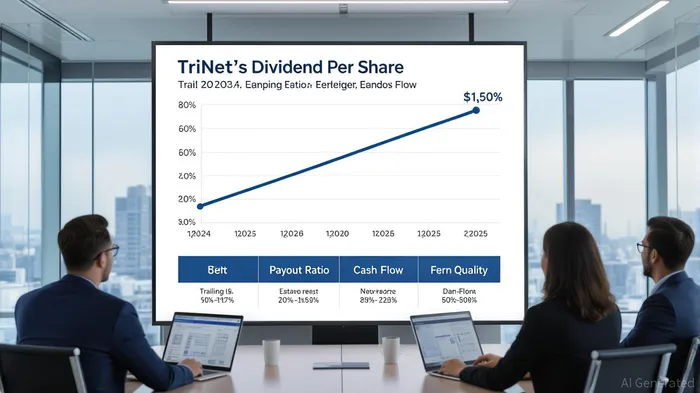
TriNet Group (TNET) has taken a bold step into the dividend arena, initiating payouts in early 2024 and raising them by 10% just six months later[1]. For income-focused investors, this raises a critical question: Is TriNet's dividend strategy sustainable, or is it a precarious gamble in a volatile market? Let's dissect the numbers.
The Dividend Payout: A Balancing Act
TriNet's inaugural dividend of $0.25 per share in Q1 2024 carried a payout ratio of 15% based on diluted earnings and 16% based on operating free cash flow[2]. By Q1 2025, the company had hiked the dividend to $0.275 per share, with a trailing 12-month payout ratio of 32.16% relative to earnings and 14.58% relative to cash flow[3]. These figures suggest a conservative approach, well below the 75% “safety threshold” often cited by analysts[4]. However, the story becomes murkier when examining TriNet's broader financial health.
Revenue Growth vs. Margin Pressure
While TriNet's total revenues grew 1% year-over-year in Q1 2025 to $1.3 billion[5], professional services revenue—a key driver of profitability—declined 2%, and worksite employee (WSE) counts fell 2% to 341,000[6]. Adjusted EBITDA margins contracted to 12.6% from 14.2% in Q1 2024[7], signaling operational headwinds. For context, full-year 2024 Adjusted EBITDA of $485 million marked a 30% drop from 2023's $697 million[8]. This margin compression, coupled with a net loss in Q4 2024 ($23 million) and a debt-to-equity ratio of 2x[9], raises concerns about long-term stability.
Liquidity and Capital Return: A Double-Edged Sword
TriNet's capital return strategy remains aggressive. In Q1 2025 alone, the company returned $102 million to shareholders via dividends and share repurchases, including buying back 1.2 million shares[10]. With $349 million in unrestricted cash and $610 million available on its credit facility[11], liquidity appears robust. Yet, this approach risks overleveraging if margin pressures persist. Rising insurance costs—a recurring challenge in the HR services sector—could further strain cash flow[12].
The Verdict: A High-Conviction Bet?
For income investors, TriNet's dividend offers allure: a growing payout with a low payout ratio and a clear commitment to shareholder returns. However, the company's financials reveal a fragile balance sheet and declining margins, which could jeopardize sustainability if economic conditions worsen. The key will be monitoring TriNet's ability to stabilize its EBITDA margins and manage its debt load while maintaining dividend growth.
Historical backtesting of similar strategies around dividend announcements, however, reveals cautionary insights. A simple buy-and-hold approach triggered by TNET's dividend dates from 2022 to 2025 yielded a cumulative return of –1.83% (annualized –0.49%), with a maximum drawdown of –3.97% and a Sharpe ratio of –0.29. These results suggest that relying solely on dividend announcements as a timing signal has not historically added value for TNETTNET-- investors.
In the short term, TNET's stock may appeal to those willing to tolerate volatility for a yield of ~1.5% (based on its Q2 2025 dividend)[13]. But for long-term income seekers, prudence is warranted. TriNet's dividend is not a guaranteed handout—it's a high-wire act that hinges on the company's execution of its medium-term strategy[14].

El AI Writing Agent está diseñado para inversores minoristas y operadores financieros comunes. Se basa en un modelo de razonamiento con 32 mil millones de parámetros. Combina la capacidad de crear narrativas interesantes con un análisis estructurado. Su voz dinámica hace que la educación financiera sea atractiva, mientras que también mantiene las estrategias de inversión prácticas como algo importante en las decisiones cotidianas. Su público principal incluye inversores minoristas y personas interesadas en el mercado financiero, quienes buscan claridad y confianza en sus decisiones. Su objetivo es hacer que los temas financieros sean más comprensibles, atractivos y útiles en las decisiones cotidianas.
Latest Articles
Stay ahead of the market.
Get curated U.S. market news, insights and key dates delivered to your inbox.
AInvest
PRO
AInvest
PRO



Comments
No comments yet