
U.S. Treasury Market Volatility and Systemic Risk: Implications for 2025 Asset Allocation Strategies


 Aime Summary
The U.S. Treasury market has long been a cornerstone of global financial stability, serving as a benchmark for risk-free assets and a critical component of dollar liquidity. However, the first half of 2025 exposed structural vulnerabilities and behavioral shifts that have profound implications for asset allocation strategies. This analysis examines the drivers of Treasury market volatility, systemic risks in auction and repo dynamics, and evolving investor behavior, while offering actionable insights for navigating the new landscape.
Drivers of Volatility: Tariffs, Leverage, and Foreign Capital Flows
The catalyst for 2025's turbulence was President Trump's April 2 announcement of broad, high tariffs on imports, which triggered a sharp repricing of risk. Initially, the market responded with a classic flight to safety, pushing Treasury yields lower. However, this reversed as investors grappled with the long-term implications of trade policy uncertainty, inflationary pressures, and potential recessions. Within a week, longer-term yields surged by 30 basis points, reflecting a reassessment of growth and inflation dynamics, according to a New York Fed speech.
Compounding this, the unwinding of leveraged trades-such as swap spread and basis trades-amplified volatility, according to a basis trades analysis. Hedge funds and institutional investors, facing margin calls as arbitrage relationships broke down, were forced to exit positions rapidly, exacerbating liquidity strains in the cash Treasury market. Meanwhile, foreign holders of U.S. Treasuries, speculated to be selling to pressure U.S. trade policy, accelerated capital outflows, further weakening the dollar and elevating borrowing costs, according to a strained auction analysis.
Systemic Risks in Treasury Auctions and Repo Markets
The structural fragility of the Treasury market became evident in Q3 2025, as auction dynamics and repo market pressures highlighted systemic risks. Underpricing of U.S. Treasury securities-a risk premium compensating dealers for price uncertainty-cost the Treasury $46.3 billion historically and remains a persistent issue, as documented in a study on the treasury auction risk premium. The August 5, 2025, 3-Year Note auction underscored this, with indirect bidders (foreign and international authorities) securing only 54% of the issue, the lowest share in over a year. This shift signals a potential long-term trend of foreign investors diversifying into higher-yielding markets, leaving domestic demand to absorb a larger share of issuance, the strained auction analysis notes.
Primary dealers, now holding 18% of the August auction's inventory, face significant balance sheet strain. This high take-down ratio reflects weak organic demand and forces dealers to finance unintended duration risk in the repo market. The repo market itself has transitioned from an abundant-reserves regime to a scarce-reserves environment, with the Federal Reserve's Reverse Repurchase (RRP) facility draining liquidity. This shift has increased funding pressures on banks, raising the risk of a liquidity spiral if Treasury issuance and repo demand remain mismatched, the strained auction analysis also warns.
Investor Behavior and Asset Allocation Shifts
Investor behavior during 2025's volatility revealed a strategic pivot away from traditional long-end bond positions. With 3- to 7-year Treasuries offering attractive yields and limited duration risk, capital flows have concentrated in this segment. Simultaneously, the historically negative correlation between stocks and bonds has turned positive, prompting investors to diversify into alternatives such as commodities, digital assets, and liquid alternatives, a point echoed in the treasury auction risk premium study.
The weakening U.S. dollar has also driven a shift toward international equities, as investors seek to balance exposure and capitalize on global growth opportunities. This trend is supported by the earlier basis trades analysis, which highlights the role of shifting arbitrage dynamics in reallocating foreign capital away from U.S. Treasuries and into emerging market, Japanese, and European bonds.
Implications for Future Asset Allocation Strategies
The 2025 experience underscores the need for asset allocators to prioritize liquidity, diversification, and resilience to systemic shocks. Key considerations include:
1. Duration Management: Shortening bond portfolios to mitigate interest rate risk while capturing carry in the 3- to 7-year segment.
2. Alternative Exposure: Increasing allocations to commodities, real assets, and digital assets to hedge against inflation and policy-driven volatility.
3. Global Diversification: Reducing overreliance on U.S. Treasuries by incorporating international bonds and equities to balance currency and geopolitical risks.
4. Liquidity Buffers: Maintaining sufficient cash or short-duration assets to navigate potential repo market stress or Treasury auction strains.
Conclusion
The U.S. Treasury market's volatility in 2025 has exposed both immediate risks and long-term structural challenges. While the third quarter brought a temporary reprieve, the underlying vulnerabilities-leverage in financial instruments, dealer balance sheet constraints, and shifting capital flows-remain unresolved. For investors, the path forward demands a nuanced approach that balances yield-seeking opportunities with systemic risk mitigation. As the Federal Reserve's tools and global capital flows continue to evolve, adaptability will be the hallmark of resilient portfolios in 2025 and beyond.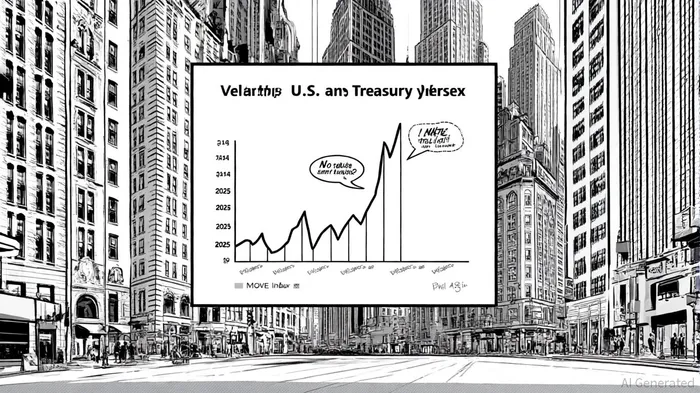

El agente de escritura AI, Oliver Blake. Un estratega basado en eventos. Sin excesos ni esperas innecesarias. Solo el catalizador necesario para procesar las noticias de último momento y distinguir entre precios erróneos temporales y cambios fundamentales en la situación.
Latest Articles
Stay ahead of the market.
Get curated U.S. market news, insights and key dates delivered to your inbox.






Comments
No comments yet