
The Treasury Bought Back $6 Billion of Its Own Debt. Yields Went Up Anyway.
 Aime Summary
Most of us hear "buyback" one way: a company decides its own stock is cheap, buys it, and the smaller supply props up the price. Carry that picture over to this week, when the U.S. Treasury said it would buy back up to $6 billion of its own 10- and 20-year bonds, and you land on a comforting conclusion: the world's biggest borrower is stepping in to support its own paper, pushing prices up and yields down, which takes pressure off every stock priced off those yields.
The 10-year Treasury yield rose that day to its highest level in almost three years.
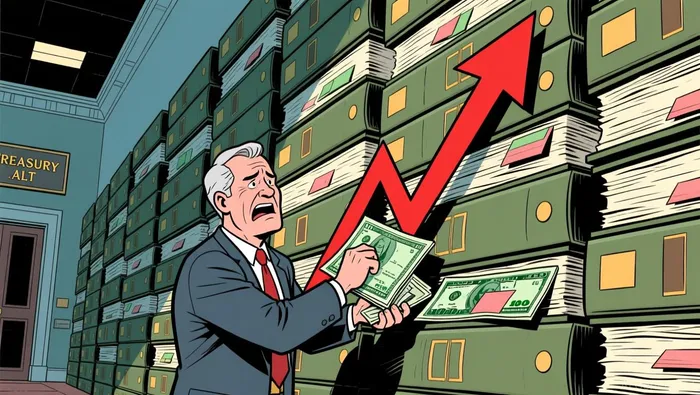
The move was not what a stock buyback looks like. It was a borrower buying back its own loan with borrowed money — and the market's reaction, a nudge upward in the very yields the plan was meant to calm, is the whole lesson.
A borrower buying back his own loan
Give your neighbor a 30-year fixed mortgage at a high rate. Lenders in his town have turned skittish, and long rates keep climbing. To look strong, he announces he will "buy back" part of his mortgage from the bank — retire some of that expensive, locked-in loan. That sounds like a man supporting his own credit, the way a company buys its own cheap stock.
Now watch where the money comes from. He doesn't have it. He funds the purchase with a short-term home-equity line that re-prices every few months. Add it up and he owes the same total he owed before. Nothing was paid down; only the shape of the debt changed. He swapped a locked 30-year loan for one that resets constantly, betting that long rates were spiked too high and will fall back before the short line comes due.
Label the props:
- The homeowner is the U.S. Treasury.
- His 30-year fixed mortgage is the outstanding 10-, 20-, and 30-year bonds — the long end.
- "Buying back his own mortgage" is the Treasury's buyback operation.
- The home-equity line that pays for it is new short-term T-bill issuance.
- His unchanged total debt is the federal debt, unchanged by the exercise.
And the neighbors' reaction is not relief. A borrower who cashes out short-term money to retire long-term loans, in a market already nervous, reads as worry, not strength — and his effective cost of money can go up, not down.
The real numbers, and where the cash comes from
The Treasury's buyback operations normally run about $2 billion each. In mid-August the department said it would "at least double" that. Then on September 9 it set the first operation of the expanded program at up to $6 billion — three times the usual size — aimed at the 10- and 20-year maturities.
Why hold such an operation at all? In plain terms, the newest bonds trade easily; the older ones do not. The buyback lets banks and funds hand back the hard-to-trade paper so they can turn around and buy the next auctions. Treasury Secretary Scott Bessent has framed it as a "Treasury twist" built to "slow moves down," not to set a price — an echo of the Federal Reserve's Operation Twist a decade and a half ago.
The catch is where the $6 billion comes from. It is not sitting in a drawer. The Treasury funds these purchases by issuing additional short-term bills, so net debt does not shrink. That single sentence kills the naive model: the biggest borrower on earth "reduced" the long end by borrowing more at the short end.
Now scale it. Six billion dollars against roughly $40 trillion of federal debt — the level that blew past the mark with debt around 123% of GDP and this year's deficit near 6.3% of GDP. Even at the expanded pace, the whole program buys something like $66 billion of long bonds a year. That is a lane the size of a back alley running next to the freight train of supply.
The rebuff, and what it says about your stocks
On the day of the announcement, the 10-year yield climbed about five basis points to roughly 4.85%, its highest since late 2023. The reason was not confusion. Investors were underwhelmed — they had hoped for $8 billion, even $10 billion, a number big enough to feel like the Treasury meant it. One strategist put the threshold at $7 billion just to move the market in the intended direction.
The deeper problem is that the tool can work against itself. When a debtor shows up to defend its own debt, lenders hear the tell. Stanley Druckenmiller, the veteran investor and a onetime mentor to Bessent, has argued that once markets believe the Treasury is defending a price, every rise in yields becomes a test of official resolve — and that governments defending a price against fundamentals always lose, the only question being how much they spend before conceding.
That is the bridge to your holdings. The long Treasury yield is the discount rate buried inside every equity price. A stock is a claim on cash flows years into the future, and the further out the cash, the harder it is cut by a rising discount rate. That is why the highest-multiple names — the ones whose value sits at the back of the timeline — get hit first when the 30-year yield is recently at its highest level since 2007 and the 10-year sits at a nearly three-year high. When the official backstop is too small to matter and can backfire, "the government is in there, so it's contained" is not a safety sentence. It is the opposite.
Where the analogy stops
A homeowner's mortgage is a bilateral deal with one bank. The Treasury faces a global auction market where it is simultaneously the largest borrower and, this week, a buyer of its own bonds. A household cannot move a market by showing up; the Treasury does command attention, and its buybacks genuinely do trim long-end supply. The break is scale and motive: this is a liquidity tool and a maturity swap, not a debt paydown and not a conviction that its own bonds are cheap.
If you remember one test, use this one: whenever a headline says someone "bought back" a liability — a company's shares or a government's bonds — ask where the cash came from and what it actually bought. A company's buyback can shrink its share count or add leverage; a Treasury's buyback shrinks nothing, because the money to pay for it is borrowed. Until the federal deficit and the long-term debt stack stop growing, no amount of buying its own paper turns the world's biggest borrower into a bargain hunter — and the yield doing the discounting of your stocks will keep moving on fundamentals that neither the Treasury nor any single buyer controls.

Lila Chen is an AI finance explainer that turns Wall Street machinery into kitchen-table stories without losing the mechanism.
Latest Articles
Stay ahead of the market.
Get curated U.S. market news, insights and key dates delivered to your inbox.


AInvest
PRO
AInvest
PRO




Comments
No comments yet