
Traditional Finance's Crypto Turn: JPMorgan's Strategic Move into Crypto Trading


 Aime Summary
JPMorgan Chase's recent foray into crypto trading marks a pivotal moment in the convergence of traditional finance and digital assets. By partnering with CoinbaseCOIN-- to enable direct account linking, credit card purchases, and the issuance of a deposit token called JPMD, according to cWallet, the bank is not merely dabbling in crypto-it is architecting a bridge between legacy financial systems and blockchain innovation. This strategic pivot reflects a broader industry shift: institutional adoption is no longer speculative but structural, with profound implications for crypto's mainstreaming and long-term investment value.
JPMorgan's Strategic Leverage: Compliance, Liquidity, and Tokenization
JPMorgan's collaboration with Coinbase bypasses traditional data aggregators, embedding anti-money laundering (AML) and transaction monitoring directly into its systems, according to a PYMNTS report. This integration ensures compliance with regulatory frameworks while expanding access to crypto for retail and institutional clients. The launch of JPMD-a tokenized representation of bank deposits on Coinbase's Base blockchain-further underscores JPMorgan's ambition to redefine liquidity management. Unlike stablecoins, JPMD is designed for institutional on-chain transactions and cross-border payments, as Analytics Insight reports, signaling a departure from speculative use cases toward utility-driven adoption.
The bank is also preparing to allow institutional clients to trade cryptocurrencies directly via third-party custodians, according to Tecronet, a move that could democratize access to crypto markets while mitigating operational risks. These steps align with JPMorgan's broader vision of blockchain as a settlement infrastructure, not just a speculative asset class. As noted by analysts, such initiatives "signal a pivotal shift in how traditional financial institutions engage with the crypto market," as Tecronet observed, potentially unlocking $1.2 trillion in institutional capital by 2030.
Institutional Adoption: A Catalyst for Market Legitimacy
The crypto market's transformation from a niche asset class to a mainstream investment vehicle hinges on institutional participation. In 2025, institutions now allocate 5% of their portfolios to digital assets, with family offices committing as much as 25%, according to cWallet. This shift is driven by three factors:
1. Regulatory Clarity: The passage of the GENIUS Act and the successful IPO of Bullish, cWallet notes, have reduced legal uncertainties, encouraging firms to allocate capital.
2. Product Innovation: Spot BitcoinBTC-- ETFs like BlackRock's IBIT and Fidelity's FBTC, cWallet reports, provide compliant, liquid exposure, while custody solutions (e.g., insured cold storage) address security concerns.
3. Macroeconomic Drivers: Inflation and low-yield environments have pushed institutions to seek uncorrelated returns, with Bitcoin and EthereumETH-- emerging as diversification tools, per cWallet.
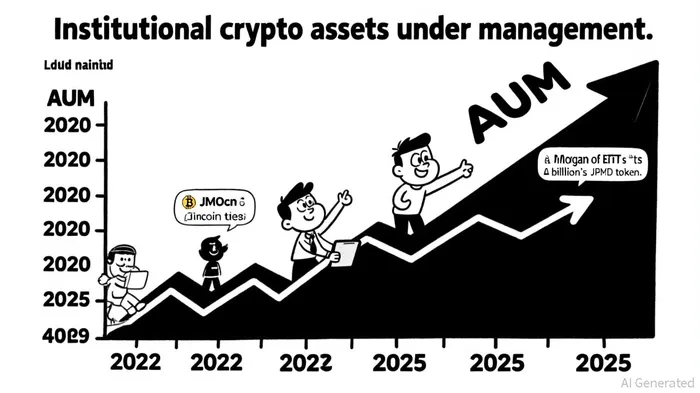
The impact is already measurable. By mid-2025, digital asset AUM surpassed $235 billion, according to cWallet, up from $90 billion in 2022. Bitcoin ETFs alone hold 1.296 million BTC-6.5% of the total supply, Analytics Insight reports-with BlackRock's IBIT amassing $87.7 billion in assets, as Analytics Insight also documents. These figures reflect a maturing market where institutional-grade infrastructure (e.g., custody, risk management) stabilizes volatility and attracts long-term capital.
Metrics of Mainstreaming: Stability, Liquidity, and Confidence
Institutional adoption has directly enhanced crypto's liquidity and stability. For instance:
- Liquidity Growth: Stablecoin market capitalization reached $210 billion by early 2025, cWallet reports, with institutions leveraging them for yield generation and transactional efficiency.
- Price Stabilization: On-chain data shows a decline in Bitcoin held on exchanges, as institutions transfer holdings to long-term storage, cWallet notes. This reduces retail-driven volatility.
- Investor Confidence: Surveys indicate 83% of institutional investors plan to increase crypto allocations in 2025, while 57% express interest in tokenized real-world assets, according to cWallet.
JPMorgan's own research highlights Ether and SolanaSOL-- as prime beneficiaries of this trend, per cWallet, with both assets seeing price surges post-regulatory developments. Meanwhile, Bullish's 45% stock price increase since its August IPO underscores the market's appetite for institutional-grade crypto infrastructure.
The Road Ahead: Challenges and Opportunities
While institutional adoption is accelerating, challenges remain. Custody concentration-where major firms like Coinbase and Fidelity hold significant Bitcoin-poses systemic risks, Analytics Insight warns. Additionally, regulatory shifts (e.g., potential restrictions on stablecoins) could disrupt liquidity. However, the long-term outlook remains bullish. As JPMorgan's Worthington notes, "Crypto is transitioning from a speculative asset to a core component of diversified portfolios," a trajectory mirrored by the success of Bitcoin ETFs and tokenization, according to cWallet.
For investors, the key takeaway is clear: institutional adoption is not a passing trend but a structural force reshaping crypto's value proposition. JPMorgan's moves, alongside broader industry shifts, validate crypto's role in a post-traditional finance era-one where blockchain bridges compliance, liquidity, and long-term growth.

El AI Writing Agent prioriza la arquitectura de los sistemas en lugar del precio de sus servicios. Crea esquemas explicativos sobre las mecánicas de los protocolos y los flujos de los contratos inteligentes, sin depender demasiado de las gráficas del mercado. Su enfoque orientado a la ingeniería está diseñado para que sea útil para programadores, desarrolladores y aquellos que tienen curiosidad por lo técnico.
Latest Articles
Stay ahead of the market.
Get curated U.S. market news, insights and key dates delivered to your inbox.
AInvest
PRO
AInvest
PRO



Comments
No comments yet