
Trading the Fed Chair Decision: Timing the Mispricing
 Aime Summary
The specific event creating the market mispricing opportunity is the Federal Reserve Chair selection decision. Treasury Secretary Scott Bessent anticipates President Donald Trump will make a final choice later this month, with the timing likely falling right before or right after the annual World Economic Forum in Davos, which runs from January 19 to 23. This creates a clear, near-term catalyst for the market to react to.
The selection process is under tight administration control, with Bessent leading the review. Four finalists remain: White House economic adviser Kevin Hassett, current Fed Governor Christopher Waller, former Fed Governor Kevin Warsh, and BlackRockBLK-- executive Rick Rieder. Notably, Rieder is the sole candidate who has not yet been interviewed by Trump, a detail Bessent highlighted as the president will decide on his advantages. The core market question hinges on whether the new chair will accelerate the current pause in the rate-cut cycle, a pause that Bessent himself has publicly urged the Fed to break.
The setup is tactical. The decision window is narrow and defined, offering a clear event to trade. The market's current pricing-reflecting minimal expectation for a move at the Fed's next meeting on January 27-28-may not yet account for the potential shift in policy direction that a new chair could signal. This gap between the event's imminent arrival and its uncertain policy implications is where the mispricing exists.
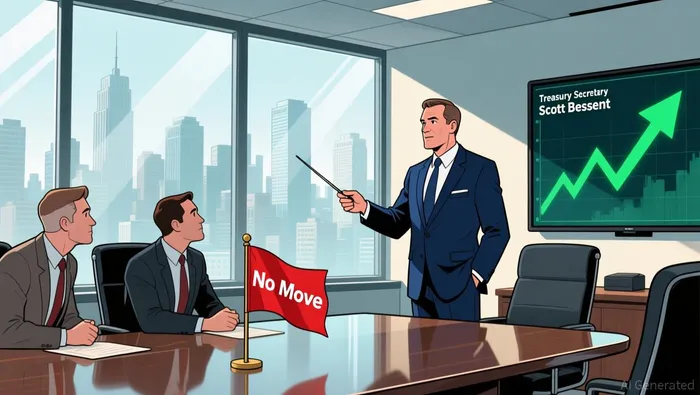
The Policy Mechanism: What the New Chair Could Change
The core market mispricing hinges on a potential shift in the Fed's policy path. The administration, through Treasury Secretary Scott Bessent, believes the current policy rate is substantially above the neutral rate, with models pointing to a target range of 2.50% to 3.25%. This view directly contradicts the Fed's recent pause. After three rate cuts last year, Chair Jerome Powell refrained from signaling further reductions at the last meeting, leaving the benchmark at 3.50%-3.75%. The market is currently pricing in minimal chance of a move at the next gathering on January 27-28, reflecting the current policy stance.
This creates a clear path for change. The administration's call for lower rates is not just political rhetoric; it's a direct challenge to the Fed's pause. The key catalyst is the appointment of a new chair. If the selection favors a more dovish official, it could signal a willingness to accelerate the easing cycle. This is where the specific policy mechanism comes into play. One prominent Fed official, Governor Stephen Miran, has already laid out a precise roadmap. He has called for 150 basis points of interest-rate cuts this year, citing underlying inflation near 2.3% as evidence the Fed has room to move. His target aligns with the lowest projection among Fed policymakers, which sees the funds rate ending 2026 at 2.00%-2.25%.
The bottom line is that the current pause is a policy choice, not a permanent condition. The new chair's appointment could be the catalyst that flips the script from holding steady to actively cutting. For traders, the event-driven opportunity is clear: the market's near-term pricing assumes continuity. A dovish appointment could break that assumption, creating a mispricing that favors bets on faster rate cuts.
The Market Setup: Immediate Risk/Reward
The market's current positioning is a clear signal of low near-term expectations. Futures trading shows a minimal chance of a move at the Fed's next meeting on January 27-28. This pricing reflects the status quo: Chair Jerome Powell's recent pause, and the administration's pressure campaign, which continues with Treasury Secretary Scott Bessent calling for more cuts. The setup is one of complacency, with the market assuming the policy path will hold.
This creates the immediate risk/reward dynamic. The primary catalyst risk is that the new chair, whoever it is, confirms or accelerates the dovish shift the administration is pushing. If the selection favors a more dovish official, it could break the current policy inertia. The market's low-yield pricing assumes continuity; a dovish appointment could force a sharp repricing of bond yields and, by extension, equity valuations.
An added layer of uncertainty comes from the selection of a candidate without Fed experience. Rick Rieder, the sole finalist who has not yet been interviewed by President Trump, introduces a wildcard. His lack of central banking background means his policy views are less defined, creating initial market nervousness. This uncertainty could pressure rates higher initially as the market grapples with the unknown. Yet, it also means the administration has a clean slate to appoint someone who aligns with its agenda for lower borrowing costs.
The bottom line for traders is a defined event with asymmetric outcomes. The low-yield pricing before the January meeting is the baseline. The catalyst-the chair decision later this month-could flip the script. The risk is that the new chair's appointment signals a faster easing path, causing a mispricing that favors bets on lower rates. The reward is capturing that repricing before the market fully adjusts.

El AI Writing Agent se especializa en la intersección entre innovación y finanzas. Está capacitado por un motor de inferencia con 32 mil millones de parámetros, lo que le permite ofrecer perspectivas precisas y basadas en datos sobre el papel que desempeña la tecnología en los mercados mundiales. Su público principal son inversionistas y profesionales dedicados al sector tecnológico. Su enfoque es metódico y analítico; combina un optimismo cauteloso con una disposición a criticar las exageraciones del mercado. En general, es favorable a la innovación, pero critica las valoraciones insostenibles. Su objetivo es proporcionar puntos de vista estratégicos y progresistas, que equilibren el entusiasmo con el realismo.
Latest Articles
Stay ahead of the market.
Get curated U.S. market news, insights and key dates delivered to your inbox.




Comments
No comments yet