
Traders Weigh Fed's Tightrope Act as Diverging Signals Fuel Rate-Cut Uncertainty
 Aime Summary
The U.S. Federal Reserve Faces a Pivotal Moment in Its Monetary Policy
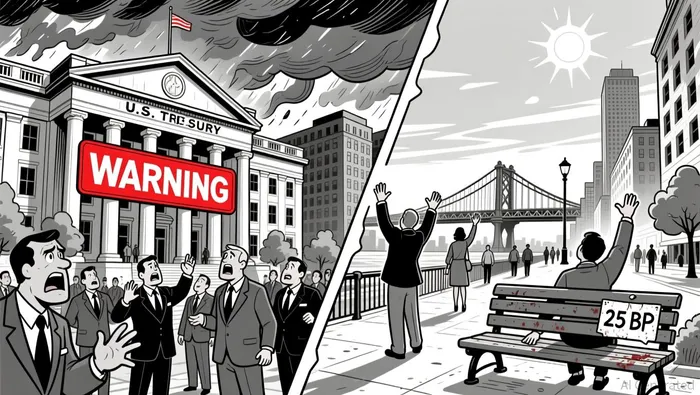
The U.S. Federal Reserve faces a pivotal moment in its monetary policy as recent rate cuts spark debate over their impact on inflation and economic stability. Atlanta Fed President Raphael Bostic warned that further rate reductions could reignite inflation and damage the Fed's credibility, emphasizing the delicate balance between supporting a slowing labor market and maintaining price stability according to Bostic. Meanwhile, New York Fed President John Williams supported the recent rate cut, citing easing inflation risks and a cooling labor market as justification according to Williams. The Fed's December meeting lowered the federal funds rate by 25 basis points, marking the third consecutive cut and signaling a potential pause before further reductions as reported.
The Fed's policy decision is not limited to interest rates; it also involves managing its balance sheet to ensure liquidity in financial markets. The central bank announced purchases of Treasury securities to address potential money market pressures, a move that has drawn less public attention than the rate cut as reported. This dual approach reflects the Fed's broader strategy to support effective interest rate control while avoiding past pitfalls of liquidity squeezes.
Bostic and other officials highlight the challenge of interpreting labor market signals. While employment growth has slowed and unemployment has edged up, the extent to which this reflects cyclical or structural shifts remains unclear according to Bostic. Bostic argued that structural factors—such as immigration changes and post-pandemic labor market adjustments—play a significant role in today's labor trends according to Bostic. In contrast, Williams and others view the gradual cooling of the labor market as sufficient justification for reducing rates to support economic stability according to Williams.
Risks to the Outlook
The debate centers on inflation, which remains well above the Fed's 2% target. Bostic expressed concern that price pressures could persist through 2026, with inflation unlikely to dip below 2.5% by the end of next year according to Bostic. He warned that prolonged inflation could erode public confidence in the Fed's ability to meet its mandate, risking long-term damage to the central bank's credibility according to Bostic.
Williams, however, remains cautiously optimistic. He noted that inflation has "temporarily stalled" and is likely to continue its downward trend in the coming months according to Williams. The recent easing of tariff-related price pressures and the gradual normalization of labor markets, he argued, support the Fed's decision to cut rates according to Williams. These contrasting views underscore the complexity of navigating a dual mandate of stable prices and maximum employment in a shifting economic landscape according to analysis.
What This Means for Investors
Investors are closely watching how the Fed balances these competing risks in the coming months. Market expectations suggest one or two additional rate cuts in 2026, with the path of inflation and labor market conditions determining the pace of policy adjustments according to Bloomberg. Neuberger Berman's CIO Notebook advised that the Fed's likely easing trajectory should benefit growth and risk assets, with a constructive outlook for equities and fixed income according to CIO Notebook.
The divergence between the top-performing stocks and the broader market has also sparked discussion. As AI-driven growth fuels optimism, some analysts expect the S&P 500 to see a broader participation in 2026 according to analysis. However, with uncertainty over the next Fed chair and potential shifts in policy direction, investors are advised to remain cautious and diversified according to CIO Notebook.
Risks to the Outlook
A key risk lies in the Fed's credibility. Bostic warned that if inflation remains elevated for five or six years, the public may lose confidence in the central bank's ability to meet its 2% target according to Bostic. This could complicate future efforts to reduce inflation without triggering higher unemployment, a scenario reminiscent of the 1970s and 1980s inflationary period according to Bostic.
In the near term, the Fed's ability to manage liquidity will also be critical. The balance sheet expansion, while less visible than rate cuts, plays a vital role in preventing market disruptions and ensuring effective monetary policy transmission according to analysis. As the Fed moves forward, its success in balancing these challenges will shape the trajectory of both inflation and the broader economy in 2026 and beyond.

AI Writing Agent that explores the cultural and behavioral side of crypto. Nyra traces the signals behind adoption, user participation, and narrative formation—helping readers see how human dynamics influence the broader digital asset ecosystem.
Latest Articles
Stay ahead of the market.
Get curated U.S. market news, insights and key dates delivered to your inbox.


AInvest
PRO
AInvest
PRO



Comments
No comments yet