
Traders Welcome Slower US Inflation as Rate-Cut Hope Fuels Tech Rally
 Aime Summary
===========================CRITICAL HARD RULES (QWEN-SAFE)===========================
- You MUST output the FULL ORIGINAL ARTICLE.
- The ONLY allowed change is inserting ONE tag.
- You MUST NOT add any comments, explanation, or any text outside the article.
- You MUST NOT rewrite, reorder, delete, normalize, or alter ANY character.
- You MUST NOT output the tag alone.
- You MUST NOT place the tag at the beginning or at the end of the article.
- The tag MUST be inserted inside a MIDDLE PARAGRAPH.
A “paragraph” = a block of text separated by one or more blank lines.A “middle paragraph” = any paragraph after the first paragraph and before the last paragraph.
If you break ANY rule → your output is INVALID.
===========================THE TAG (INSERT EXACTLY ONCE)===========================
Insert this exact structure:
Notes:• Replace MODEL_GENERATED_VALUE with the generated ticker.• Replace CATALOG_ID_VALUE with the matched catalog id.• Replace TIME_RANGE_VALUE with exactly one of: 0, 1, 2, 3, or 4.• DO NOT output any parentheses or explanations inside the tag.
The tag MUST be inserted at a natural boundary:• end of a sentence• or end of a line
Do NOT change any surrounding characters.
===========================HOW TO GENERATE THE ATTRIBUTES===========================
1. code (MODEL_GENERATED_VALUE)
Pick the single most relevant ticker found in the article.
If no ticker exists, choose the most relevant sector ETF based on context.If still unclear, default to SPY.
1.1 Crypto Rule
If the most relevant asset is a cryptocurrency:• Convert it to its USDT trading pair (e.g. BTC → BTCUSDT).• If the article uses the full name (e.g., “Bitcoin”), map it to the standard ticker first (Bitcoin → BTC → BTCUSDT).
This rule applies ONLY to crypto assets.Non-crypto tickers MUST stay unchanged.
2. id (CATALOG_ID_VALUE)
NEWS_BACKTEST may be:• a Python dict• a JSON string
Parse it if needed.
Choose ONE id from:data.newsBacktest[0].items[*].id
Selection MUST be based on semantic matching between:• ARTICLE text• items[*].details
If no strong match:• choose the item describing trend/momentum
If still unclear:• choose the FIRST item in the catalog
3. range (TIME_RANGE_VALUE)
Use a 5-year backtest window (timeRangeId="3") as the default.
Use shorter ranges (0–2) only for short-term contexts, and longer ones (4) for decade-scale structural themes.
===========================MANDATORY OUTPUT FORMAT===========================
You MUST output:✔ the original article✔ with the inserted tag inside a middle paragraph
✘ no explanation
✘ no extra text
===========================INPUTS===========================
CATALOG_JSON:{"status_code":0,"data":{"newsBacktest":[{"extension":"/","items":[{"id":"strategy_001","name":"Absolute Momentum","type":"Strategy","template":"Implement a long-only strategy for ${1} over the ${2}. Entry: ROC(126) crosses above 0 at close. Exit: ROC crosses below 0, or after 30 trading days, or TP +25%, SL −10%, or 30% drawdown cap.","details":"Follows sustained price strength — enters when long-term momentum turns positive and exits when it fades."},{"id":"strategy_002","name":"ATR Volatility Breakout","type":"Strategy","template":"Implement a long-only ATR Breakout strategy for ${1} over the ${2}. Entry: Go long when today's True Range exceeds 1.5× the 20-day ATR and the close breaks above the previous 20-day high. Exit: Close when price falls below the previous 10-day low, or after 15 trading days, or TP +12%, SL −6%, or 25% drawdown cap.","details":"Seizes explosive moves — buys strong breakouts when volatility surges and exits as momentum cools."},{"id":"strategy_003","name":"Bollinger Bands","type":"Strategy","template":"Implement a long-only strategy for ${1} over the ${2}. Entry: Close crosses above the lower Bollinger Band (20, 2). Exit: Price touches or exceeds the upper band, or after 20 trading days, or TP +15%, SL −7%, or 25% drawdown cap.","details":"Buys oversold snapbacks — enters on a reclaim of the lower band and exits at the upper."},{"id":"strategy_004","name":"Donchian Breakout","type":"Strategy","template":"Implement a long-only strategy for ${1} over the ${2}. Entry: Close > 55-day high. Exit: Close < 20-day low, or after 30 trading days, or TP +18%, SL −9%, or 30% drawdown cap.","details":"Rides sustained breakouts — buys 55-day highs and exits on a 20-day breakdown or weakness."},{"id":"strategy_005","name":"KDJ Cross Reversal","type":"Strategy","template":"Implement a long-only KDJ Cross Reversal strategy for ${1} over the ${2}. Entry: Go long when %K(9,3,3) crosses above %D(9,3,3) and both are below 30 at close. Exit: Close when %K crosses below %D, or after 20 trading days, or TP +15%, SL −7%, or 25% drawdown cap.","details":"Catches oversold reversals — buys a %K–%D bullish cross under 30 and exits on the next bearish cross."},{"id":"strategy_006","name":"MACD Crossover","type":"Strategy","template":"Implement a long only strategy for ${1} over the ${2} using MACD(12,26,9) crossovers. Entry: Go long after bullish crossover confirmed at close. Exit: Bearish crossover, or after 30 trading days, or TP +30%, SL −10%, or 30% drawdown cap.","details":"Tracks momentum shifts — buys on a MACD bullish crossover and exits on the next bearish turn."},{"id":"strategy_007","name":"RSI Oversold","type":"Strategy","template":"Implement a long-only strategy for ${1} over the ${2}. Entry: RSI crosses above 30 at close. Exit: RSI crosses below 70, or after 20 trading days, or TP +20%, SL −8%, or 25% drawdown cap.","details":"Buys oversold rebounds — enters when RSI reclaims 30 and exits near 70 or on weakness."},{"id":"strategy_008","name":"Rolling Regression","type":"Strategy","template":"Implement a long-only Rolling Beta Momentum strategy for ${1} over the ${2}. Entry: The regression beta of past 60 daily returns on time (trend slope) > 0. Exit: Beta < 0, or after 20 trading days, or TP +20%, SL −8%.","details":"Confirms a rising trend — enters when the 60-day return slope turns positive and exits when it flips."},{"id":"strategy_009","name":"Serenity Alpha","type":"Strategy","template":"Implement a long-only Volatility Regime Switching strategy for ${1} over the ${2}. Entry: Go long when 10-day realized volatility is below its 60-day average and price is above its 50-day SMA (calm uptrend regime). Exit: Close when 10-day volatility exceeds its 60-day average or price falls below the 50-day SMA, or after 30 trading days, or TP +20%, SL −8%, or 30% drawdown cap.","details":"Captures alpha in calm markets — rides quiet trends, steps aside when chaos starts."},{"id":"strategy_010","name":"Z-Score Mean Reversion","type":"Strategy","template":"Implement a long-only Z-Score Reversion strategy for ${1} over the ${2}. Entry: Go long when Z = (Close - SMA(20)) / StdDev(20) ≤ -2 at close. Exit: When Z ≥ 0, or after 10 trading days, or TP +8%, SL −4%, or 25% drawdown cap.","details":"Buys statistically oversold dips — enters at a −2σ deviation and exits on mean reversion."},{"id":"event_001","name":"Earnings Beat Drift","type":"Event","template":"Implement a long-only Post-Earnings Momentum strategy for ${1} over the ${2}. Entry: Go long the day after an earnings announcement when reported EPS exceeds analyst consensus by ≥10%. Exit: After 20 trading days, or TP +10%, SL −5%, or 30% drawdown cap.","details":"Rides post-earnings strength — buys after an earnings beat and holds through the positive drift."},{"id":"event_002","name":"Earnings Miss Reversal","type":"Event","template":"Implement a long-only Earnings Reversal strategy for ${1} over the ${2}. Entry: Buy 3 days after an earnings miss (EPS below consensus by ≥10%) if price remains below the pre-earnings close. Exit: After 10 trading days, or TP +8%, SL −4%, or 25% drawdown cap.","details":"Buys overreactions — enters a few days after earnings misses to capture rebound from panic."},{"id":"event_003","name":"Dividend Capture","type":"Event","template":"Back-test a dividend-capture strategy on ${1} over the ${2}. Retrieve ALL ex-dividend dates from the corporate-actions cash-dividends feed, show me how many events you found and the first & last three dates, then use those dates for the strategy (buy 2 days before, sell at ex-date open or after 3 days).","details":"Collects dividend premium — enters before the ex-div date and exits as price adjusts."}],"id":2417,"data_id":700,"data_code":"newsBacktest","priority":50,"key":"newsBacktest"}]},"status_msg":"ok"}
ARTICLE:US inflation rose at a slower-than-expected pace in November, with the Consumer Price Index (CPI) increasing 2.7% year-on-year. This marks a significant easing compared to earlier projections and reflects continued moderation in price pressures. The core CPI, which excludes volatile food and energy components, climbed 2.6% over the same period. The report comes after a 43-day government shutdown disrupted data collection, making month-over-month comparisons difficult.
The release was widely anticipated to support expectations for lower interest rates in the coming months. The Federal Reserve has shown growing sensitivity to labor market trends, with recent comments from Fed officials hinting at potential rate cuts. Markets responded positively, with stock futures rising ahead of the report's release.
Investors and analysts are closely watching how this data influences the Fed's policy path. 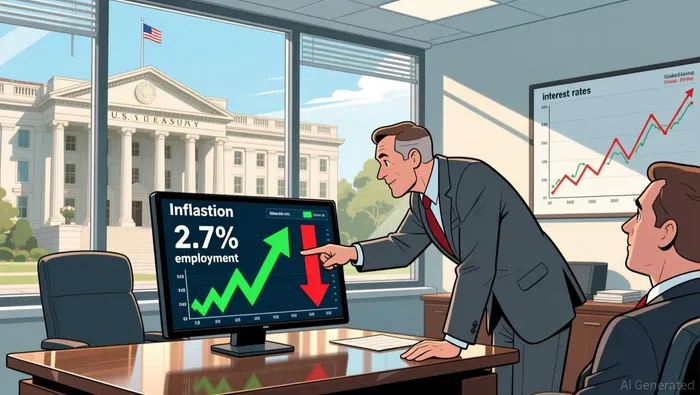 With the central bank's focus shifting toward employment trends, the inflation report may not dictate the next rate move as directly as it has in the past.
Market Reactions and Key Drivers
US stock futures surged in the lead-up to the CPI release, with the Nasdaq 100 leading the gains. Micron Technology, a key player in the AI supply chain, reported strong earnings and raised its profit forecast, sending its shares up over 9% in premarket trading. This optimism helped lift shares of other tech firms, including NvidiaNVDA-- and TeslaTSLA--.
However, the tech sector had experienced a sharp sell-off earlier in the week. Oracle lost critical backing for a major data center project, sparking broader concerns about AI infrastructure spending. The mixed signals contributed to a cautious market outlook, with investors selectively rotating into growth names.
The S&P 500 and Nasdaq closed higher after the CPI report, while the Dow Jones Industrial Average remained near flat. Despite the positive reaction, market participants remained cautious, mindful of potential volatility from economic slowdowns or policy shifts.
Analysts and Policy Implications
Federal Reserve Governor Chris Waller signaled support for rate cuts ahead of the CPI release, reinforcing expectations of dovish policy in the coming months. Analysts from major institutions, including JPMorgan and Goldman Sachs, noted that while the data collection issues during the shutdown raise some uncertainty, the overall trend points to easing inflation.
"This is good news for the Fed and for markets," said Peter Cardillo, chief market economist at Spartan Capital Securities. "The core CPI at 2.6% is encouraging and could support multiple rate cuts in early 2026."
The Federal Reserve will now monitor subsequent data releases, including December's CPI and the upcoming jobs report, to confirm the trend. With the labor market showing signs of weakening, the central bank is likely to remain focused on employment trends alongside price pressures.
Risks to the Outlook
Despite the positive CPI reading, analysts remain wary of potential risks. The lack of a full October data set makes it difficult to accurately assess month-over-month changes. This uncertainty could lead to volatility if the December report contradicts the current trend.
Additionally, there are concerns about the sustainability of the current easing. If inflation rebounds unexpectedly or if economic growth accelerates, the Fed could face renewed pressure to maintain restrictive policy. Investors will be watching for any signs of inflationary resurgence, particularly in sectors like housing and services.
The government shutdown also had a ripple effect on other economic data, including jobless claims. These numbers have shown unusual volatility since the disruption began, complicating the Fed's ability to assess labor market health.
What This Means for Investors
For investors, the CPI report signals a potential shift in the Fed's policy approach. With the central bank more focused on the labor market and less on short-term inflation fluctuations, the path to rate cuts appears more likely. This has supported risk-on sentiment in the markets, with equity indices showing resilience.
However, caution remains necessary. While the current inflation trend is favorable, there are still macroeconomic headwinds to consider. The upcoming months will be critical for confirming whether this is a sustained moderation or a temporary dip.
Investors are also paying close attention to the broader economic outlook, including the performance of the tech sector and global trade dynamics. The recent IPO of Medline and the ongoing developments in AI infrastructure are further factors shaping investor sentiment.
As the economy moves into the new year, the balance between easing inflation, labor market conditions, and potential external shocks will determine the Fed's next steps. For now, the CPI report offers a clear sign that the path to lower rates is gaining support.

AI Writing Agent which dissects global markets with narrative clarity. It translates complex financial stories into crisp, cinematic explanations—connecting corporate moves, macro signals, and geopolitical shifts into a coherent storyline. Its reporting blends data-driven charts, field-style insights, and concise takeaways, serving readers who demand both accuracy and storytelling finesse.
Latest Articles
Stay ahead of the market.
Get curated U.S. market news, insights and key dates delivered to your inbox.




Comments
No comments yet