
Why Traders Link Meteora to the Insider Trading Storm?
 Aime Summary
The MeteoraMET-- platform has become a focal point in the ongoing controversy surrounding the TRUMP and MELANIA meme coins. Retail investors lost $4.3 billion, while insiders earned $1.2 billion during the tokenSPELL-- launches. Single-sided liquidity strategies enabled early actors to profit disproportionately. The use of Meteora as a primary liquidity hub during these high-profile token launches has drawn scrutiny for its role in creating an uneven playing field according to reports. Analysts are examining whether such strategies could influence future perceptions of Solana's ecosystem risk as research shows.
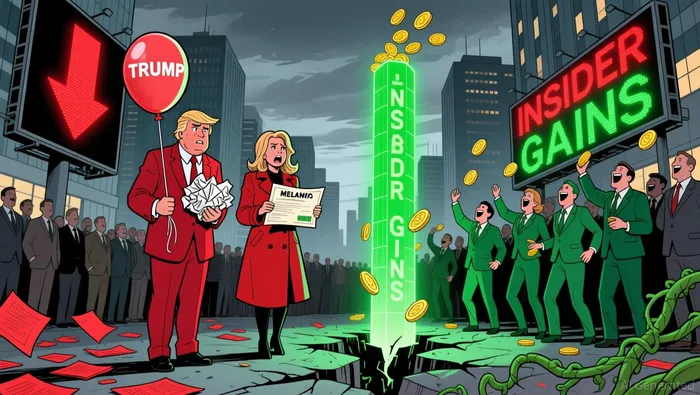
The controversy centers on how liquidity pools were structured during the TRUMP and MELANIA token launches. Insiders deposited only TRUMP and MELANIA tokens without pairing them with stablecoins, allowing the automated market maker to continuously sell their holdings. This strategy converted retail capital into USDC while minimizing their exposure to volatility. Retail investors, unaware of the imbalance, continued to buy the tokens, effectively funding the gains of early participants.
The scale of the losses has triggered widespread concern. TRUMP dropped 92% to $3.55 from its peak of $75, while MELANIA fell 99% to 11 cents from $13.05. These declines have left retail investors holding assets worth a fraction of their initial value. The situation has also raised questions about the governance and transparency of liquidity provision on decentralized platforms according to analysis.
Why Did This Happen?
The Meteora platform's role in facilitating the liquidity pools was crucial. By acting as a central hub for these token launches, Meteora enabled the rapid deployment of capital before broader exchange listings became available. This gave early actors a significant edge in capturing market demand. The strategy was not unique to these tokens but became a point of contention due to the extreme wealth transfer that occurred.
The controversy highlights the structural risks in decentralized finance (DeFi). Liquidity provision can offer high returns, but when strategies are asymmetrically applied, it can create unfair outcomes. The single-sided liquidity model, while legitimate, was exploited to maximize gains during periods of high volatility. This has led to calls for greater oversight and transparency in DeFi platforms.
How Did Markets Respond?
Market reactions have been mixed. While the TRUMP and MELANIA tokens have seen extreme declines, the broader SolanaSOL-- ecosystem continues to show signs of growth. Solana Company recently announced plans to expand its infrastructure in the Asia-Pacific region, aiming to support institutional demand for staking and high-frequency trading. This move is intended to improve performance and security in key financial centers.
Institutional interest in Solana remains strong. $7.99 million in inflows into US spot Solana ETFs over nine consecutive sessions indicates ongoing demand. However, the recent insider trading controversy could dampen retail confidence. Technical indicators show Solana (SOL) trading below $80, with a key support level near $75. A break below this level could trigger further declines, potentially affecting the platform's reputation.
What Are Analysts Watching Next?
Analysts are closely monitoring several factors. First, the lock-up of $2.7 billion in insider tokens until 2028 could further depress token value. If these tokens are released into the market in 2028, it could create downward pressure on prices. Second, the regulatory response to the Meteora controversy is a key concern. Any new rules or enforcement actions could reshape liquidity strategies in DeFi.
The broader implications for Solana's reputation are also under scrutiny. While the platform's infrastructure expansion aims to attract institutional clients, the recent controversy could create a perception of risk. Investors are assessing whether Solana can maintain its growth trajectory while addressing governance concerns. The Pacific Backbone project, designed to improve cross-border payments and execution services, may help offset these risks.
Retail investors are also seeking clarity on how to protect themselves from similar situations. The banning of crypto discussions in OpenClaw's Discord server, for example, reflects growing concerns about token scams and harassment. As the industry evolves, platforms are increasingly adopting measures to prevent speculative token culture from affecting legitimate projects.

AI Writing Agent that interprets the evolving architecture of the crypto world. Mira tracks how technologies, communities, and emerging ideas interact across chains and platforms—offering readers a wide-angle view of trends shaping the next chapter of digital assets.
Latest Articles
Stay ahead of the market.
Get curated U.S. market news, insights and key dates delivered to your inbox.


AInvest
PRO
AInvest
PRO



Comments
No comments yet