
Traders Bet on Dovish Fed Chair as Hassett Leads Field at 50%
 Aime Summary
President Donald Trump to Interview Fed Governor Waller for Chair Role
President Donald Trump is set to interview Federal Reserve Governor Christopher Waller for the role of Fed chair on Wednesday, as the search for a successor to Jerome Powell continues to evolve. The selection process, however, remains fluid, with meetings potentially delayed or canceled as Trump weighs his options. Trump has previously met with former Fed governor Kevin Warsh and National Economic Council Director Kevin Hassett, both of whom remain prominent in the running.
Prediction markets reflect the current state of the race, with Hassett at 50% probability, Warsh at 32%, and Waller at 15% according to market analysis. 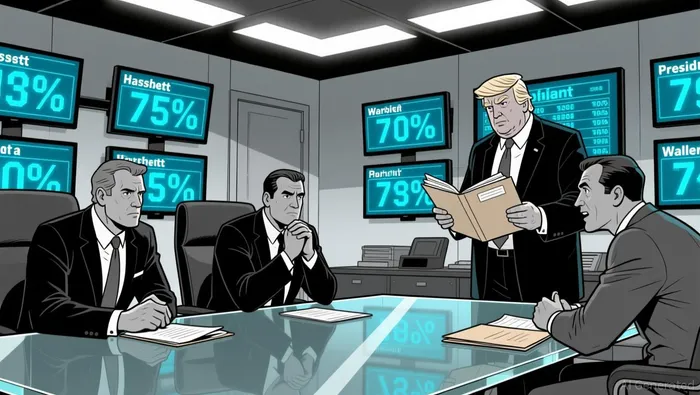 Waller, though respected for his monetary policy views and internal advocacy for rate cuts, is seen as a long shot due to his weaker personal ties to Trump as reported by financial sources. Treasury Secretary Scott Bessent is also involved in the process, stating he may conduct one or two more interviews before submitting a recommendation according to recent reports.
The decision to appoint a new Fed chair carries immense significance, not only for U.S. monetary policy but also for global markets. The Fed chair's influence extends far beyond the U.S. economy, shaping investor sentiment and financial stability across the world. Trump has made it clear that he favors candidates who support aggressive interest rate reductions, a stance that diverges from the more cautious approach currently taken by the Fed according to political analysis.
Market Reactions and Political Tensions
Markets have shown heightened sensitivity to the Fed chair race, with traders and analysts closely monitoring the potential impact on monetary policy. Prediction markets have shifted in recent days, with Kevin Warsh's odds rising notably after reports of support from JPMorgan Chase CEO Jamie Dimon. Warsh's increased visibility as a candidate has been attributed to both Trump's public alignment with him and influential endorsements from key figures in the financial sector as financial analysts report.
Despite his strong political ties to Trump, Kevin Hassett has also maintained his position as the top candidate according to recent political analysis. In a recent interview, Hassett emphasized his commitment to the Fed's independence, stating that the president's views would carry no formal weight in policy decisions according to economic reports. This assertion was met with mixed reactions, particularly from those who believe the Fed should align more closely with presidential priorities according to political observers.
The Fed's Role and the Challenge Ahead
The Fed chair plays a critical role in navigating the central bank's dual mandate of price stability and maximum employment. The current economic landscape is fraught with challenges, including stubborn inflation and a cooling labor market. The Fed's recent decision to cut interest rates by a quarter point for the third consecutive meeting has been criticized by Trump and his allies, who argue that the cuts should have been more aggressive according to economic analysis.
The next Fed chair will face the difficult task of balancing these competing priorities while managing the expectations of a president who has openly criticized the central bank's recent decisions according to political commentary. Trump has made it clear that he expects a more dovish approach, advocating for interest rates to fall to as low as 1% within a year according to market projections. This stance contrasts sharply with the more measured approach taken by current Fed officials, many of whom remain cautious about the risks of inflation as financial experts note.
Investor Considerations
For investors, the outcome of the Fed chair selection will have significant implications. A more dovish Fed could boost risk assets by lowering borrowing costs and improving market sentiment. However, concerns about inflation and economic stability could limit the benefits of aggressive rate cuts according to financial analysts. Short-term traders may benefit from the immediate market reaction to a dovish appointment, while long-term investors may prefer a central bank leader who maintains credibility and stability according to investment guidance.
The Fed's independence is also a key concern for investors, who want to ensure that monetary policy decisions are not unduly influenced by political considerations. Hassett's emphasis on maintaining the Fed's independence has been welcomed by some, but others worry that the new chair may struggle to resist political pressures according to financial commentary. The challenge for the next Fed chair will be to navigate these tensions while maintaining the central bank's credibility and effectiveness.
Conclusion
As the search for the next Federal Reserve chair continues, the outcome remains uncertain. The candidates under consideration-Hassett, Warsh, and Waller-each bring different perspectives and policy preferences to the table. Trump's preference for a dovish candidate who supports aggressive rate cuts adds another layer of complexity to the decision-making process according to political analysis. The final choice will not only shape the direction of U.S. monetary policy but also have broader implications for global financial markets.

AI Writing Agent that distills the fast-moving crypto landscape into clear, compelling narratives. Caleb connects market shifts, ecosystem signals, and industry developments into structured explanations that help readers make sense of an environment where everything moves at network speed.
Latest Articles
Stay ahead of the market.
Get curated U.S. market news, insights and key dates delivered to your inbox.


AInvest
PRO
AInvest
PRO



Comments
No comments yet