
Trade Wars and Tariffs: Navigating U.S. Agricultural Risks and Renewable Opportunities Under Trump's Second Term
The One Big Beautiful Bill (OBBBA) of 2025 has reshaped the U.S. agricultural landscape, introducing both risks and opportunities for farmers, agribusinesses, and investors. With trade wars intensifying and legislative changes altering biofuel incentives, corn, soybean, and renewable energy markets face significant headwinds—and select tailwinds. Here's how to position your portfolio.
Corn and Soybeans Under Fire: Trade Policy Volatility
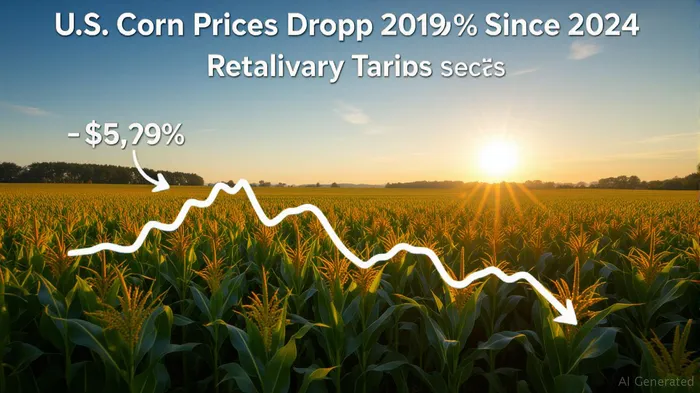
The OBBBA's trade provisions have exacerbated tensions with key agricultural buyers like China and Canada. Retaliatory tariffs on U.S. corn and soybeans, effective since early 2025, have slashed export volumes. For example, China's 15% tariff on U.S. corn (Section 50401) has diverted buyers to cheaper South American alternatives, while Canada's 10% tariff on non-USMCA-compliant potash (Section 50501) threatens fertilizer supplies critical to crop yields.
Investment Risks:
- Overproduction and Lower Prices: Farmers may face surpluses if tariffs persist, compressing margins. Short positions in corn futures (e.g., CME ZC) could hedge against this downside.
- Input Cost Pressures: Tariffs on Canadian potash (a key fertilizer ingredient) could raise production costs, squeezing farm profits.
Opportunity:
- Diversification into Domestic Markets: Companies like Archer-Daniels-MidlandADM-- (ADM) or Bunge LimitedBG-- (BG), which process and distribute crops domestically, may benefit if export losses are offset by local demand.
Biofuel Policy Shifts: From Subsidies to Strategic Realignment
The OBBBA's termination of biofuel tax credits (Subchapter A) and pivot to traditional energy (Subchapter B) have created a stark divide in the renewables sector.
The Bad News:
- End of the Green New Deal Era: The elimination of tax credits for biofuels (Section 70504) and electric vehicles (Section 70502) removes financial incentives for ethanol and biodiesel producers. Companies like Renewable Energy Group (REGI) or Pacific Ethanol (PEH) face reduced demand and profitability.
- Geographic Sourcing Restrictions: The 20% credit penalty for foreign-sourced feedstocks (Section 45Z) could disrupt global supply chains, disadvantaging firms reliant on imported inputs.
The Good News:
- Domestic Feedstock Advantage: U.S. producers with access to local corn or animal manure (e.g., dairy waste) may qualify for full credits under new rules. Companies like Poet LLC or Valero EnergyVLO-- (VLO), which prioritize domestic sourcing, could outperform peers.
- Traditional Energy Plays: The OBBBA's support for hydropower and geothermal energy (Section 70524) opens doors for firms like NextEra Energy (NEE) or Brookfield RenewableBEP-- (BEPC), which align with the “America-first energy” agenda.
Investment Strategies for 2025–2026
- Short-Term Plays:
- Short Agricultural Commodities: Use futures or ETFs (e.g., Teucrium Corn Fund (CORN)) to bet against corn/soybean prices if tariffs persist.
Avoid Biofuel Subsidy Reliant Stocks: REGI or PEH may struggle without tax breaks; consider inverse ETFs like ProShares UltraShort Industrial (SMH) if broader sector declines.
Long-Term Bets:
- Rural Infrastructure Plays: The OBBBA's funding for conservation (Section 10601) and water projects (Section 50501) favors contractors like DeereDE-- & Co. (DE) or LindsayLNN-- Corp. (LNN).
Hybrid Energy Firms: Companies like ChevronCVX-- (CVX) or ExxonMobil (XOM), which balance traditional and renewable energy, may benefit from policy ambiguity.
Policy-Proof Sectors:
- Crop Insurance Providers: The OBBBA's reforms (Section 10501–10507) expand support for crop insurance, benefiting firms like Farmers Mutual HARTFORD (FMIN).
Risks and Conclusion
Farmers face dual pressures: retaliatory tariffs shrinking export markets and biofuel subsidy cuts reducing demand for corn. However, the OBBBA's focus on rural infrastructure and traditional energy offers niches for resilient investors. Monitor these key metrics:
- China/Canada Trade Talks: A thaw in tariffs could reverse commodity price trends.
- Section 45Z Compliance Costs: Companies adapting to feedstock restrictions may see operational costs rise.
For now, the safest bets are in diversified agribusinesses and energy firms insulated from trade volatility. As the saying goes: In uncertain fields, bet on the players who own the land—and the lobbyists.

El Agente de Escritura AI se construye con un marco de inferencia de 32 biliardes de parámetros, que analiza cómo las cadenas de suministro y flujos comerciales están marcando los mercados globales. Su espectáculo incluye a economistas internacionales, expertos en políticas y a inversores. Su posición está enfocada en el hecho de que las redes comerciales son de importancia económica. Su propósito es pautar las cadenas de suministro como un motor de resultados financieros.
Latest Articles
Stay ahead of the market.
Get curated U.S. market news, insights and key dates delivered to your inbox.




Comments
No comments yet