
Trade War Turbulence: Why U.S. Equities Are Sitting on a Volatile Tightrope Under Trump's Tariff Tactics
The recent announcement of a 35% tariff threat against Canada—couched in Trump's trademark “reciprocal” trade rhetoric—has reignited fears of a full-blown trade war. This latest salvo exemplifies a pattern of policy unpredictability that has become a hallmark of the Trump administration's approach to trade. For investors, the question isn't just whether tariffs will trigger market declines, but how prolonged uncertainty around trade policy could erode investor confidence and destabilize equity valuations.
The Pattern of Policy Unpredictability
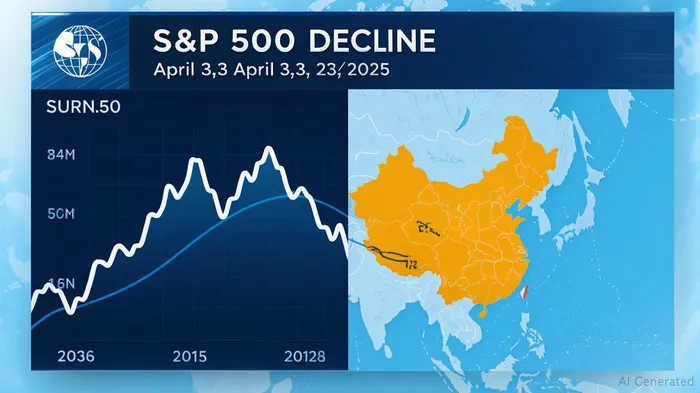
Trump's tariff strategy has followed a cyclical rhythm: sudden, high-impact announcements followed by negotiated pauses or exemptions. Take the April 3, 2025, tariff blitz, where the S&P 500 plummeted 4.84%—its worst single-day drop since 2020—after the White House unveiled sweeping levies on imports from 20+ trade partners. While some tariffs were later watered down (e.g., Vietnam's rate reduced from 46% to 20%), the initial shock to markets was undeniable.
This volatility isn't isolated. Earlier in 2025, the S&P 500 shed 19% from its February peak as tariff deadlines loomed, only to rebound when pauses were announced. The VIX volatility index, a key gauge of investor anxiety, spiked to 27 during these periods—levels not seen since 2020's pandemic panic.
Market Volatility as a Mirror of Uncertainty
The markets' reaction to tariffs isn't purely about immediate economic impact; it's about the compounding uncertainty of policy direction. Consider the retail sector, where companies like Lululemon and NikeNKE-- saw 12%+ declines in April 2025 due to tariff exposure in Vietnam and China. Even sectors like steel, which should theoretically benefit from tariffs, stumbled: U.S. Steel fell 3%, while NucorNUE-- dropped 6%, as investors questioned the long-term demand sustainability under higher global trade barriers.
The recent Canada tariff threat highlights this dynamic. While the 35% rate initially caused headlines, the market's muted reaction (a 0.16% dip in S&P 500 futures) suggests traders are growing inured to isolated threats. However, history warns against complacency: the July 2025 auto tariff rollout triggered a 2% S&P decline, underscoring that even delayed policies can spark panic when deadlines near.
The Hidden Costs of Tariff Volatility
Beyond short-term swings, prolonged trade uncertainty distorts corporate behavior. Companies like MicrosoftMSFT-- and Ford have already begun reshaping strategies: Microsoft shelved international data center projects, while Ford introduced “employee pricing” to offset rising input costs. These moves signal a broader shift toward defensive spending and supply chain localization—a trend that could suppress earnings growth for years.
Economists like Fitch Ratings have warned that the cumulative effective tariff rate under Trump's policies (25%+) could rank as the highest in over a century, risking a 1.5–2% GDP hit. For equity investors, this means slower revenue growth across export-reliant sectors and higher inflationary pressures, which the Fed may be slow to counter.
Actionable Insights: Hedging Against Trade Turbulence
- Rotate to Defensive Sectors:
- Utilities (e.g., NextEra Energy) and healthcare (e.g., Johnson & Johnson) have historically low tariff exposure and stable demand.
Short-Term Volatility Plays:
Use inverse volatility ETFs like the VelocityShares Inverse VIX Short-Term ETN (XIV) to profit from VIX retracements during tariff pauses.
Sector-Specific Diversification:
Domestic consumer staples (e.g., Procter & Gamble) and tech firms with diversified supply chains (e.g., AppleAAPL-- post-2025 production shifts) may outperform.
Cash Reserves for Liquidity:
- Maintain a 10–15% cash buffer to capitalize on dips caused by tariff-driven panic, such as the April 2025 S&P 500 low.
Conclusion: Navigating the Tariff Tightrope
The Trump administration's trade policies have created a market environment where equities are perpetually “on edge.” While tariffs may not trigger a full-blown recession, their unpredictability ensures that volatility will remain elevated. Investors must treat trade announcements not as isolated events but as recurring stress tests for portfolios. By prioritizing defensive allocations and liquidity, investors can mitigate downside risk while positioning to capitalize on periods of temporary market calm.
As history shows, markets eventually stabilize—but only after pricing in the worst-case scenarios. For now, the tightrope of trade uncertainty remains the defining theme for equity investors.

Delivering real-time insights and analysis on emerging financial trends and market movements.
Latest Articles
Stay ahead of the market.
Get curated U.S. market news, insights and key dates delivered to your inbox.


AInvest
PRO
AInvest
PRO



Comments
No comments yet