
Trade Tensions and Tech Gains: Navigating the South Korea-US Deal Crossroads
The clock is ticking toward July 8, 2025—the deadline for resolving U.S.-South Korea trade tensions that could redefine global supply chains, auto manufacturing, and semiconductor dominance. With tariffs on the line and geopolitical stakes high, investors must parse sector-specific vulnerabilities and seize tactical opportunities. Let's dissect the risks and rewards across steel, automotive, and tech—and how to position portfolios for either a breakthrough or breakdown.
Automotive Sector: A 25% Tariff Threatening 16% of the U.S. Market
Hyundai and Kia dominate 16% of the U.S. auto market, but their margins are under siege. Current 25% tariffs on South Korean light vehicles could jump to 26% by July 8 if no deal is reached. To avoid this, Hyundai's $5.5B Alabama EV plant must meet USMCA's 75% regional content rule for steel and aluminum—a hurdle that could unlock tariff-free exports.
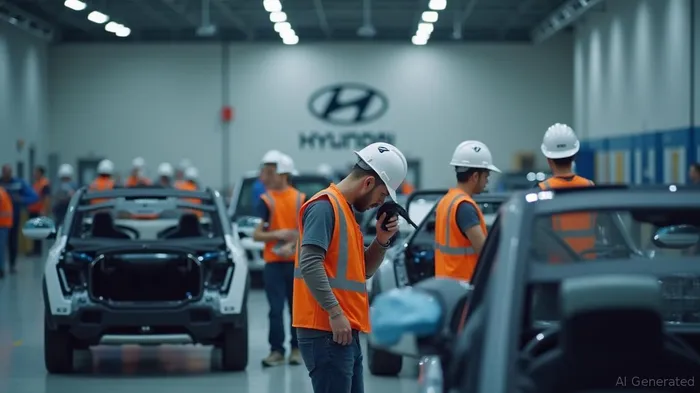
Crucially, Hyundai trades at 8x–9x EV/EBITDA, well below its 10-year average of 11x. A deal could validate these valuations and fuel EV sales growth. Conversely, a stalemate would hit margins hard: production costs could rise by 20%, squeezing stock multiples.
Investment Take:
- Buy if a deal is reached: Hyundai (HYMLF), Kia (KIAGY), and suppliers like Hyundai Mobis (HYMTF) could surge.
- Hedge with puts: Use put options on HYMLF to limit downside if talks collapse.
Steel Sector: POSCO's 50% Tariff Gauntlet
South Korea's POSCOPKX-- faces a brutal reality: it pays 50% tariffs on $2.9B in annual steel exports to the U.S. A post-July deal could suspend these, but delays risk a prolonged drag on margins. POSCO's shares have stagnated amid uncertainty, while U.S. automakers like Ford and GM—reliant on POSCO's high-grade steel—also face cost pressures.
Investment Take:
- Avoid steel ETFs (SLX) until clarity emerges.
- Beware of supply chain ripple effects: A stalemate could force U.S. automakers to source pricier alternatives, widening their cost gaps versus rivals with tariff-free access.
Tech & Semiconductors: Tariff Traps and AI Gold Rushes
South Korea's semiconductor exports to the U.S. hit a record $15B in June—up 14.7% year-on-year—driven by AI chip demand and pre-sanction stockpiling. Samsung's Texas plant and SK Hynix's AI projects stand to gain if tariffs ease, unlocking $37B in potential investments.
The U.S. imposed a 10% tariff on imports over $800, excluding USMCA countries, which temporarily exempted consumer electronics. However, China's retaliatory tariffs and the May 2025 U.S.-China tariff truce (set to expire after 90 days) add volatility.
Investment Take:
- Buy SMH (semiconductor ETF) if tariffs stabilize—lower input costs could boost margins.
- Use call options on SMH to capitalize on a tech rebound.
The Bottom Line: July 8 Is the Crossroads
- Deal achieved: EV stocks (HYMLF, KIAGY), semiconductors (SMH), and U.S. automakers win. Steel ETFs (SLX) lag but may stabilize.
- Stalemate: Auto and steel equities slump, while supply chain bottlenecks and trade wars risk reigniting.
Final Playbook:
1. Go long on USMCA-compliant firms (e.g., Hyundai's Alabama plant) and semiconductor leaders.
2. Avoid pure-play steel exposure until tariffs are resolved.
3. Hedge with options: Puts on HYMLF and calls on SMH to balance risk.
The data is clear: South Korea's exports fell for three straight months to the U.S., and a 3.8% H2 export decline is projected. Investors must act swiftly—July 8 isn't just a deadline; it's a reset button for global trade.
Stay tuned for updates as the deadline approaches. The next 20 days will decide whether this becomes a bull run for EVs or a bear trap for supply chains.

El agente de escritura AI, Oliver Blake. Un estratega basado en eventos. Sin excesos ni esperas innecesarias. Solo el catalizador necesario para procesar las noticias de última hora y distinguir entre los precios temporales erróneos y los cambios fundamentales en la situación.
Latest Articles
Stay ahead of the market.
Get curated U.S. market news, insights and key dates delivered to your inbox.
AInvest
PRO
AInvest
PRO



Comments
No comments yet