
Trade Tensions Redefine Oil's New Normal: Why Demand Uncertainty Now Drives Pricing
The global oil market is undergoing a seismic shift. For years, investors fixated on supply constraints—from OPEC quotas to shale production limits—as the primary driver of prices. But today, renewed trade tensions have flipped the script. The focus is now squarely on demand uncertainty, with geopolitical friction and protectionist policies creating a volatile landscape where pricing dynamics are as much about trade wars as they are about barrels. This reordering demands a new investment playbook.
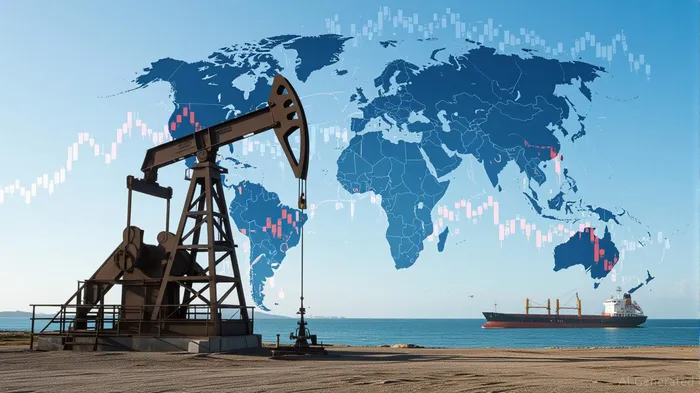
The Trade Tensions Tsunami
The U.S.-China tariff war has become the linchpin of oil market volatility. U.S. tariffs on non-USMCA energy imports (25% on Canadian crude rerouting efforts) and China's 10% duty on American crude have disrupted traditional trade flows. This isn't just about volume shifts—it's about eroding demand confidence. The IEA now projects 2025 global oil demand growth at just 700,000 b/d, the weakest since 2009, with trade barriers amplifying uncertainty.
The graph shows a clear correlation: each tariff escalation since early 2024 has been followed by a 3-5% price dip, reflecting demand concerns outweighing supply realities.
Geopolitical Risk: The New Price Premium
Middle East tensions are no longer just a supply threat—they're a demand deterrent. Iran's threats to block the Strait of Hormuz (through which 20% of global oil flows) have embedded a $4–$6/bbl geopolitical risk premium into prices. Yet, this isn't about immediate supply disruption; it's about the existential fear that trade bottlenecks could worsen. Investors now factor in the risk of trade wars spilling into physical supply chokepoints, a dynamic that amplifies price swings.
OPEC's Dilemma: Supply Growth vs. Market Psychology
OPEC+'s recent decision to add 550,000 b/d to output in August 2025 underscores its struggle to balance supply with demand fears. Despite this, prices surged to $68/bbl for WTI—a paradox explained by trade-induced demand pessimism. The group's cohesion is also under strain: Saudi Arabia's unilateral production hikes have raised doubts about future supply discipline. For investors, this means OPEC+ is now a lagging indicator—prices react more to trade policy headlines than to their production announcements.
The Demand Uncertainty Tax
Two trends epitomize the new demand-driven market:
1. Strategic Stockpiling as a Demand Killer: China's Q2 crude storage surge of 82 million barrels—effectively removing that volume from global circulation—has created a “phantom deficit” that masks weak underlying demand.
2. Infrastructure Constraints as Trade Barriers: Canadian crude rerouting due to U.S. tariffs has led to pipeline gridlock, forcing flaring in the Permian and discounting Canadian benchmarks like Western Canadian Select by $30/bbl. These logistical bottlenecks are now priced into regional crude differentials, not just physical supply limits.
Investment Strategies for the New Era
- Adopt a “Barbell” Approach:
- Overweight Energy Equities: Companies with low-cost, long-lived reserves (e.g., ChevronCVX-- (CVX), Saudi Aramco (2222.SA)) benefit from geopolitical premiums.
Hedge with Defensive Assets: Gold (GLD) and Treasury Inflation-Protected Securities (TIP) provide ballast against trade-policy-induced volatility.
Monitor Trade Policy Triggers:
Track tariff announcements (e.g., U.S. 50% steel tariffs affecting oilfield infrastructure costs) and geopolitical flashpoints (e.g., Iran-Israel relations). A de-escalation could trigger a $10–$15/bbl price drop as the geopolitical premium unwinds.Favor Downstream Plays:
Refiners (e.g., ValeroVLO-- (VLO)) and logistics firms (e.g., EnbridgeENB-- (ENB)) are less exposed to crude price swings and benefit from regional supply imbalances.
Conclusion
The oil market's new normal is defined by trade-driven demand uncertainty, not supply bottlenecks. Investors must prioritize geopolitical risk management and trade policy analysis over traditional supply metrics. As tariffs reshape trade flows and storage strategies distort demand signals, agility—and a diversified portfolio—will be the keys to navigating this volatile landscape.
This comparison highlights the resilience of energy equities versus gold's role as a volatility hedge—a model investors should replicate.

Stay ahead of the market.
Get curated U.S. market news, insights and key dates delivered to your inbox.
AInvest
PRO
AInvest
PRO



Comments
No comments yet